What is Prompt Engineering? A Beginner’s Guide
📝 SEO Introduction
What is Prompt Engineering? Prompt Engineering is the skill of writing clear and effective instructions for Artificial Intelligence systems such as ChatGPT, Microsoft Copilot, Google Gemini, and other AI assistants. In this beginner-friendly guide, you’ll learn how prompts work, why they matter, and how better prompts can produce better AI responses.
👥 Who Should Read This?
This lesson “What is Prompt Engineering? ” is designed for anyone who wants to communicate effectively with Artificial Intelligence using simple, well-written prompts.
It is especially helpful for:
- 🎓 Students using AI for learning and homework
- 👩🏫 Teachers creating lessons, quizzes, and educational resources
- 👨👩👧 Parents helping children use AI responsibly
- 💼 Professionals improving workplace productivity
- 👴 Senior citizens exploring AI assistants for everyday tasks
- 🏪 Small business owners using AI for marketing, customer communication, and business growth
No programming knowledge or technical background is required.
📖 What You’ll Learn
By the end of this lesson, you’ll be able to:
- Understand what Prompt Engineering is.
- Learn why prompts are important when using AI.
- Discover the characteristics of a good prompt.
- Compare weak prompts with effective prompts.
- Explore practical prompting techniques for beginners.
- Learn how to use Prompt Engineering responsibly.
📚 In This Lesson
Introduction
Imagine asking two people exactly the same question.
To the first person, you simply say:
“Tell me about India.”
To the second person, you say:
“Explain India’s freedom movement to a Class 8 student in simple language using three important events and a short timeline.”
Which person is more likely to give you the answer you actually wanted?
Most people would choose the second one.
The second request is more specific, provides context, defines the audience, and clearly explains the expected response.
Artificial Intelligence works in much the same way.
The quality of the answer you receive often depends on the quality of the instructions you provide.
These instructions are called prompts.
As AI tools such as ChatGPT, Microsoft Copilot, Google Gemini, Claude, and other AI assistants become part of everyday life, knowing how to write effective prompts is becoming an essential digital skill.
A well-written prompt can help AI explain complex topics more clearly, generate better content, solve problems more accurately, and save valuable time.
A vague prompt, on the other hand, may produce incomplete, confusing, or less useful responses.
This skill of communicating effectively with AI is known as Prompt Engineering.
The good news is that Prompt Engineering is not programming.
It is simply the ability to ask better questions and provide clearer instructions.
Whether you’re a student preparing for an exam, a teacher creating lesson plans, a professional writing reports, or a business owner generating marketing content, Prompt Engineering can help you unlock the full potential of Artificial Intelligence.
In this lesson, you’ll learn what Prompt Engineering is, why it matters, how to write better prompts, and how a few simple improvements can dramatically enhance the quality of AI-generated responses.
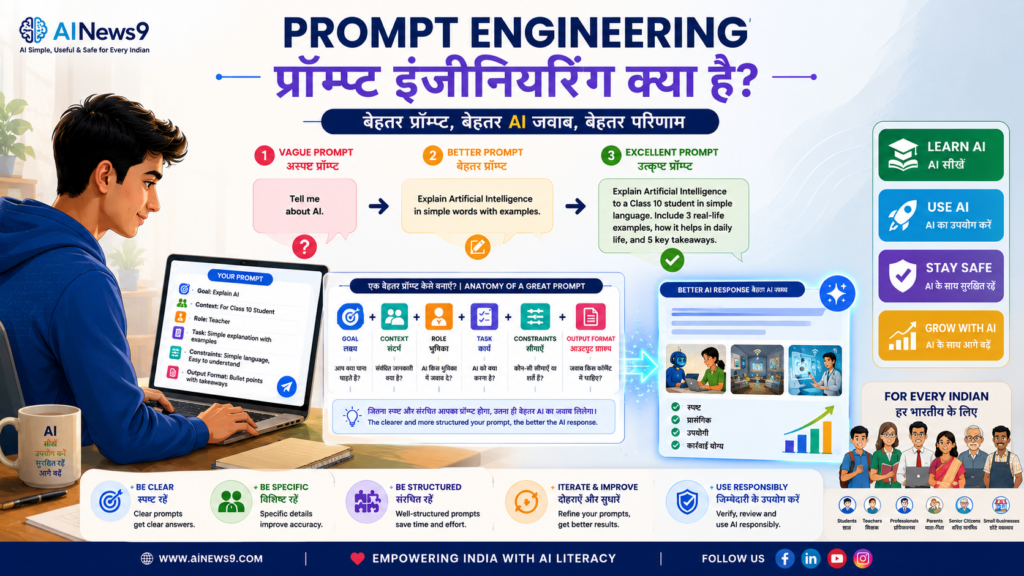
💬 What is Prompt Engineering?
Prompt Engineering is the practice of designing clear, specific, and well-structured instructions that help Artificial Intelligence generate more accurate, useful, and relevant responses.
A prompt is simply the instruction, question, or request you give to an AI system.
For example:
- Explain photosynthesis in simple language.
- Write a professional leave application.
- Create a weekly study plan for a Class 10 student.
- Summarize this article in five bullet points.
- Suggest marketing ideas for a small bakery.
Every interaction with an AI assistant begins with a prompt.
The better your prompt, the more likely the AI is to understand your goal and produce a helpful response.
Think of Prompt Engineering as learning how to communicate effectively with an intelligent digital assistant.
You don’t need programming knowledge.
You simply need to explain your request clearly.
🎯 Why is Prompt Engineering Important?
Many people believe that AI always provides perfect answers.
In reality, AI responds based on the information and instructions it receives.
If your prompt is unclear, the AI may misunderstand your request or produce a generic answer.
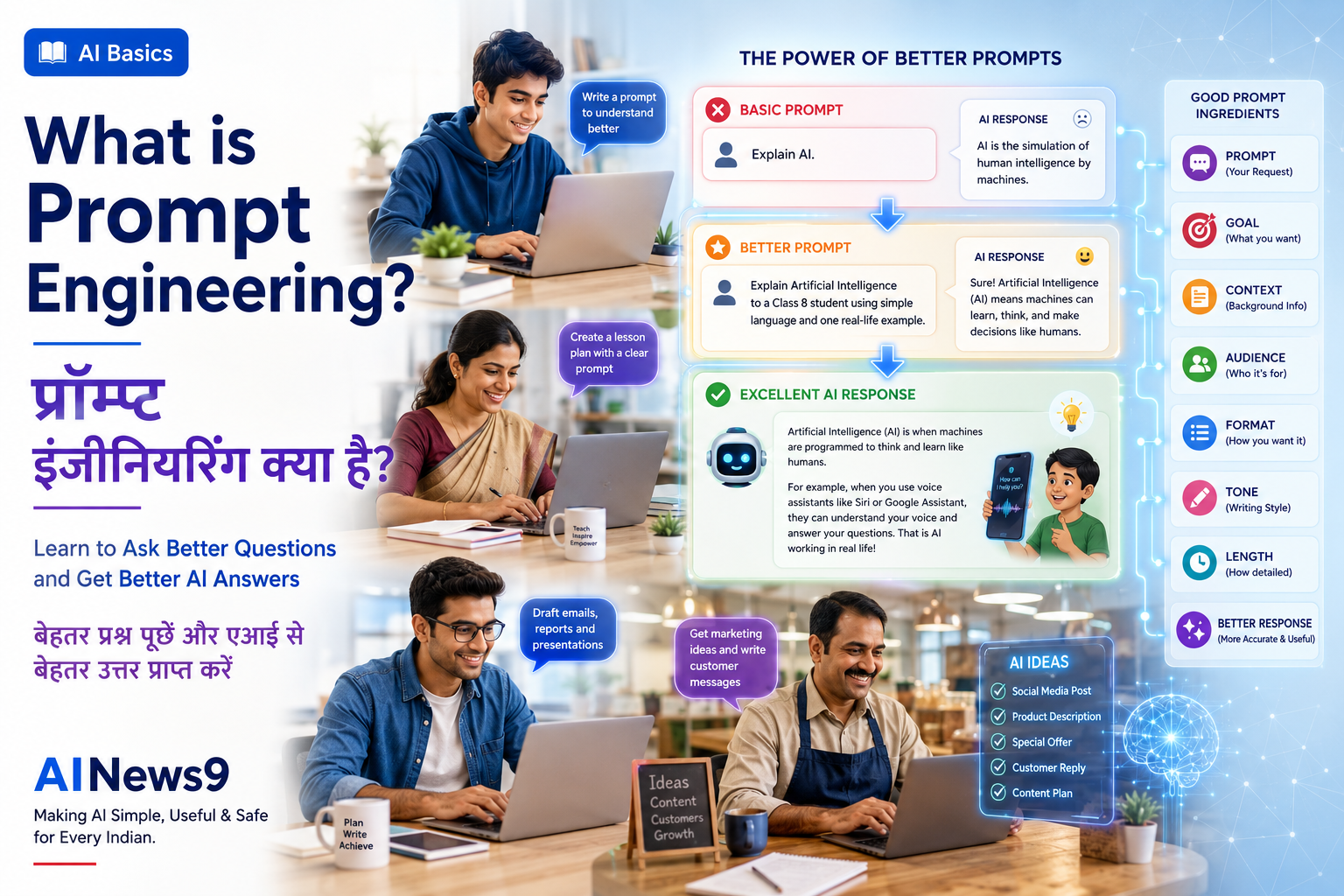
Consider these two prompts:
Prompt 1
Explain Artificial Intelligence.
Prompt 2
Explain Artificial Intelligence to a 12-year-old student using simple language, one real-life example, and a short comparison with human intelligence.
The second prompt gives the AI much more context.
As a result, the response is usually clearer, more relevant, and easier to understand.
This simple example demonstrates why Prompt Engineering matters.
Instead of expecting AI to guess what you need, Prompt Engineering teaches you how to communicate your expectations effectively.
🌍 Where Do We Use Prompt Engineering?
Whether you realize it or not, you’re already using prompts whenever you interact with AI.
People use Prompt Engineering for many everyday tasks.
🎓 Education
Students use prompts to:
- Understand difficult concepts
- Prepare study notes
- Generate practice questions
- Learn new subjects
👩🏫 Teaching
Teachers use prompts to:
- Create lesson plans
- Prepare quizzes
- Generate classroom activities
- Simplify complex topics
💼 Workplace
Professionals use prompts to:
- Draft emails
- Prepare reports
- Summarize meetings
- Create presentations
🏪 Business
Business owners use prompts to:
- Generate marketing ideas
- Write product descriptions
- Create social media content
- Respond to customer enquiries
🎨 Creativity
Content creators use prompts to:
- Brainstorm ideas
- Write blog articles
- Develop video scripts
- Generate creative concepts
Prompt Engineering is quickly becoming a valuable skill across education, business, and everyday life.
🔗 Connection to the Previous Lesson
In the previous lesson, you learned about AI Agents—intelligent systems that can plan, make decisions, use tools, and complete tasks.
However, even the most advanced AI Agent depends on one important thing:
Clear instructions from the user.
Prompt Engineering is the skill that enables people to communicate effectively with AI assistants and AI Agents.
Learning how to write better prompts helps AI understand your goals more accurately, leading to better responses, better workflows, and better outcomes.
In the next section, we’ll explore the anatomy of a good prompt and discover simple techniques that can dramatically improve the quality of AI-generated responses.
⚙️ How Does Prompt Engineering Work?
Every conversation with an AI system begins with a prompt.
The prompt tells the AI what you want, how you want it, and sometimes even who the response is intended for.
Although Artificial Intelligence is highly advanced, it cannot read your mind.
It relies on the information you provide.
The clearer your instructions, the better the results are likely to be.
Let’s understand this process step by step.
🔄 What Happens When You Enter a Prompt?
Whenever you type a prompt into an AI assistant, several things happen behind the scenes.
Step 1 — You Define Your Goal
Everything begins with your objective.
For example:
- Explain Machine Learning.
- Write a formal email.
- Create a travel itinerary.
- Summarize this article.
- Suggest business ideas.
The AI first tries to understand what you want to achieve.
Step 2 — The AI Understands Context
Next, the AI analyzes your prompt.
It looks for clues such as:
- The topic
- The audience
- The writing style
- The expected format
- The level of detail
For example, compare these two prompts.
Prompt A
Explain climate change.
Prompt B
Explain climate change to a Class 7 student using simple language and one real-life example.
Prompt B provides much more context.
As a result, the AI is more likely to generate an answer that matches the user’s needs.
Step 3 — The AI Generates a Response
Using the information in your prompt, the AI predicts the most appropriate response.
It decides:
- What information to include
- How much detail to provide
- What tone to use
- How to organize the answer
The AI isn’t guessing randomly—it is using patterns learned during training to create a response that best fits your request.
Step 4 — You Refine the Prompt
One of the biggest advantages of AI is that conversations are interactive.
If the first response isn’t exactly what you wanted, you can improve your prompt.
For example:
Instead of saying:
Explain Artificial Intelligence.
You might say:
Explain Artificial Intelligence to a beginner using simple language, three real-world examples, and a comparison with human intelligence.
A small improvement in the prompt often leads to a much better response.
This process is called prompt refinement.
🧩 The Anatomy of a Good Prompt
A good prompt usually contains several important elements.
You don’t always need every element, but including more useful information often improves the quality of the response.
| Element | Purpose | Example |
|---|---|---|
| Task | What should AI do? | Explain Machine Learning |
| Context | Background information | For a school project |
| Audience | Who is it for? | Class 8 student |
| Format | Desired structure | Bullet points |
| Tone | Writing style | Friendly and simple |
| Length | Response size | Around 200 words |
The more clearly you define these elements, the easier it becomes for the AI to understand your expectations.
✍️ Weak Prompt vs Strong Prompt
Let’s compare two examples.
❌ Weak Prompt
Write about pollution.
This prompt is too vague.
The AI doesn’t know:
- Which type of pollution?
- Who will read it?
- How long should it be?
- What style should it use?
✅ Strong Prompt
Write a 250-word article explaining air pollution for Class 6 students using simple language, one real-life example, and five practical ways to reduce pollution.
Notice how much more information this prompt provides.
Because the instructions are clear, the AI can generate a much more useful response.
🌟 Characteristics of an Effective Prompt
Good prompts are usually:
🎯 Specific
Clearly state what you want.
Instead of:
Tell me about AI.
Try:
Explain Artificial Intelligence to a beginner using simple language.
📝 Clear
Avoid ambiguous wording.
Simple, direct instructions work best.
🎭 Contextual
Provide background information whenever possible.
For example:
Write an email to my manager requesting leave because I have a family emergency.
The additional context helps the AI create a more appropriate response.
👥 Audience-Focused
Tell the AI who the response is for.
Examples:
- School students
- Teachers
- Parents
- Business owners
- Senior citizens
The same topic can be explained very differently depending on the audience.
📋 Format-Oriented
Specify how you’d like the response presented.
Examples:
- Bullet points
- Table
- Essay
- Summary
- Step-by-step guide
- FAQ
Formatting instructions make the output easier to use.
📏 Length-Aware
If you have specific requirements, mention them.
Examples:
- 100 words
- 300 words
- One paragraph
- Five bullet points
The AI can usually adapt its response to match your preferred length.
🌍 Everyday Examples of Prompt Engineering
Prompt Engineering is already helping millions of people.
🎓 Student
Prompt:
Explain photosynthesis to a Class 7 student using a classroom example.
👩🏫 Teacher
Prompt:
Create a 10-question quiz on the Solar System with answers.
💼 Professional
Prompt:
Write a professional follow-up email after a client meeting.
🏪 Small Business Owner
Prompt:
Create a one-week social media content plan for a local bakery.
✈️ Traveller
Prompt:
Plan a three-day trip to Jaipur with a budget of ₹20,000.
Each prompt clearly communicates the objective, allowing the AI to generate more relevant and practical responses.
📌 Remember
Prompt Engineering is not about using complicated language.
It’s about giving clear, specific, and meaningful instructions.
The better your prompt, the better your chances of receiving a useful, accurate, and well-structured response from AI.
🌟 Benefits of Prompt Engineering
Prompt Engineering is one of the most valuable skills for anyone using Artificial Intelligence.
Whether you’re learning, teaching, writing, researching, coding, or running a business, better prompts can significantly improve the quality of AI-generated responses.
Let’s explore some of the biggest advantages.
⏱️ 1. Saves Time
Instead of repeatedly asking the AI to revise its answers, a well-written prompt often produces a useful response on the first attempt.
For example, rather than asking:
Write an email.
You could ask:
Write a professional email requesting two days of leave due to a family function.
Providing clear instructions reduces the need for multiple revisions and saves valuable time.
🎯 2. Produces More Accurate Responses
Artificial Intelligence performs best when it clearly understands your request.
Specific prompts reduce misunderstandings and help the AI generate responses that are more relevant to your needs.
The more information you provide, the better the AI can tailor its answer.
📚 3. Improves Learning
Students and lifelong learners can use Prompt Engineering to make complex topics easier to understand.
For example:
- Explain gravity using everyday examples.
- Compare Machine Learning and Artificial Intelligence using a simple table.
- Summarize this chapter in five key points.
Well-designed prompts turn AI into a more effective learning assistant.
✍️ 4. Enhances Creativity
Prompt Engineering is also valuable for creative work.
Content creators can ask AI to generate:
- Blog ideas
- Video scripts
- Story outlines
- Marketing campaigns
- Product names
- Social media posts
Instead of replacing creativity, AI becomes a brainstorming partner that helps generate fresh ideas.
💼 5. Boosts Workplace Productivity
Professionals increasingly use Prompt Engineering to complete routine tasks more efficiently.
Examples include:
- Drafting emails
- Preparing reports
- Summarizing meetings
- Creating presentations
- Organizing project plans
Better prompts often result in better workplace productivity.
🌍 6. Works Across Different AI Tools
Prompt Engineering is not limited to one AI platform.
The same principles apply when using tools such as:
- ChatGPT
- Microsoft Copilot
- Google Gemini
- Claude
- AI-powered search assistants
- AI image generators
- AI coding assistants
Learning Prompt Engineering once allows you to apply the skill across many different AI applications.
⚠️ Common Mistakes in Prompt Engineering
Even experienced users sometimes write prompts that produce disappointing results.
Let’s look at some common mistakes and how to avoid them.
❌ 1. Being Too Vague
Example:
Tell me about AI.
This prompt provides very little direction.
A better version would be:
Explain Artificial Intelligence to a beginner using simple language and two real-life examples.
The second prompt gives the AI much clearer guidance.
❌ 2. Missing Context
Suppose you ask:
Write a speech.
The AI doesn’t know:
- Who the audience is
- What the topic is
- How long it should be
- What tone to use
Adding context produces much better results.
❌ 3. Asking Multiple Unrelated Questions Together
For example:
Explain AI, write a poem, summarize my report, and create a presentation.
Although AI can often handle complex requests, combining too many unrelated tasks may reduce the quality of the response.
Breaking large requests into smaller prompts often produces better outcomes.
❌ 4. Expecting AI to Read Your Mind
AI only knows what you tell it.
If important details are missing, the response may not meet your expectations.
Always include the information that matters most.
❌ 5. Never Refining the Prompt
Many beginners stop after the first answer.
Experienced AI users usually improve their prompts based on the initial response.
Prompt Engineering is an interactive process.
Small refinements often produce dramatically better results.
🚀 Tips for Writing Better Prompts
You don’t need to memorize complicated techniques.
Following a few simple best practices can greatly improve your AI experience.
✅ Be Specific
Clearly explain what you want.
✅ Provide Context
Tell the AI why you need the response.
✅ Define the Audience
Examples:
- Beginner
- School student
- Teacher
- Professional
- Business owner
✅ Specify the Format
Examples:
- Bullet points
- Table
- Step-by-step guide
- Essay
- FAQ
- Summary
✅ Mention the Tone
Examples:
- Friendly
- Professional
- Simple
- Formal
- Motivational
✅ Define the Length
Examples:
- 100 words
- 500 words
- One paragraph
- Five bullet points
✅ Review and Improve
If the first answer isn’t perfect, improve the prompt and try again.
Prompt Engineering is a process of continuous refinement.
🌍 Real-World Prompt Engineering Examples
Here are a few practical examples that demonstrate how better prompts lead to better AI responses.
| Situation | Basic Prompt | Improved Prompt |
|---|---|---|
| Learning | Explain photosynthesis. | Explain photosynthesis to a Class 8 student using simple language, one diagram description, and a real-life example. |
| Write an email. | Write a professional email requesting leave for two days because of a family event. | |
| Business | Give marketing ideas. | Suggest ten low-cost digital marketing ideas for a local bakery in India. |
| Travel | Plan a trip. | Create a three-day Jaipur itinerary for a family of four with a budget of ₹25,000. |
| Presentation | Make a presentation. | Create a 10-slide presentation outline on renewable energy for college students. |
Notice how the improved prompts include:
- A clear objective
- Context
- Audience
- Format
- Specific expectations
This allows the AI to generate responses that are more useful and better aligned with the user’s needs.
📌 Remember
Prompt Engineering is not about using complex words.
It is about communicating your ideas clearly.
The best prompts answer five simple questions:
- What do I want?
- Who is it for?
- Why do I need it?
- What format should it follow?
- How detailed should it be?
The more clearly you answer these questions, the better your AI assistant can help you.
🎯 Key Takeaways
Congratulations!
You’ve now learned one of the most practical skills in modern Artificial Intelligence.
Let’s quickly recap the key concepts from this lesson.
- ✅ Prompt Engineering is the skill of writing clear and effective instructions for AI systems.
- ✅ Better prompts usually produce better AI responses.
- ✅ A good prompt includes a clear task, context, audience, format, tone, and desired length.
- ✅ Prompt Engineering improves learning, creativity, productivity, and communication with AI.
- ✅ Small improvements to a prompt can dramatically improve the quality of the output.
- ✅ Prompt Engineering works across many AI tools, including ChatGPT, Microsoft Copilot, Google Gemini, Claude, and AI image generators.
- ✅ Anyone can learn Prompt Engineering—no programming knowledge is required.
Learning Prompt Engineering helps you move from simply using AI to using AI effectively.
❓ Frequently Asked Questions (FAQs)
1. What is Prompt Engineering?
Prompt Engineering is the practice of writing clear, specific, and well-structured instructions that help Artificial Intelligence generate better responses.
2. Do I need programming knowledge to learn Prompt Engineering?
No.
Prompt Engineering is about communicating effectively with AI using natural language.
Anyone can learn it, regardless of their technical background.
3. Why are prompts so important?
AI systems generate responses based on the information they receive.
Clear prompts help AI better understand your goals, resulting in more useful and accurate answers.
4. Which AI tools use Prompt Engineering?
Prompt Engineering can be used with many AI applications, including:
- ChatGPT
- Microsoft Copilot
- Google Gemini
- Claude
- AI coding assistants
- AI image generators
- AI search assistants
The same principles work across most modern AI tools.
5. Can Prompt Engineering improve AI responses?
Yes.
Providing additional context, defining the audience, specifying the format, and clearly describing the task often leads to significantly better results.
6. What makes a good prompt?
A good prompt usually includes:
- A clear objective
- Relevant context
- Intended audience
- Desired format
- Appropriate tone
- Expected length
The more specific the prompt, the better the AI can respond.
7. Can Prompt Engineering help students?
Absolutely.
Students can use Prompt Engineering to:
- Understand difficult concepts
- Generate study notes
- Practice exam questions
- Improve writing
- Prepare presentations
It makes AI a more effective learning companion.
8. Is Prompt Engineering only useful for text-based AI?
No.
Prompt Engineering is also important for:
- AI image generation
- AI video generation
- AI coding assistants
- AI design tools
- AI productivity platforms
Different AI systems may require different prompt styles, but the basic principles remain the same.
9. Can Prompt Engineering guarantee perfect answers?
No.
Even with excellent prompts, AI can occasionally produce incorrect or incomplete information.
Important information should always be reviewed and verified.
10. What should I learn after Prompt Engineering?
Once you’ve mastered Prompt Engineering, the next step is learning about AI Hallucinations and AI Safety.
Understanding both the strengths and limitations of AI helps you become a more responsible and confident AI user.
🎓 Continue Your AI Learning Journey
Congratulations!
You’ve completed another important milestone in your AI literacy journey.
So far, you’ve learned:
- ✅ What is Artificial Intelligence?
- ✅ What is Generative AI?
- ✅ What is Machine Learning?
- ✅ What are Large Language Models (LLMs)?
- ✅ What is ChatGPT?
- ✅ What are AI Agents?
- ✅ What is Prompt Engineering?
These lessons provide a strong foundation for understanding how modern AI works and how to use it effectively.
➡️ Next Article
What are AI Hallucinations?
In the next lesson, you’ll learn:
- What AI Hallucinations are
- Why AI sometimes generates incorrect information
- Common examples of AI Hallucinations
- How to identify inaccurate AI responses
- Best practices for verifying AI-generated information
- Tips for using AI safely and responsibly
Understanding AI Hallucinations is essential for becoming a responsible AI user.
📚 Recommended Resources
To deepen your understanding of Prompt Engineering and AI communication, explore these trusted resources:
- OpenAI – Learn how effective prompts improve AI interactions.
- DeepLearning.AI – ChatGPT Prompt Engineering for Developers
- Github-OpenAI Prompt Engineering Guide & Best Practices
These resources complement this lesson and help you continue building practical AI skills.
💬 Final Thoughts
Artificial Intelligence is becoming increasingly powerful—but its effectiveness depends on how people communicate with it.
Prompt Engineering bridges the gap between human intent and AI capability.
Instead of treating AI as a search engine, Prompt Engineering teaches you to think like a communicator.
The clearer your instructions, the more useful the results become.
Whether you’re a student preparing for exams, a teacher creating engaging lessons, a professional improving workplace productivity, or a business owner exploring new opportunities, Prompt Engineering is a skill that will continue to grow in importance.
As AI evolves, people who know how to ask better questions will consistently achieve better outcomes.
Learning Prompt Engineering today is an investment in your future ability to work confidently, creatively, and responsibly with Artificial Intelligence.
About AINews9
AINews9 is India’s AI Literacy Platform with a mission to make Artificial Intelligence Simple, Useful & Safe for Every Indian.
Through beginner-friendly lessons, practical tutorials, AI safety awareness, real-world examples, and responsible AI education, AINews9 helps students, teachers, parents, professionals, senior citizens, and small businesses confidently understand and use Artificial Intelligence.
Whether you’re just beginning your AI journey or expanding your AI knowledge, AINews9 is here to help you learn, use, stay safe, and grow with AI.
Next Article: How Does AI Work? A Beginner’s Guide