What is Machine Learning? A Simple Beginner’s Guide
👥 Who Should Read This?
This lesson is designed for anyone who wants to understand Machine Learning (ML) in simple, everyday language—without needing a technical background.
It is especially helpful for:
- 🎓 Students beginning their AI learning journey
- 👩🏫 Teachers introducing AI concepts in classrooms
- 👨👩👧 Parents helping children understand modern technology
- 💼 Professionals curious about how AI-powered systems work
- 👴 Senior citizens exploring today’s digital world
- 🏪 Small business owners interested in using AI to improve decision-making
No programming knowledge is required.
📖 What You’ll Learn
By the end of this lesson, you’ll be able to:
- Understand what Machine Learning is.
- Learn how computers “learn” from data.
- Discover how Machine Learning is different from Artificial Intelligence and Generative AI.
- Explore everyday examples of Machine Learning.
- Understand why Machine Learning is becoming one of the world’s most important technologies.
- Learn why high-quality data is essential for building reliable AI systems.
📖 In This Lesson
Introduction
In the previous lesson, you learned about Generative AI—a type of Artificial Intelligence that can create text, images, videos, music, computer code, and much more.
But have you ever wondered how Generative AI becomes intelligent enough to create all these things?
The answer lies in another important branch of Artificial Intelligence called Machine Learning.
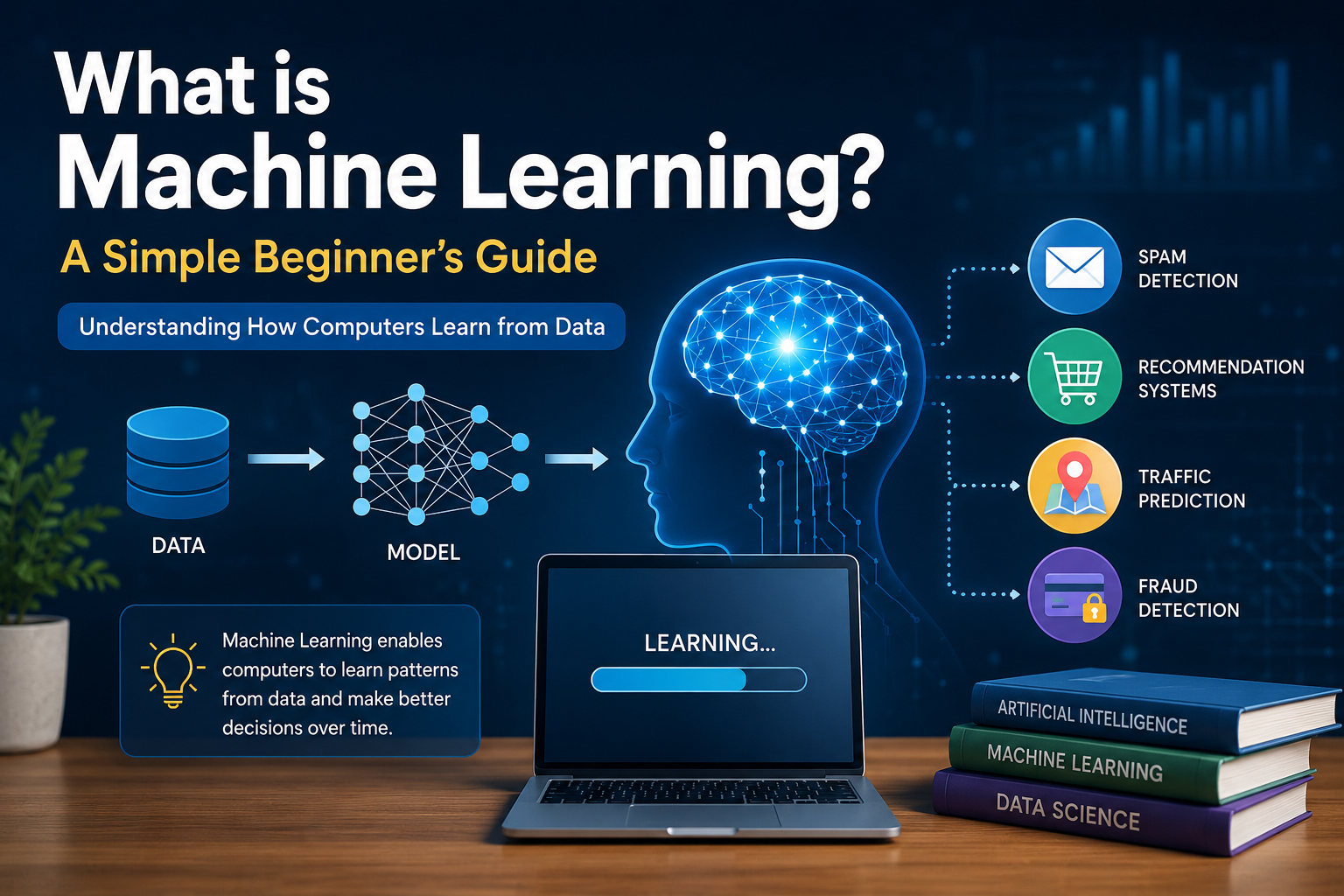
Machine Learning is the technology that enables computers to improve their performance by learning from data instead of relying only on fixed instructions written by programmers.
Today, Machine Learning quietly powers many of the digital services we use every day.
When Netflix recommends your next favourite movie, Google Maps predicts traffic, your bank detects suspicious transactions, or YouTube suggests videos you might enjoy, Machine Learning is working behind the scenes.
Although it sounds like an advanced technology, the basic idea is surprisingly simple.
Just as humans learn through experience, computers can also improve by studying large amounts of data and recognizing patterns.
In this lesson, we’ll explore Machine Learning in simple language using practical examples that anyone can understand.
🤖 What is Machine Learning?
Machine Learning (ML) is a branch of Artificial Intelligence (AI) that enables computers to learn from data and improve their performance without being explicitly programmed for every possible situation.
Traditional computer programs follow instructions exactly as they are written.
Machine Learning works differently.
Instead of writing thousands of detailed rules, developers provide the computer with large amounts of relevant data.
The computer studies that data, discovers patterns, learns from experience, and gradually becomes better at performing a specific task.
The more high-quality data it receives, the more accurate its predictions and decisions usually become.
This ability to continuously improve makes Machine Learning one of the most powerful technologies in modern Artificial Intelligence.
🍎 A Simple Example
Imagine you want to teach a young child to recognize apples.
You don’t begin by explaining colour combinations, mathematical formulas, or scientific definitions.
Instead, you simply show many examples.
“This is an apple.”
“This is also an apple.”
“This is an orange.”
“This is a mango.”
After seeing enough examples, the child naturally begins recognizing apples without needing further explanation.
Machine Learning follows a very similar approach.
Instead of learning from parents or teachers, computers learn from carefully prepared data.
Instead of using human memory, they use mathematical models that identify patterns hidden inside millions of examples.
The better the examples, the better the learning.
🧠 Machine Learning vs Artificial Intelligence
Many people think Artificial Intelligence and Machine Learning mean the same thing.
They don’t.
Machine Learning is actually one important branch of Artificial Intelligence.
A simple way to understand the relationship is to imagine a large tree.
🌳 Artificial Intelligence is the entire tree.
🌿 Machine Learning is one of its strongest branches.
🍎 Generative AI grows from that branch and focuses on creating new content.
This means:
- Every Machine Learning system is part of Artificial Intelligence.
- But not every AI system uses Machine Learning in exactly the same way.
Understanding this relationship makes it much easier to understand modern AI tools such as ChatGPT, Microsoft Copilot, Google Gemini, Claude, and AI Agents.
🌍 Machine Learning in Everyday Life
Many people think Machine Learning is something only scientists or software engineers use.
In reality, it has already become part of everyday life.
Here are some familiar examples:
▶️ YouTube
Machine Learning studies your viewing habits and recommends videos that match your interests.
🎬 Netflix & OTT Platforms
Streaming services learn what you enjoy watching and recommend movies or TV shows based on your viewing history.
📧 Email Services
Spam filters continuously learn which emails are unwanted, helping keep your inbox safe and organized.
🗺️ Google Maps
Machine Learning analyses traffic patterns from millions of anonymous devices to estimate travel times and suggest the fastest routes.
🛍️ Online Shopping
E-commerce websites recommend products based on your browsing history, purchases, and customer behaviour.
🏦 Banking
Banks use Machine Learning to detect unusual spending patterns that may indicate fraudulent transactions, helping protect customers from financial scams.
These examples show that Machine Learning is already working quietly behind the scenes, making many everyday services smarter, faster, and more useful.
📌 Remember
Machine Learning does not make computers think like humans.
Instead, it helps computers learn patterns from data, improve through experience, and make better predictions over time.
The quality of the results depends heavily on the quality of the data used for learning.
Good data leads to better decisions.
Poor or biased data can lead to inaccurate or unfair outcomes.
🔗 Connection to the Previous Lesson
In Previous Lesson, you learned that Generative AI can create new content such as text, images, videos, music, and computer code.
Machine Learning is one of the key technologies that makes many Generative AI systems possible.
Without Machine Learning, today’s advanced AI tools would not be able to recognize patterns, understand language, or improve through experience.
As you continue your AI learning journey, you’ll discover how Machine Learning forms the foundation of many modern AI applications.
⚙️ How Does Machine Learning Work?
At first, Machine Learning may sound like magic.
How can a computer learn without having a brain?
The answer is much simpler than most people imagine.
Just like students learn by studying books, practising exercises, and learning from their mistakes, Machine Learning systems learn by studying data.
Instead of classrooms and textbooks, computers use large collections of information to identify patterns and improve their performance over time.
Let’s understand the process step by step.
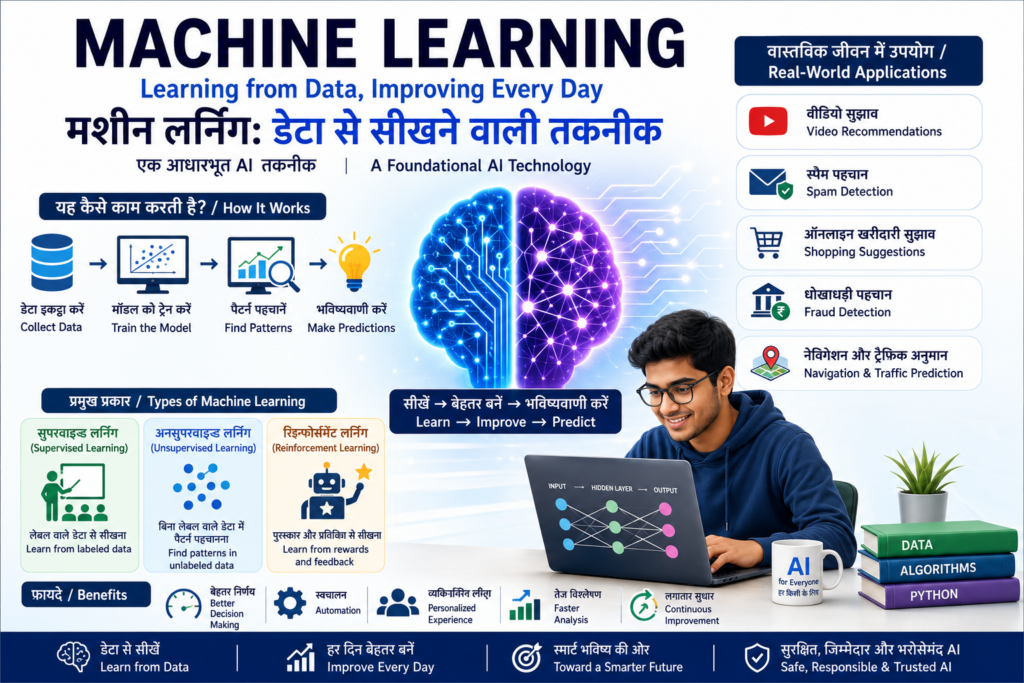
Step 1: Collect Data
Every Machine Learning project begins with data.
Data is simply information that helps a computer understand a problem.
For example, imagine you want to teach a computer to recognize different fruits.
You would provide thousands of labelled images such as:
- 🍎 Apple
- 🍌 Banana
- 🥭 Mango
- 🍊 Orange
The more examples the computer sees, the better it understands the differences between them.
This is why data is often called:
“The fuel that powers Machine Learning.”
Without good-quality data, even the smartest Machine Learning model cannot produce reliable results.
Step 2: Learn from the Data
After collecting the data, the computer begins studying it.
Instead of memorizing every single example, it looks for patterns.
For instance, after analysing thousands of apple images, it may notice that apples usually have:
- A round shape
- A stem
- Smooth skin
- Certain colour patterns
Nobody writes these rules manually.
The Machine Learning model discovers them automatically using mathematical techniques.
This stage is known as training the model.
Just like students become better through practice, Machine Learning models become more accurate as they train on more high-quality data.
Step 3: Make Predictions
Once the model has learned enough patterns, it can analyse completely new information.
Imagine you upload a photo of a fruit the computer has never seen before.
Instead of guessing randomly, it compares the new image with everything it learned during training.
If the features closely match the patterns of an apple, it predicts:
“This is most likely an apple.”
The prediction is based on probability—not certainty.
That is why Machine Learning systems can occasionally make mistakes.
Step 4: Improve Through Feedback
Learning doesn’t stop after making one prediction.
Machine Learning systems continue improving as they receive more data and feedback.
If a prediction is incorrect, developers can retrain the model using additional examples.
Over time, the model becomes more accurate and reliable.
This ability to improve continuously is one of the biggest advantages of Machine Learning.
🎓 A Classroom Analogy
Imagine a teacher preparing students for a mathematics exam.
On the first day, students solve only a few questions correctly.
The teacher explains their mistakes and gives them more practice.
Every week, they solve additional problems.
Gradually, they become faster, more confident, and more accurate.
Machine Learning follows a very similar process.
Instead of practising mathematics, computers practise identifying patterns in data.
Instead of receiving marks, they receive feedback that helps improve future predictions.
Learning happens through practice, experience, and continuous improvement.
📊 Types of Machine Learning
Not all Machine Learning systems learn in the same way.
Depending on the type of problem, different learning approaches are used.
The three most common types are:
1️⃣ Supervised Learning
Supervised Learning uses labelled data.
This means every training example already includes the correct answer.
For example:
| Label | |
|---|---|
| “Congratulations! You’ve won ₹10 lakh.” | Spam |
| “Team meeting at 3 PM tomorrow.” | Not Spam |
After studying thousands of labelled emails, the computer gradually learns to identify spam automatically.
Common Applications
- 📧 Spam email detection
- 🏦 Loan approval
- 🏥 Disease prediction
- 🏠 House price estimation
- 📈 Sales forecasting
This is the most widely used type of Machine Learning today.
2️⃣ Unsupervised Learning
In Unsupervised Learning, the data has no labels.
Instead of being told the correct answer, the computer searches for hidden patterns and relationships on its own.
Imagine a supermarket analysing customer purchases.
The computer may discover that customers who frequently buy:
- Bread
- Butter
also tend to buy:
- Jam
Nobody programmed this relationship.
The Machine Learning model discovered it by analysing shopping behaviour.
Common Applications
- 🛒 Product recommendations
- 👥 Customer segmentation
- 📊 Market analysis
- 💳 Fraud pattern discovery
3️⃣ Reinforcement Learning
Reinforcement Learning is inspired by the way humans and animals learn through rewards and mistakes.
Imagine teaching a child to ride a bicycle.
Every successful attempt increases confidence.
Every fall teaches an important lesson.
Eventually, the child learns how to balance without assistance.
Machine Learning works similarly.
Correct decisions receive rewards.
Incorrect decisions receive penalties.
Gradually, the computer learns which actions produce the best outcomes.
Common Applications
- 🤖 Robotics
- 🚗 Self-driving vehicles
- 🎮 Game-playing AI
- 📦 Warehouse automation
🌍 Machine Learning in Everyday Life
You may not realise it, but Machine Learning already helps you throughout the day.
Here are some familiar examples.
▶️ YouTube
Machine Learning studies your viewing history and recommends videos based on your interests.
🎬 Netflix & OTT Platforms
Streaming services analyse what you watch and recommend movies or TV shows you are likely to enjoy.
📧 Email Services
Spam filters continuously learn to identify unwanted emails, helping keep your inbox clean and secure.
🗺️ Google Maps
Machine Learning analyses traffic conditions from millions of anonymous devices to predict travel times and recommend faster routes.
🛒 Online Shopping
Websites like Amazon and Flipkart recommend products based on your browsing history, purchases, and customer preferences.
🏦 Banking
Banks use Machine Learning to detect unusual spending patterns, identify fraudulent transactions, and improve customer security.
📱 Smartphones
Many smartphone features rely on Machine Learning, including:
- Face Unlock
- Voice Assistants
- Predictive Text
- Camera Enhancements
- Speech Recognition
- Photo Organisation
Most people use Machine Learning every day without even realising it.
🇮🇳 Machine Learning in India
Machine Learning is helping transform many industries across India.
🏥 Healthcare
Doctors use AI-powered systems to assist in detecting diseases earlier and supporting medical decision-making.
🌾 Agriculture
Smart farming solutions help farmers monitor crop health, estimate yields, and optimise irrigation.
💳 Digital Payments
Banks and payment platforms use Machine Learning to detect suspicious UPI transactions and reduce online fraud.
🎓 Education
Learning platforms personalise lessons based on each student’s progress, helping learners study at their own pace.
🚦 Smart Cities
Machine Learning supports traffic management, waste collection, energy optimisation, and public safety initiatives.
As India’s digital economy continues to grow, Machine Learning is becoming an essential technology across education, healthcare, agriculture, finance, manufacturing, and public services.
💡 Did You Know?
Every search you perform, every online purchase you make, every movie you watch, and every navigation route you follow generates data.
When used responsibly and with appropriate privacy protections, this data helps Machine Learning systems become smarter and deliver better recommendations, predictions, and services for millions of people around the world.
🌟 Benefits of Machine Learning
Machine Learning is transforming the way people work, learn, communicate, and solve problems.
From healthcare and education to banking and agriculture, it helps organizations make better decisions by analysing large amounts of data quickly and accurately.
Let’s explore some of its biggest advantages.
⚡ 1. Faster Decision-Making
Humans often need hours—or even days—to analyse large datasets.
Machine Learning can analyse millions of records within seconds and identify meaningful patterns.
This helps businesses, hospitals, banks, and governments make faster and more informed decisions.
🎯 2. Improved Accuracy
Machine Learning models can identify patterns that humans may overlook.
When trained using high-quality data, they often achieve impressive levels of accuracy for specific tasks.
For example:
- Detecting spam emails
- Predicting weather
- Identifying fraudulent transactions
- Recommending products
- Recognising faces in photographs
However, accuracy always depends on the quality of the training data.
💰 3. Increased Productivity
Machine Learning automates repetitive tasks, allowing people to focus on work that requires creativity, critical thinking, and decision-making.
Examples include:
- Automatically sorting emails
- Organising digital photographs
- Processing customer support requests
- Recommending products to shoppers
- Predicting equipment maintenance
Instead of replacing people, Machine Learning often helps them work more efficiently.
🎓 4. Personalised Experiences
Every person has different interests and preferences.
Machine Learning learns these preferences over time to deliver personalised experiences.
Examples include:
- Netflix recommending movies you may enjoy
- Spotify suggesting songs based on your listening habits
- Amazon recommending products
- Educational apps adapting lessons to individual learners
This makes digital services more useful and relevant.
🏥 5. Better Healthcare
Machine Learning is helping doctors and hospitals improve patient care.
It can assist in:
- Detecting diseases earlier
- Analysing medical images
- Predicting health risks
- Supporting treatment decisions
Although doctors always make the final medical decisions, Machine Learning provides valuable insights that support better healthcare.
🌾 6. Smarter Agriculture
Farmers are increasingly using Machine Learning to improve crop production.
AI-powered systems can help:
- Monitor crop health
- Predict weather conditions
- Detect plant diseases
- Optimise irrigation
- Estimate crop yields
These technologies support more efficient and sustainable farming practices.
🏦 7. Stronger Security
Banks and financial institutions use Machine Learning to protect customers from fraud.
It continuously analyses transaction patterns and quickly identifies unusual activities.
For example:
- Unexpected international transactions
- Multiple failed login attempts
- Suspicious spending behaviour
By identifying potential risks early, Machine Learning helps improve digital security.
⚠️ Limitations of Machine Learning
Although Machine Learning is powerful, it is not perfect.
Understanding its limitations is just as important as understanding its benefits.
📊 1. Machine Learning Depends on Data
Machine Learning cannot learn without data.
If the data is:
- Incomplete
- Incorrect
- Outdated
- Biased
the results are also likely to be inaccurate.
This is why people often say:
“Good data creates good AI.”
⚖️ 2. Bias Can Affect Results
If training data contains bias, the Machine Learning model may unintentionally learn those same biases.
For example, if a recruitment system is trained using biased hiring data, it may continue making unfair recommendations.
Developers must carefully test Machine Learning systems to reduce bias and improve fairness.
🤔 3. Machine Learning Does Not Understand Like Humans
Machine Learning can recognise patterns extremely well.
However, it does not truly understand the world in the way humans do.
It has:
- No emotions
- No personal experiences
- No common sense
- No independent thinking
It makes predictions based on patterns—not genuine understanding.
💸 4. Training Can Be Expensive
Building advanced Machine Learning systems often requires:
- Large datasets
- Powerful computers
- Skilled engineers
- Significant time and resources
For large organisations, this investment is worthwhile.
For smaller organisations, cost can sometimes be a challenge.
🔄 5. Continuous Updates Are Necessary
The world keeps changing.
Customer preferences change.
Traffic conditions change.
Financial behaviour changes.
Because of this, Machine Learning models must be updated regularly using fresh data.
Otherwise, their predictions may become less accurate over time.
🚨 Common Myths About Machine Learning
Let’s clear up some common misconceptions.
❌ Myth 1: Machine Learning Thinks Like Humans
Reality:
Machine Learning identifies patterns in data.
It does not think, reason, or possess consciousness.
❌ Myth 2: Machine Learning Never Makes Mistakes
Reality:
Machine Learning models can make incorrect predictions, especially when they receive poor-quality or unfamiliar data.
❌ Myth 3: Machine Learning Will Replace Every Job
Reality:
Machine Learning is changing many jobs, but it is also creating new opportunities.
People who learn to work alongside AI are likely to benefit the most.
❌ Myth 4: Only Programmers Need to Learn Machine Learning
Reality:
Understanding the basics of Machine Learning is becoming valuable for students, teachers, professionals, entrepreneurs, and anyone who uses modern digital technologies.
You don’t need to become a programmer to benefit from AI literacy.
🛡️ Using Machine Learning Responsibly
As Machine Learning becomes more common, using it responsibly is essential.
Here are a few good practices:
- Protect personal information and privacy.
- Verify important AI-generated recommendations before making decisions.
- Understand that AI can make mistakes.
- Avoid relying entirely on automated systems.
- Use Machine Learning to support human decision-making—not replace it.
Responsible AI combines the strengths of technology with human judgement.
🚀 How Can Beginners Start Learning Machine Learning?
If you’re interested in Machine Learning, don’t worry about learning advanced mathematics immediately.
Start by building a strong understanding of the basic concepts.
A simple learning roadmap is:
Step 1
Understand Artificial Intelligence.
✅ Completed in L001
Step 2
Understand Generative AI.
✅ Completed in L002
Step 3
Understand Machine Learning.
✅ You are here.
Step 4
Learn about Large Language Models (LLMs).
➡️ Coming in L004
Step 5
Explore AI tools such as ChatGPT, Microsoft Copilot, Google Gemini, and Claude.
Step 6
Begin writing simple prompts and experimenting with AI responsibly.
Learning AI is a journey.
Every lesson builds upon the previous one, making complex ideas easier to understand.
🎯 Important Points
Before moving to the next lesson, remember these important points:
✅ Machine Learning is a branch of Artificial Intelligence.
✅ It enables computers to learn from data instead of following only fixed instructions.
✅ Better data usually leads to better predictions.
✅ Machine Learning already powers many everyday applications such as YouTube, Google Maps, banking, healthcare, and online shopping.
✅ It has many benefits but also important limitations.
✅ Responsible human oversight remains essential.
The better you understand Machine Learning, the easier it becomes to understand advanced AI technologies such as Large Language Models and Generative AI.
❓ Frequently Asked Questions (FAQs)
1. What is Machine Learning in simple words?
Machine Learning is a branch of Artificial Intelligence (AI) that enables computers to learn from data and improve their performance without being explicitly programmed for every situation.
Instead of following fixed instructions, Machine Learning systems identify patterns in data and use those patterns to make predictions or decisions.
2. Is Machine Learning the same as Artificial Intelligence?
No.
Artificial Intelligence (AI) is the broader field that focuses on creating intelligent computer systems.
Machine Learning (ML) is one of the most important techniques used to build AI systems.
Think of it this way:
- 🌳 Artificial Intelligence is the entire tree.
- 🌿 Machine Learning is one of its major branches.
- 🍎 Generative AI is a specialised branch built using Machine Learning.
3. Where do we use Machine Learning in everyday life?
Machine Learning is already part of many daily activities.
Examples include:
- YouTube video recommendations
- Netflix and OTT suggestions
- Google Maps traffic predictions
- Email spam filtering
- Face Unlock on smartphones
- Online shopping recommendations
- Banking fraud detection
- Voice assistants
- Language translation
Most people use Machine Learning every day without even realizing it.
4. Does Machine Learning replace human intelligence?
No.
Machine Learning is designed to assist people—not replace human intelligence.
It can analyse large amounts of data quickly, but it cannot think, feel, reason, or understand the world like humans.
Human judgement, creativity, ethics, and critical thinking remain essential.
5. Does Machine Learning always make correct decisions?
No.
Machine Learning models can make mistakes.
Their accuracy depends on several factors, including:
- Quality of the training data
- Amount of available data
- Design of the model
- Real-world conditions
This is why important decisions should always involve human oversight.
6. Why is data so important in Machine Learning?
Machine Learning learns from examples.
If the data is accurate and diverse, the model usually performs better.
If the data is incomplete, biased, or incorrect, the predictions may also become inaccurate.
That’s why experts often say:
“Good data creates good AI.”
7. Can beginners learn Machine Learning?
Absolutely.
You don’t need to be a programmer to understand the basic concepts.
Start by learning:
- Artificial Intelligence
- Generative AI
- Machine Learning
- Large Language Models (LLMs)
- AI tools such as ChatGPT and Microsoft Copilot
Once you understand these fundamentals, learning advanced topics becomes much easier.
8. Is Machine Learning used in India?
Yes.
Machine Learning is rapidly transforming many sectors across India.
Examples include:
- 🏥 Healthcare
- 🌾 Agriculture
- 🏦 Banking
- 🎓 Education
- 🚦 Smart Cities
- 🛒 E-commerce
- 🚕 Transportation
- 📱 Digital Payments
As India’s digital economy grows, Machine Learning is becoming an increasingly important technology.
📌 Lesson Summary
Congratulations!
You now understand one of the most important technologies behind modern Artificial Intelligence.
Let’s quickly recap what you’ve learned.
Machine Learning enables computers to learn from data instead of relying only on fixed programming.
By identifying patterns and continuously improving through experience, Machine Learning powers many of the intelligent systems we use every day—from video recommendations and navigation apps to fraud detection and healthcare.
You also learned that:
- Machine Learning is a branch of Artificial Intelligence.
- It learns by analysing data and recognising patterns.
- Better data usually leads to better predictions.
- Machine Learning already supports many everyday applications.
- Responsible human oversight is always important.
Understanding Machine Learning gives you a strong foundation for exploring more advanced AI technologies.
🎓 What’s Next?
Now that you understand how computers learn from data, it’s time to explore the technology that powers today’s most popular AI chatbots.
In the next lesson, you’ll discover Large Language Models (LLMs)—the powerful AI systems behind ChatGPT, Microsoft Copilot, Google Gemini, Claude, and many other modern AI assistants.
You’ll learn:
- What Large Language Models are
- How they understand human language
- Why they can answer questions and generate content
- How they differ from traditional Machine Learning models
- Why LLMs are changing the future of education, business, and technology
👉 Continue to Lesson L004 – What are Large Language Models (LLMs)?
📚 Recommended Resources
To deepen your understanding of Machine Learning, explore these trusted resources:
- Google AI – Beginner-friendly articles explaining Machine Learning and Artificial Intelligence.
- Microsoft AI – Learn how Machine Learning is transforming business, education, and productivity.
- IBM Think – Simple guides covering Machine Learning concepts and real-world applications.
- DeepLearning.AI – Beginner courses created by AI experts for anyone starting their AI journey.
- NVIDIA AI – Learn how Machine Learning powers robotics, healthcare, autonomous vehicles, and scientific research.
These resources complement this lesson and provide opportunities to continue learning from globally recognized organizations.
💬 Final Thought
Machine Learning is no longer a technology of the future.
It is already helping doctors diagnose diseases, farmers improve crop yields, banks detect fraud, students learn more effectively, businesses serve customers better, and millions of people make smarter decisions every day.
Understanding Machine Learning doesn’t mean becoming a data scientist.
It means becoming an informed digital citizen who understands how intelligent technologies influence everyday life.
As AI continues to evolve, Machine Learning will remain one of its most important foundations.
The more you understand it today, the better prepared you’ll be for the opportunities of tomorrow.
Next Lesson: L004 – What are Large Language Models (LLMs)?