How to Stay Relevant in an AI-Driven World
🚀 Practical Strategies to Build Future-Ready Skills and Thrive in the Age of AI
How to Stay Relevant in an AI-Driven World
Artificial Intelligence is transforming how we learn, work, and solve problems. While some jobs are changing, new opportunities are emerging for people who continue learning and adapting. Staying relevant doesn’t mean competing with AI or becoming a programmer—it means developing the skills to work effectively alongside AI. Whether you’re a student, professional, teacher, entrepreneur, or lifelong learner, this guide will help you build future-ready skills, embrace change with confidence, and prepare for long-term success in an AI-driven world.
👥 Who Should Read This?
This guide is ideal for:
- 🎓 Students preparing for future careers
- 💼 Professionals who want to remain competitive
- 👩🏫 Teachers preparing learners for the future
- 🚀 Entrepreneurs and Startup Founders
- 🏪 Small Business Owners
- 👨👩👧 Parents guiding their children’s career choices
- 🌱 Lifelong Learners who believe in continuous growth
No technical or programming background is required.
📖 What You’ll Learn
By the end of this guide, you’ll be able to:
- Understand what it means to stay relevant in the AI era.
- Identify the skills that will remain valuable for years to come.
- Learn how to work with AI instead of competing against it.
- Build habits that support lifelong learning and adaptability.
- Create a practical roadmap for becoming future-ready.
⚡ Quick Summary
Artificial Intelligence is changing the way we study, work, and do business—but it isn’t replacing the need for human creativity, judgment, communication, and problem-solving. The people who succeed in the AI era will be those who combine AI literacy with strong human skills, continuous learning, and adaptability. This guide provides practical strategies to help you remain valuable and confident in an AI-powered future.
📚 In This Article
🌍 Why Staying Relevant Matters
Every generation experiences technological change.
The Industrial Revolution transformed manufacturing.
The Internet changed communication and commerce.
Smartphones reshaped everyday life.
Today, Artificial Intelligence is transforming how people learn, work, create, and make decisions.
Naturally, many people are asking questions like:
- 🤔 Will AI replace my job?
- 🤔 Which skills should I learn now?
- 🤔 How can I prepare for future careers?
- 🤔 Will my current knowledge become outdated?
These are reasonable questions—but history offers an encouraging answer.
Technology rarely removes the need for people.
Instead, it changes how people create value.
When computers became common, new careers emerged.
When the internet became mainstream, entirely new industries were created.
AI is likely to follow a similar path.
The biggest opportunity isn’t trying to compete with AI.
It’s learning how to use AI to become better at what you already do.
Whether you’re a teacher creating better lesson plans, a doctor interpreting medical reports, a designer generating new ideas, or a business owner serving customers more effectively, AI can become a powerful partner.
The future won’t belong to the people who fear AI. It will belong to the people who learn, adapt, and use AI responsibly to solve real-world problems.
💡 Understanding Relevance in the AI Era
Remaining relevant doesn’t mean learning every new AI tool that appears.
It doesn’t mean becoming an AI researcher or software engineer either.
Being relevant means continuing to develop skills that allow you to adapt as technology evolves.
For example:
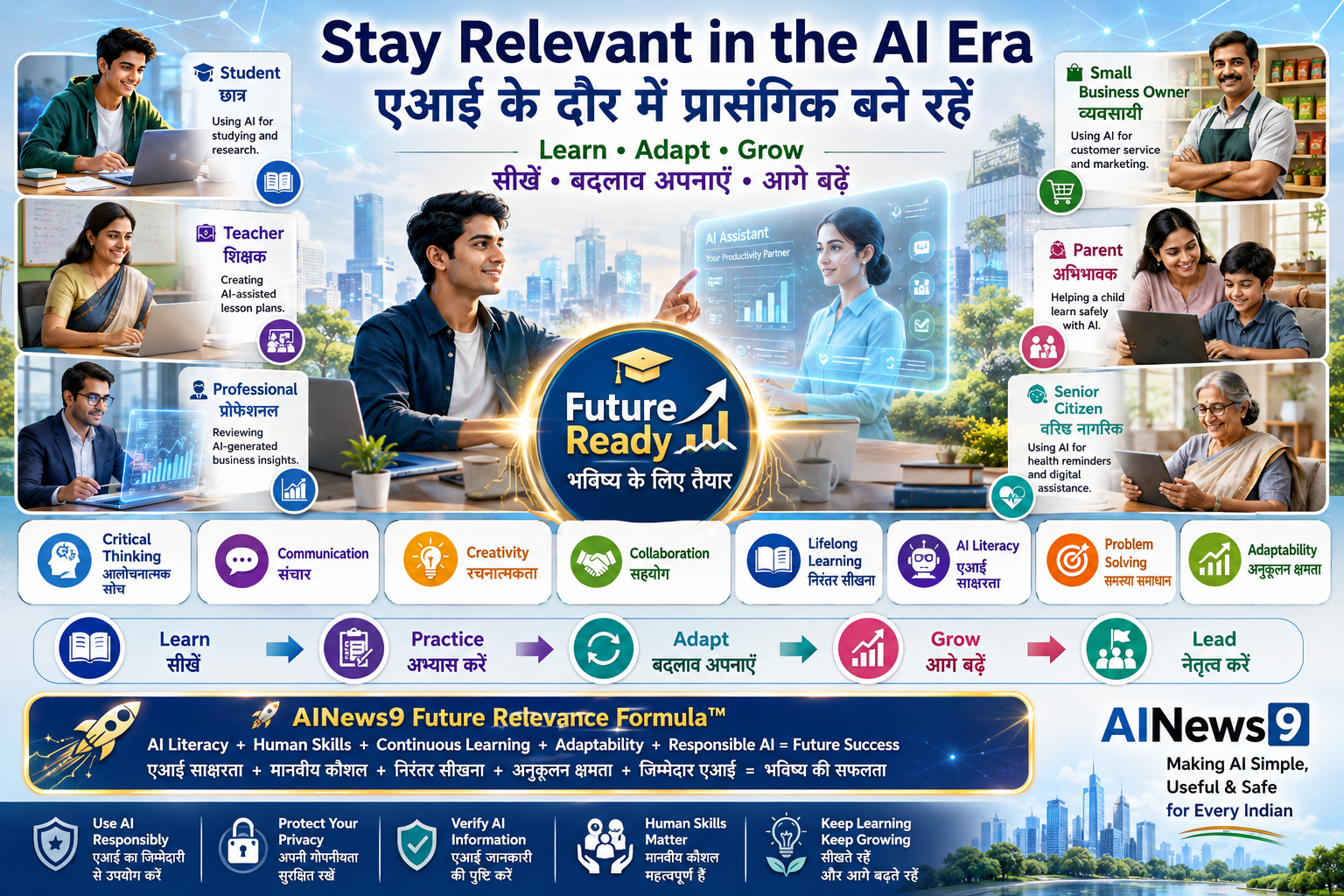
- 👩🏫 A teacher can use AI to prepare lesson plans while focusing more on mentoring students.
- 👨⚕️ A doctor can use AI-assisted analysis while applying clinical judgment.
- 💼 A professional can automate routine reports while concentrating on strategic decisions.
- 🛍️ A business owner can use AI for marketing while building stronger customer relationships.
- 🎓 A student can use AI for learning while continuing to think critically and solve problems independently.
In every case, AI supports human expertise—it doesn’t replace it.
The most successful people won’t necessarily know the most AI tools.
They’ll know how to combine AI with uniquely human strengths such as creativity, communication, ethics, empathy, leadership, and critical thinking.
🌟 AINews9 Future Insight
Don’t ask:
“Will AI replace me?”
Ask:
“How can AI help me become even better at what I do?”
That simple shift in mindset can transform uncertainty into opportunity.
🧠 The AI Mindset Shift
One of the biggest changes people need to make isn’t learning a new AI tool—it’s changing the way they think about AI.
Many people see AI as a competitor.
Successful people see AI as a collaborator.
Instead of asking:
“Will AI replace me?”
Ask:
“How can AI help me do my work better?”
This simple shift changes everything.
Think about a calculator.
It didn’t replace mathematicians.
It helped them solve problems faster.
Similarly, AI can help you write, research, analyze information, generate ideas, and automate repetitive tasks—while you continue making decisions, solving problems, and building relationships.
People who embrace this mindset are more likely to discover new opportunities instead of fearing change.
💼 How AI Is Changing the Workplace
Artificial Intelligence is already influencing almost every profession.
Some tasks are becoming automated.
Others are becoming easier.
Many entirely new roles are also emerging.
Here’s how AI is supporting different professions:
| Profession | How AI Helps |
|---|---|
| 🎓 Students | Personalized learning, research, study support |
| 👩🏫 Teachers | Lesson planning, quizzes, feedback, content creation |
| 💼 Professionals | Reports, presentations, email drafting, productivity |
| 🏪 Business Owners | Marketing, customer service, analytics |
| 👨⚕️ Healthcare | Medical documentation, image analysis, research |
| 🎨 Creators | Writing, design, video editing, brainstorming |
Notice something important.
In every example, AI supports people—it doesn’t replace their expertise.
Human judgment remains essential.
⭐ The Skills That Will Always Matter
Technology will continue to evolve.
Human potential will continue to matter.
Some skills are becoming even more valuable because AI cannot easily replicate them.
💡 Critical Thinking
AI can generate answers.
People decide whether those answers are correct, useful, and appropriate.
🎨 Creativity
AI can generate ideas.
Humans imagine, innovate, and create original solutions.
🗣️ Communication
Strong communication builds trust, teamwork, and leadership.
These remain deeply human abilities.
❤️ Emotional Intelligence
Understanding emotions, building relationships, resolving conflicts, and showing empathy are essential in every profession.
⚖️ Ethical Judgment
AI can provide suggestions.
People remain responsible for making ethical decisions.
🤝 Collaboration
The future belongs to people who work well with both technology and other people.
Technical knowledge alone is not enough.
🤖 AI Literacy Is Becoming a Core Skill
A few decades ago, computer literacy became essential.
Today, AI literacy is following the same path.
Being AI literate doesn’t mean building AI systems.
It means understanding:
- What AI can do.
- What AI cannot do.
- How to use AI responsibly.
- How to verify AI-generated information.
- When human judgment is necessary.
Just as email and the internet became everyday workplace skills, AI literacy is becoming an important capability across many industries.
The earlier you start learning, the more confident you’ll become.
🤝 Learn to Work With AI, Not Against It
Trying to compete with AI isn’t a sustainable strategy.
Learning to collaborate with AI is.
Instead of viewing AI as a threat, think of it as a productivity partner.
For example:
- A student uses AI to understand difficult concepts faster.
- A teacher uses AI to prepare engaging classroom activities.
- A marketing professional uses AI to brainstorm campaign ideas.
- A small business owner uses AI to answer customer questions and save time.
- A software developer uses AI to review code while focusing on solving complex problems.
In every case, AI handles routine or repetitive work.
People contribute creativity, experience, judgment, and responsibility.
The strongest combination isn’t Human vs AI.
It’s Human + AI.
🛡️ AINews9 Future Tip #1
Don’t try to learn every new AI tool.
Instead:
- ✅ Learn the fundamentals of AI.
- ✅ Master one or two trusted AI tools.
- ✅ Practice using them in your daily work or studies.
- ✅ Keep improving your human skills.
- ✅ Stay curious and continue learning.
Technology will continue to change.
A strong learning mindset will always remain valuable.
📚 Build a Habit of Continuous Learning
The biggest advantage you can have in the AI era isn’t knowing everything.
It’s being willing to keep learning.
Technology changes quickly, but learning is a skill that stays valuable throughout life.
You don’t need to spend hours studying every day.
Even 15–20 minutes of focused learning can make a big difference over time.
Simple ways to build a learning habit include:
- 📖 Read one AI-related article each week.
- 🎥 Watch short educational videos.
- 🛠️ Experiment with one new AI feature every month.
- 🎓 Complete beginner-friendly online courses.
- 💬 Discuss new ideas with friends or colleagues.
Small, consistent efforts often produce better results than occasional intensive study.
🌱 Develop a Growth Mindset
People with a growth mindset believe that skills can be improved through learning and practice.
Instead of saying:
“I’m not good with technology.”
Try saying:
“I’m still learning.”
This small change in attitude encourages continuous improvement.
People with a growth mindset:
- Welcome new challenges.
- Learn from mistakes.
- Ask questions.
- Stay curious.
- Keep improving over time.
Remember:
Everyone starts as a beginner.
Even AI experts were once learning the basics.
🧩 Build Transferable Skills
Some technical tools will change.
Certain job titles may evolve.
But many skills remain valuable across almost every profession.
These are called transferable skills because you can use them in different careers and industries.
Focus on developing skills such as:
- 🧠 Problem-solving
- 💬 Communication
- 🤝 Teamwork
- 📅 Time management
- 🎯 Decision-making
- 📖 Learning how to learn
- 🌍 Adaptability
These skills help you remain valuable even as technology continues to evolve.
🗂️ Create Your Personal Learning System
Learning becomes easier when you have a simple routine.
You don’t need an expensive program or complicated schedule.
A practical learning system might look like this:
📅 Every Day
- Spend 15–20 minutes learning something new.
- Practice using one AI tool.
📅 Every Week
- Read one high-quality article.
- Watch one educational video.
- Apply one new idea.
📅 Every Month
- Learn one new AI feature.
- Complete a small project.
- Reflect on what you’ve learned.
Consistency matters more than speed.
🚀 The 5-Step Future Relevance Framework™
Remaining relevant doesn’t happen by accident.
It happens through continuous improvement.
Step 1 — Build AI Literacy
Understand what AI can do, its limitations, and how to use it responsibly.
Step 2 — Strengthen Human Skills
Develop creativity, communication, critical thinking, leadership, and emotional intelligence.
Step 3 — Apply What You Learn
Practice using AI in your studies, work, or daily life.
Knowledge becomes valuable only when applied.
Step 4 — Stay Curious
Technology evolves constantly.
Keep exploring new ideas, tools, and opportunities.
Step 5 — Never Stop Learning
Lifelong learning is the most future-proof skill you can develop.
People who continue learning continue growing.
⚠️ Common Mistakes That Reduce Future Readiness
Avoid these common mistakes:
- ❌ Believing AI will solve every problem.
- ❌ Refusing to learn new technologies.
- ❌ Ignoring human skills.
- ❌ Blindly trusting AI-generated information.
- ❌ Waiting until change becomes unavoidable.
- ❌ Learning tools without understanding the fundamentals.
Instead, stay balanced.
Use AI wisely while continuing to develop your own knowledge and judgment.
🇮🇳 The Indian Perspective
India has one of the world’s youngest workforces and one of the fastest-growing digital economies.
Artificial Intelligence is creating opportunities across:
- 🏥 Healthcare
- 🌾 Agriculture
- 🎓 Education
- 🏭 Manufacturing
- 🛍️ Retail
- 💰 Financial Services
- 🚀 Startups
- 🏛️ Government Services
This creates exciting possibilities for students, professionals, entrepreneurs, and businesses across the country.
The greatest opportunity isn’t simply using AI.
It’s combining India’s creativity, innovation, and entrepreneurial spirit with responsible AI adoption.
🌟 AINews9 Future Insight
You don’t need to predict the future perfectly.
You simply need to become someone who can learn, adapt, and grow as the future unfolds.
That’s a skill no technology can take away.
📅 Your 30-60-90 Day Future Readiness Plan
Preparing for an AI-driven future doesn’t require a dramatic career change.
Small, consistent actions can make a big difference.
Here’s a simple roadmap to help you become more future-ready.
📆 First 30 Days – Build Awareness
Goal: Understand AI and become comfortable using it.
Focus on:
- Learn AI fundamentals.
- Explore one AI assistant such as ChatGPT, Gemini, or Microsoft Copilot.
- Understand responsible AI use.
- Practice writing simple prompts.
- Read one AI-related article every week.
Milestone:
✅ You understand what AI can and cannot do, and you’re confident using it for everyday tasks.
📆 Days 31–60 – Apply AI to Your Work
Goal: Use AI to improve productivity without replacing your own thinking.
Start using AI to:
- Brainstorm ideas.
- Summarize documents.
- Draft emails and reports.
- Organize information.
- Improve presentations.
Build:
- One AI-assisted project.
- One workflow that saves time.
- One personal case study documenting what you learned.
Milestone:
✅ AI becomes your productivity partner rather than just another tool.
📆 Days 61–90 – Build Your Future Portfolio
Goal: Demonstrate your AI readiness.
Create evidence of your learning:
- Publish a LinkedIn post about something you’ve learned.
- Build a small portfolio project.
- Document an AI-assisted workflow.
- Join an AI learning community or webinar.
- Continue experimenting with new AI tools responsibly.
Milestone:
✅ You have visible proof of your skills, continuous learning, and future readiness.
🛤️ Future Skills Roadmap
The future belongs to people who combine technical knowledge with strong human abilities.
💻 Technical Skills
- AI Literacy
- Prompt Writing
- Digital Productivity
- Data Literacy
- Cybersecurity Awareness
- Automation Basics
🤝 Human Skills
- Critical Thinking
- Creativity
- Communication
- Collaboration
- Leadership
- Emotional Intelligence
- Ethical Judgment
- Adaptability
- Lifelong Learning
Technology will continue to evolve.
These human strengths will continue to create value.
🚀 The AINews9 Future Relevance Formula™
Staying relevant isn’t about knowing every new AI tool.
It’s about building habits that help you grow throughout your life.
Future Relevance = AI Literacy + Human Skills + Continuous Learning + Adaptability + Responsible AI
This formula brings together everything you’ve learned across the AINews9 journey:
- 📘 Learn AI → Build AI Literacy
- 🛠️ Use AI → Apply AI Productively
- 🛡️ Stay Safe → Use AI Responsibly
- 🚀 Grow with AI → Keep Learning & Adapting
When these five elements work together, you become prepared not only for today’s technology—but for tomorrow’s opportunities as well.
📝 Key Points
Remember these important lessons:
- ✅ AI is changing work, but human talent remains essential.
- ✅ Learn to work with AI instead of competing against it.
- ✅ Build both technical and human skills.
- ✅ Continuous learning is your greatest long-term advantage.
- ✅ Adaptability matters more than mastering one specific tool.
- ✅ Small, consistent improvements create lasting success.
- ✅ Responsible AI use builds trust and confidence.
- ✅ Your future depends more on your willingness to learn than your current knowledge.
❓ Frequently Asked Questions
1. What does it mean to stay relevant in an AI-driven world?
It means continuously learning, adapting to change, and combining AI with valuable human skills such as creativity, communication, and critical thinking.
2. Will AI replace every profession?
No.
AI is automating certain tasks, but most professions will continue to require human judgment, ethics, collaboration, and decision-making.
3. Which skills should I develop first?
Start with AI literacy, communication, critical thinking, adaptability, problem-solving, and digital skills.
4. Do I need to become a programmer?
Not necessarily.
Many AI-enabled careers focus on business, education, marketing, healthcare, design, consulting, and communication rather than software development.
5. What’s the single most important habit for long-term success?
Develop a lifelong learning mindset.
People who continue learning are better prepared to adapt to new technologies and future opportunities.
📚 Trusted Resources
Continue your learning with trusted platforms:
- Google AI Essentials
- Microsoft Learn
- LinkedIn Learning
- Coursera
- World Economic Forum – Future of Jobs Report
- OpenAI Learning Resources
- AINews9 Grow with AI Series
💬 Final Thoughts
Artificial Intelligence will continue to evolve.
New tools will appear.
Jobs will change.
Skills will be updated.
But one thing is unlikely to change:
People who continue learning will continue growing.
You don’t need to predict every technological change.
You simply need to stay curious, keep improving, and use AI responsibly.
Remember:
The future doesn’t belong to people who know everything. It belongs to people who never stop learning.
🎓 Continue Your AI Journey
Congratulations!
You’ve now completed the Grow with AI pillar.
Continue exploring AINews9 to strengthen your AI knowledge across all four learning pillars.
📘 Learn AI
Build strong AI foundations through beginner-friendly lessons.
🛠️ Use AI
Discover practical ways to use AI at school, work, and in everyday life.
🛡️ Stay Safe
Learn how to use AI responsibly, protect your privacy, and identify AI-related risks.
🚀 Grow with AI
Develop future-ready skills, career strategies, and lifelong learning habits for success in an AI-powered world.
About AINews9
AINews9 is India’s AI Literacy Platform dedicated to making Artificial Intelligence Simple, Useful & Safe for Every Indian.
Through our four learning pillars—
- 📘 Learn AI
- 🛠️ Use AI
- 🛡️ Stay Safe
- 🚀 Grow with AI
—we empower students, professionals, teachers, parents, entrepreneurs, senior citizens, and businesses with the knowledge and confidence to succeed in an AI-powered future.
Whether you’re taking your first steps with AI or preparing for tomorrow’s opportunities, AINews9 is here to support your lifelong learning journey.
🎉 Congratulations!
With G010, you’ve completed the Grow with AI pillar—and the entire AINews9 AI Literacy Foundation Series.
You have explored:
- 📘 10 Learn AI lessons
- 🛠️ 10 Use AI guides
- 🛡️ 10 Stay Safe articles
- 🚀 10 Grow with AI resources
Together, these 40 cornerstone articles form a comprehensive learning path designed to help every Indian understand AI, use it confidently, stay safe, and grow in an AI-driven world.