How Does AI Work? A Beginner’s Guide
📝 SEO Introduction
How Does AI Work? Artificial Intelligence works by learning patterns from large amounts of data and using those patterns to understand information, make predictions, and generate responses. In this beginner-friendly guide, you’ll discover how AI processes your questions, why it gives the answers it does, and what really happens behind the scenes when you use tools like ChatGPT.
👥 Who Should Read This?
This lesson is designed for anyone who has used Artificial Intelligence and wondered:
“What actually happens behind the scenes?”
It is especially useful for:
- 🎓 Students curious about how AI answers questions
- 👩🏫 Teachers explaining AI concepts in simple language
- 👨👩👧 Parents helping children understand modern technology
- 💼 Professionals using AI tools at work
- 👴 Senior citizens exploring AI with confidence
- 🏪 Small business owners interested in AI-powered productivity
No programming or technical knowledge is required.
📖 What You’ll Learn
By the end of this lesson, you’ll be able to:
- Understand how Artificial Intelligence works in simple language.
- Learn how AI processes questions and generates responses.
- Discover how AI learns patterns from data.
- Understand the role of prediction in modern AI.
- Learn why AI sometimes makes mistakes.
- Explore how humans and AI work together.
📚 In This Lesson
Introduction
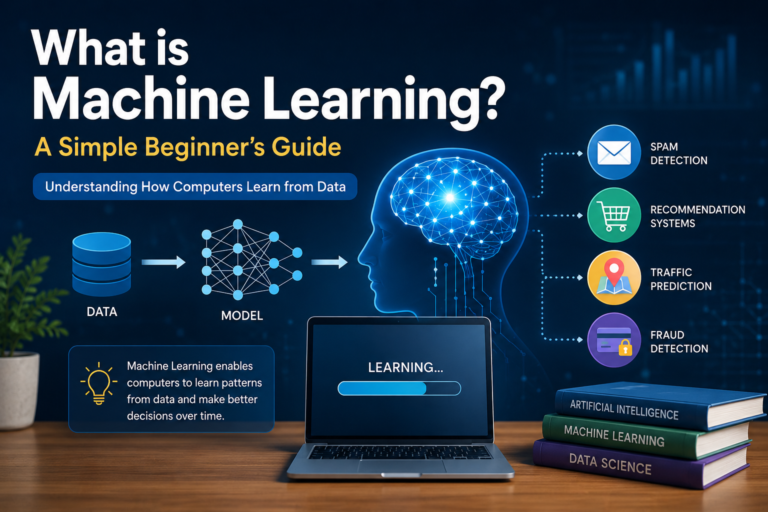
By now, you’ve learned what Artificial Intelligence is, explored Generative AI, understood Machine Learning, discovered Large Language Models (LLMs), interacted with ChatGPT, learned about AI Agents, and even mastered the basics of Prompt Engineering.
Now comes one of the most common questions people ask:
“But how does AI actually work?”
When you type a question into ChatGPT or another AI assistant, the answer often appears within seconds.
It almost feels like you’re talking to another person.
But is AI really thinking?
Does it understand language the way humans do?
Can it reason, remember, and learn exactly like our brains?
The answer is more fascinating than most people expect.
Artificial Intelligence does not think like humans.
It does not possess emotions, consciousness, beliefs, or personal experiences.
Instead, AI works by recognizing patterns in enormous amounts of data and using those patterns to predict the most appropriate response to your request.
Think of AI as someone who has read millions of books, articles, websites, conversations, and documents.
Instead of memorizing every sentence, it learns patterns about how words, ideas, and concepts are connected.
When you ask a question, AI uses those learned patterns to generate an answer that is most likely to be helpful.
This is why AI can explain science, write stories, summarize articles, answer questions, generate code, and even create images—all without actually “thinking” in the human sense.
Understanding this simple idea helps explain both the incredible strengths of Artificial Intelligence and its limitations.
In this lesson, you’ll explore how AI works step by step using everyday examples and simple analogies, so you can confidently understand what happens behind the scenes every time you interact with an AI system.
🤖 What Does AI Actually Do?
Many people imagine AI as a machine that thinks exactly like a human.
Movies often portray AI as conscious robots capable of making independent decisions and understanding the world just like people do.
Modern AI is very different.
Rather than thinking, AI primarily performs three important tasks:
- It recognizes patterns.
- It predicts the most likely outcome.
- It generates a response based on those predictions.
Everything else—from answering questions to creating images—builds on these three capabilities.
📚 Imagine the World’s Largest Library
A helpful way to understand AI is to imagine the world’s largest library.
Suppose there is a librarian who has spent years reading millions of books, newspapers, research papers, websites, conversations, and documents.
The librarian doesn’t memorize every sentence.
Instead, they begin to recognize patterns.
For example:
- Which words often appear together.
- Which ideas are connected.
- How stories are usually written.
- How questions are commonly answered.
- How people explain different topics.
Now imagine asking the librarian:
“Explain Machine Learning to a beginner.”
Instead of searching for one exact answer, the librarian combines knowledge from many different sources and creates a clear explanation based on what they have learned.
Modern AI works in a similar way.
It doesn’t search for a single stored answer.
Instead, it generates a new response by recognizing patterns learned during training.
🧠 AI Learns Patterns—Not Facts
One of the biggest misconceptions about Artificial Intelligence is that it stores every answer in a giant database.
It doesn’t.
During training, AI analyzes enormous amounts of text, images, and other information.
Over time, it learns relationships such as:
- Which words usually appear together.
- Which ideas are related.
- How sentences are structured.
- How questions are typically answered.
- How different concepts connect with each other.
Rather than memorizing facts, AI learns patterns.
This is why it can answer questions it has never seen before.
It uses its understanding of patterns to generate a new response each time.
🌍 A Simple Everyday Example
Imagine you’re completing a sentence.
You read:
“The sun rises in the _____.”
Most people immediately think:
East
Why?
Because you’ve learned that pattern through experience.
You didn’t calculate it.
You simply recognized what usually comes next.
AI works in a similar way—but on a much larger scale.
Instead of learning from years of personal experience, AI learns patterns from vast amounts of data.
When you ask a question, it predicts what information is most likely to come next based on everything it has learned.
This ability to recognize patterns and predict appropriate responses is the foundation of modern Artificial Intelligence.
🔗 Connection to the Previous Lesson
In the previous lesson, you learned that Prompt Engineering is the skill of writing better instructions for AI.
Now you can see why prompts are so important.
AI depends on your prompt to understand what kind of response you want.
A clear prompt gives the AI better context, making it easier to identify the right patterns and generate a more useful answer.
In the next section, we’ll follow the complete journey of a prompt—from the moment you type a question to the moment AI generates its response.
⚙️ What Happens When You Ask AI a Question?
Every interaction with Artificial Intelligence begins with a prompt.
Whether you ask:
“What is Machine Learning?”
or
“Plan a three-day trip to Jaipur.”
The process that follows is surprisingly similar.
Let’s explore what happens behind the scenes.
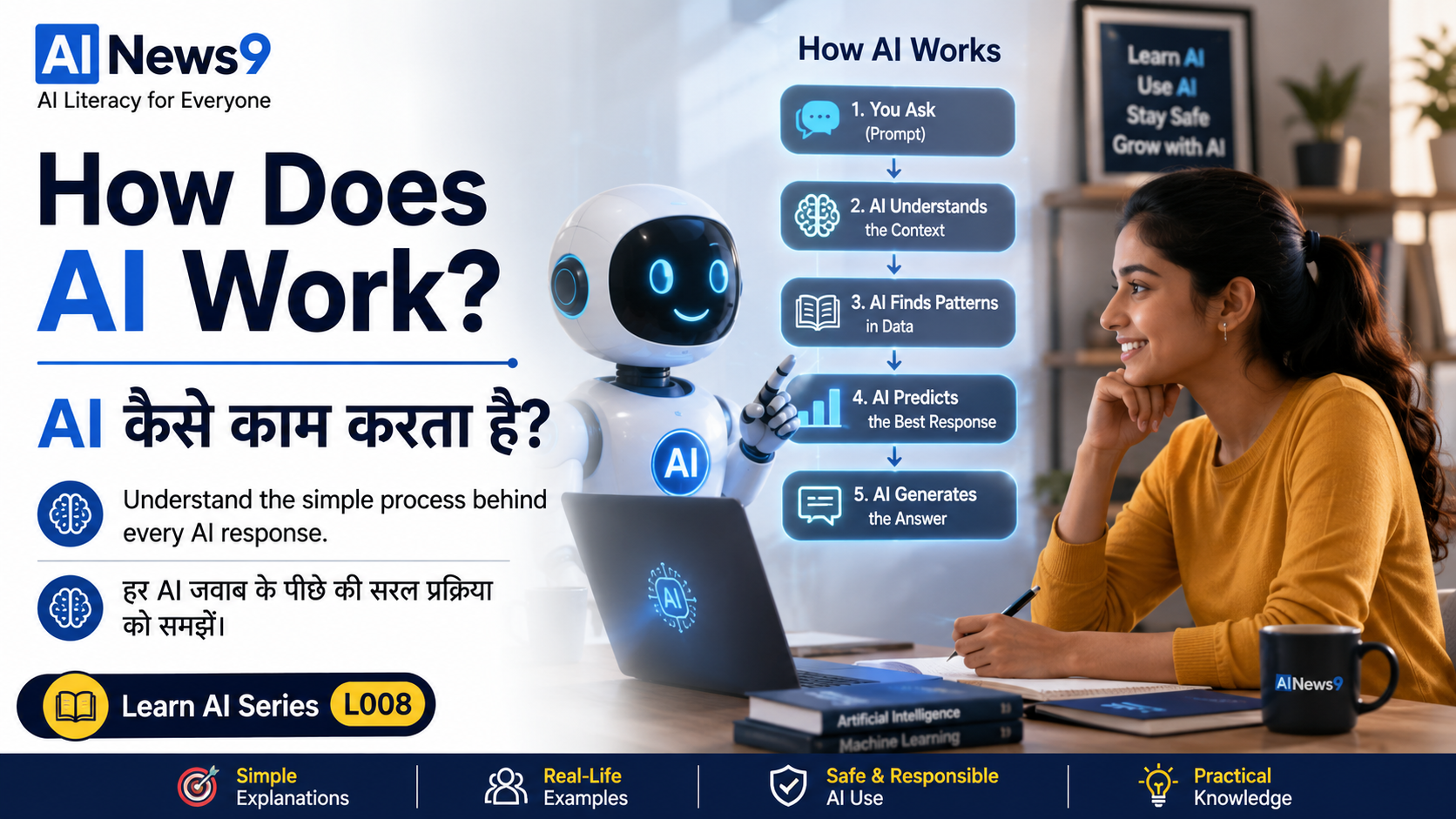
🔄 Step 1 — You Enter a Prompt
Everything begins with your question or instruction.
This is called a prompt.
For example:
- Explain photosynthesis.
- Write a professional email.
- Create a weekly study plan.
- Translate this paragraph into Hindi.
- Summarize today’s AI news.
The AI first receives your prompt and begins analyzing it.
🧠 Step 2 — AI Understands Your Request
The AI doesn’t simply read individual words.
It tries to understand:
- What you’re asking
- The topic
- The context
- The audience
- The expected format
- The writing style
For example, compare these two prompts.
Prompt A
Explain Artificial Intelligence.
Prompt B
Explain Artificial Intelligence to a Class 8 student using simple language and one real-life example.
Prompt B provides much more context.
As a result, the AI can generate a response that is better suited to the user’s needs.
This is why Prompt Engineering plays such an important role.
📚 Step 3 — AI Searches for Learned Patterns
Contrary to popular belief, AI doesn’t search the internet every time you ask a question.
Instead, it searches the patterns it learned during training.
Think of it like this.
Imagine you’ve read thousands of books about science.
Someone asks:
“Why is the sky blue?”
You don’t search every book again.
Your brain remembers patterns and combines them into a fresh explanation.
Modern AI works in a similar way.
It identifies relationships between concepts that it learned during training and uses those patterns to build a response.
🎯 Step 4 — AI Predicts What Comes Next
This is one of the most important ideas in Artificial Intelligence.
AI doesn’t “know” the answer in the human sense.
Instead, it predicts the most appropriate sequence of words based on your prompt.
Imagine this sentence:
“Birds build their nests in _____.”
Most people naturally think:
Trees
You aren’t calculating the answer.
You’re predicting the most likely word based on experience.
AI performs a similar task—but on a much larger scale.
It predicts one word (or token) at a time, continuously selecting what is most likely to come next until the complete response is generated.
This prediction process is what allows AI to write articles, answer questions, summarize documents, generate code, and even create stories.
✨ Step 5 — AI Generates the Response
After making thousands of tiny predictions in rapid succession, the AI combines them into a coherent response.
Within seconds, you receive:
- An explanation
- A summary
- A story
- A poem
- An email
- A lesson plan
- Computer code
- Or any other requested output
Although it appears effortless, the AI has performed millions of mathematical calculations behind the scenes to generate that response.
👤 Step 6 — You Review the Result
The final step still belongs to the human.
You decide whether the AI’s answer is:
- Correct
- Useful
- Complete
- Accurate
- Appropriate
If necessary, you can improve your prompt and ask the AI to revise its response.
This collaborative process allows humans and AI to work together more effectively.
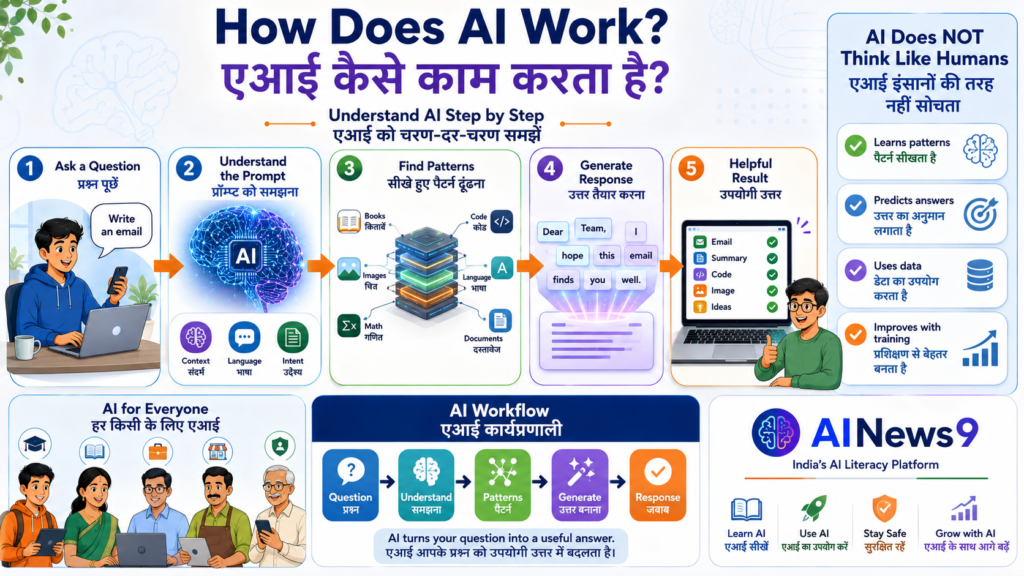
🧩 The AI Workflow at a Glance
Every AI interaction follows a similar journey:
|
Step |
What Happens? |
|---|---|
|
1 |
You enter a prompt. |
|
2 |
AI analyzes your request and context. |
|
3 |
AI identifies relevant learned patterns. |
|
4 |
AI predicts the most suitable sequence of words. |
|
5 |
AI generates a response. |
|
6 |
You review, refine, and use the output. |
This simple workflow powers many of today’s AI applications.
💬 Does AI Understand Language Like Humans?
This is one of the biggest misconceptions about Artificial Intelligence.
Humans understand language through:
- Experience
- Emotions
- Common sense
- Personal memories
- Real-world interactions
AI works differently.
It identifies patterns in language based on its training.
For example, AI can explain what happiness means.
However, it has never actually felt happiness.
It can describe the taste of chocolate.
But it has never tasted chocolate.
This distinction is important.
AI can simulate understanding remarkably well, but it does not experience the world as humans do.
🌍 Everyday Example
Imagine you’re texting a friend.
You type:
“Happy ______”
Without thinking, your phone suggests:
- Birthday
- Anniversary
- Holidays
Your phone isn’t conscious.
It predicts the next word based on patterns from previous typing.
Modern AI uses the same basic idea—but at a far greater scale and with much more sophisticated language models.
Instead of predicting one or two words, it generates complete paragraphs, conversations, explanations, and creative content.
🚀 Why AI Feels So Intelligent
AI appears intelligent because it can:
- Understand natural language.
- Recognize complex patterns.
- Generate fluent responses.
- Adapt to different writing styles.
- Follow detailed instructions.
- Respond almost instantly.
These abilities make AI feel conversational.
However, beneath the surface, it is still performing pattern recognition and prediction rather than thinking like a human.
📌 Remember
Every answer generated by AI begins with your prompt.
The AI analyzes your request, identifies relevant patterns from its training, predicts the most appropriate sequence of words, and generates a response.
Understanding this simple workflow helps explain both the impressive capabilities of Artificial Intelligence and the reasons why it can occasionally make mistakes.
🌟 Benefits of Artificial Intelligence
Now that you understand how AI works, let’s explore why it has become one of the most transformative technologies of the 21st century.
Artificial Intelligence is helping individuals, businesses, schools, hospitals, and governments solve problems faster, improve productivity, and make better decisions.
Here are some of its biggest benefits.
⏱️ 1. Saves Time
AI can complete repetitive tasks in seconds.
For example, it can:
- Summarize long documents
- Draft emails
- Generate reports
- Translate languages
- Organize information
- Create presentations
Instead of spending hours on routine work, people can focus on more meaningful and creative tasks.
📈 2. Improves Productivity
AI acts like a digital assistant that helps people work more efficiently.
Students can learn faster.
Teachers can prepare lessons more quickly.
Professionals can automate repetitive office work.
Businesses can serve customers more efficiently.
By reducing manual effort, AI helps people accomplish more in less time.
🧠 3. Supports Better Decision-Making
AI can analyze large amounts of information much faster than humans.
For example, AI can:
- Compare products
- Identify trends
- Organize research
- Detect unusual patterns
- Recommend possible solutions
While humans still make the final decisions, AI can provide valuable insights that support better choices.
🌍 4. Makes Information More Accessible
AI helps make knowledge easier to understand.
For example, it can:
- Simplify complex topics
- Translate content into multiple languages
- Summarize lengthy articles
- Explain concepts using everyday examples
This makes learning more accessible for people of different ages and backgrounds.
💡 5. Encourages Creativity
AI is not just for answering questions.
It can also help people create.
Examples include:
- Writing stories
- Brainstorming ideas
- Designing presentations
- Creating images
- Composing music
- Developing software
Rather than replacing human creativity, AI often acts as a creative partner.
🤝 6. Works Alongside Humans
The most successful use of AI is not replacing people—it is helping them.
Humans contribute:
- Creativity
- Ethics
- Experience
- Critical thinking
- Common sense
AI contributes:
- Speed
- Pattern recognition
- Automation
- Information processing
Together, they form a powerful partnership.
⚠️ Limitations of Artificial Intelligence
Although AI is incredibly capable, it is not perfect.
Understanding its limitations is just as important as understanding its strengths.
❌ 1. AI Can Make Mistakes
AI sometimes generates incorrect or misleading information.
These errors may occur because:
- The prompt is unclear.
- The available information is incomplete.
- AI predicts an incorrect response.
For this reason, important information should always be verified.
🧠 2. AI Does Not Truly Understand
AI can explain emotions such as happiness, fear, or excitement.
However, it does not actually experience these emotions.
Similarly, AI can describe the taste of mangoes without ever tasting one.
Its responses are based on learned patterns—not real-world experiences.
🔒 3. AI Depends on Data
AI learns from the information it is trained on.
If the training data contains errors, outdated information, or bias, the AI’s responses may also reflect those limitations.
Good data is essential for building reliable AI systems.
⚖️ 4. AI Should Not Replace Human Judgement
AI can assist with decision-making, but humans should remain responsible for important decisions involving:
- Healthcare
- Legal matters
- Financial investments
- Education
- Public safety
AI is a decision-support tool—not a substitute for professional expertise.
🔐 5. Privacy Matters
Users should avoid sharing sensitive information with AI systems.
Examples include:
- Passwords
- Banking details
- Personal identification numbers
- Medical records
- Confidential business information
Responsible AI use includes protecting personal and organizational data.
❌ Common Myths About How AI Works
Artificial Intelligence is often misunderstood.
Let’s separate myth from reality.
Myth 1: AI Thinks Like Humans
Reality
AI recognizes patterns and predicts responses.
It does not think, feel, or understand the world in the same way humans do.
Myth 2: AI Knows Everything
Reality
AI does not know everything.
It generates responses based on patterns learned during training and may occasionally produce incorrect information.
Myth 3: AI Learns Everything Immediately
Reality
Most AI systems do not automatically learn from every conversation.
Their knowledge is based primarily on how they were trained and how they are updated by their developers.
Myth 4: AI Always Gives the Correct Answer
Reality
AI can make mistakes.
It is important to verify important facts using reliable sources.
Myth 5: AI Will Replace All Human Jobs
Reality
AI is more likely to automate repetitive tasks than replace every profession.
People who learn to work effectively with AI will be better prepared for the future workplace.
🛡️ Using Artificial Intelligence Responsibly
Artificial Intelligence is most valuable when used thoughtfully and responsibly.
Here are some best practices.
- ✅ Ask clear and specific questions.
- ✅ Verify important information before using it.
- ✅ Protect personal and confidential data.
- ✅ Review AI-generated content carefully.
- ✅ Use AI to support—not replace—human judgement.
- ✅ Respect privacy, ethics, and intellectual property.
- ✅ Continue learning as AI technology evolves.
Responsible AI use helps ensure that technology benefits individuals, businesses, and society.
🚀 How Beginners Can Better Understand AI
If you’re just starting your AI journey, don’t worry about learning complex mathematics or computer programming.
Instead, focus on understanding the big ideas.
Start by asking simple questions such as:
- How does AI recognize patterns?
- Why does AI sometimes make mistakes?
- How can better prompts improve responses?
- Which AI tools are best for different tasks?
The more you experiment with AI and ask thoughtful questions, the better you’ll understand how it works.
Remember, becoming AI literate is a journey—not a race.
Every lesson you complete builds a stronger foundation for using AI confidently and responsibly.
🎯 Important Point
Congratulations!
You’ve now explored one of the most important questions in Artificial Intelligence:
“How does AI actually work?”
Let’s quickly recap the key concepts from this lesson.
- ✅ Artificial Intelligence works by learning patterns from large amounts of data.
- ✅ AI does not think or feel like humans.
- ✅ Every interaction with AI begins with a prompt.
- ✅ AI analyzes your request, identifies learned patterns, predicts the most appropriate response, and generates an answer.
- ✅ Modern AI relies on prediction rather than memorizing answers.
- ✅ AI is powerful, but it can still make mistakes and should be used responsibly.
- ✅ Humans and AI work best together, combining human judgement with AI’s speed and efficiency.
Understanding how AI works helps you become a more informed, confident, and responsible AI user.
❓ Frequently Asked Questions (FAQs)
1. How does AI work?
Artificial Intelligence works by learning patterns from large amounts of data. When you ask a question, AI analyzes your prompt, identifies relevant patterns, predicts the most appropriate response, and generates an answer.
2. Does AI think like humans?
No.
AI does not possess emotions, consciousness, personal experiences, or common sense like humans.
It recognizes patterns and predicts responses based on its training.
3. Does AI understand everything?
No.
Although AI can generate impressive responses, it does not truly understand information in the same way humans do.
Its responses are based on statistical patterns rather than human understanding.
4. Why does AI sometimes make mistakes?
AI predicts the most likely response based on learned patterns.
If the prediction is inaccurate, incomplete, or based on unclear instructions, the AI may generate incorrect information.
This is why important information should always be verified.
5. Does AI search the internet every time I ask a question?
Not always.
Many AI systems generate responses using patterns learned during training.
Some AI tools can also access the internet or external databases when those capabilities are enabled.
6. Why are prompts important?
Prompts tell AI what you want to achieve.
Clear, detailed prompts provide better context, helping AI generate more accurate and relevant responses.
7. Can AI continue learning from every conversation?
Not necessarily.
Most AI systems do not automatically learn from every interaction.
Their capabilities improve through updates and additional training performed by their developers.
8. Is AI always correct?
No.
AI can occasionally generate incorrect, outdated, or misleading information.
Users should always verify important facts before making decisions.
9. Can anyone understand how AI works?
Absolutely.
You don’t need programming knowledge or advanced mathematics.
By understanding concepts such as patterns, prediction, prompts, and data, anyone can develop a solid foundation in Artificial Intelligence.
10. What should I learn next?
Now that you understand how AI works, it’s important to learn about one of its biggest limitations:
AI Hallucinations.
Understanding why AI sometimes generates incorrect information will help you become a safer and more responsible AI user.
🎓 Continue Your AI Learning Journey
Congratulations!
You’ve now completed another important milestone in your AI literacy journey.
So far, you’ve learned:
- ✅ What is Artificial Intelligence?
- ✅ What is Generative AI?
- ✅ What is Machine Learning?
- ✅ What are Large Language Models (LLMs)?
- ✅ What is ChatGPT?
- ✅ What are AI Agents?
- ✅ What is Prompt Engineering?
- ✅ How Does AI Work?
These lessons provide a strong conceptual foundation for understanding today’s AI technologies and preparing for future developments.
➡️ Next Article
What are AI Hallucinations?
In the next lesson, you’ll learn:
- What AI Hallucinations are
- Why AI sometimes produces incorrect information
- Common examples of AI Hallucinations
- How to identify unreliable AI responses
- Practical ways to verify AI-generated content
- Best practices for using AI safely and responsibly
Understanding AI Hallucinations is essential for becoming a confident and responsible AI user.
📚 Recommended Resources
To continue your learning journey, explore these trusted resources:
- OpenAI – Learn more about how modern AI systems work and evolve.
- DeepLearning.AI – Access courses covering Machine Learning, Generative AI, and Prompt Engineering.
These resources complement this lesson and provide reliable information for learners who want to deepen their understanding of Artificial Intelligence.
💬 Final Thoughts
Artificial Intelligence may seem mysterious at first, but its core ideas are surprisingly simple.
AI learns patterns from large amounts of data, understands the context of your request, predicts the most appropriate response, and generates an answer within seconds.
Although it appears intelligent, AI is fundamentally a sophisticated prediction system rather than a thinking human mind.
This distinction is important.
Understanding how AI works helps you appreciate both its remarkable capabilities and its limitations.
As AI becomes part of education, business, healthcare, and everyday life, AI literacy will become an essential skill for everyone.
The more you understand how AI works, the more effectively—and responsibly—you’ll be able to use it.
Learning AI isn’t just about understanding technology.
It’s about preparing for the future.
About AINews9
AINews9 is India’s AI Literacy Platform with a mission to make Artificial Intelligence Simple, Useful & Safe for Every Indian.
Through beginner-friendly lessons, practical tutorials, AI safety awareness, and real-world examples, AINews9 helps students, teachers, parents, professionals, senior citizens, and small businesses confidently understand and use Artificial Intelligence.
Whether you’re taking your first steps into AI or expanding your knowledge of emerging technologies, AINews9 is here to help you Learn AI, Use AI, Stay Safe, and Grow with AI.
Next Article: What are AI Hallucinations? A Beginner’s Guide