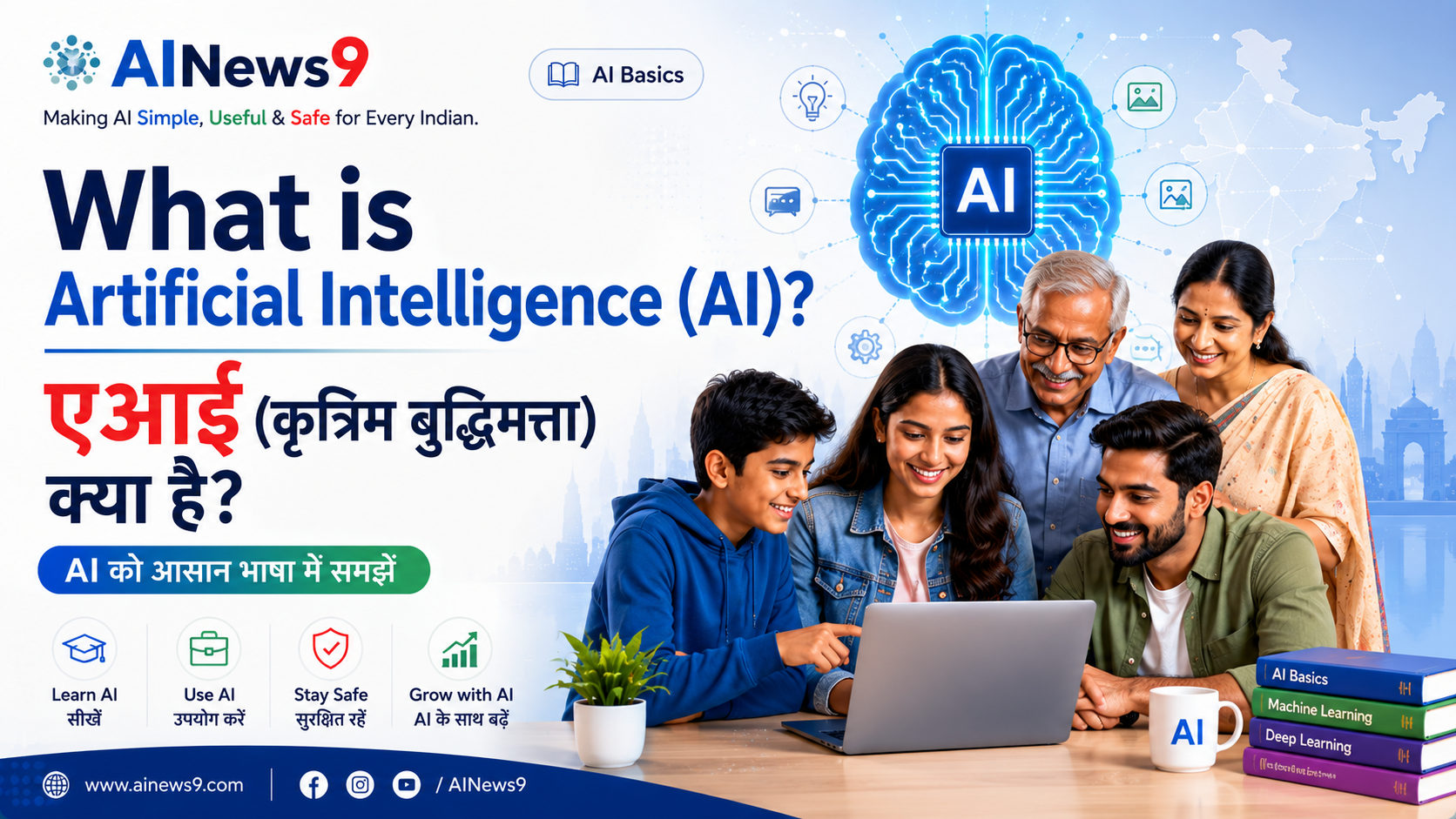
What is Artificial Intelligence (AI)? A Beginner’s Guide for Everyone
👥 Who Should Read This?
This guide is designed for anyone who wants to understand Artificial Intelligence in simple, everyday language.
It is especially useful for:
- 🎓 Students beginning their AI learning journey
- 👩🏫 Teachers introducing AI in classrooms
- 👨👩👧 Parents preparing their children for an AI-powered future
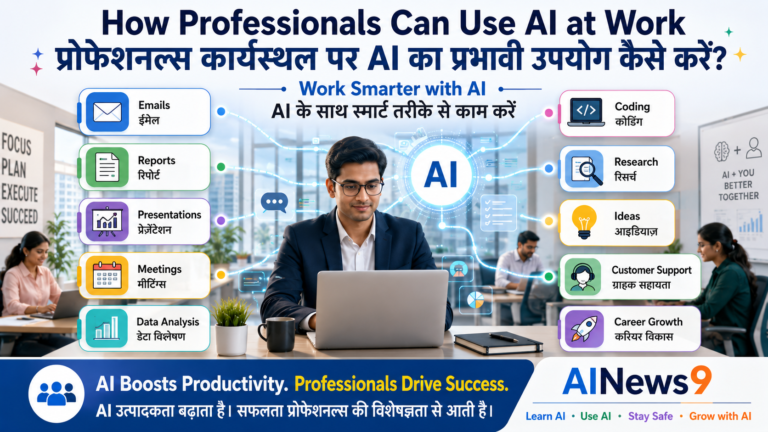
- 💼 Professionals looking to stay relevant at work
- 👴 Senior citizens curious about modern technology
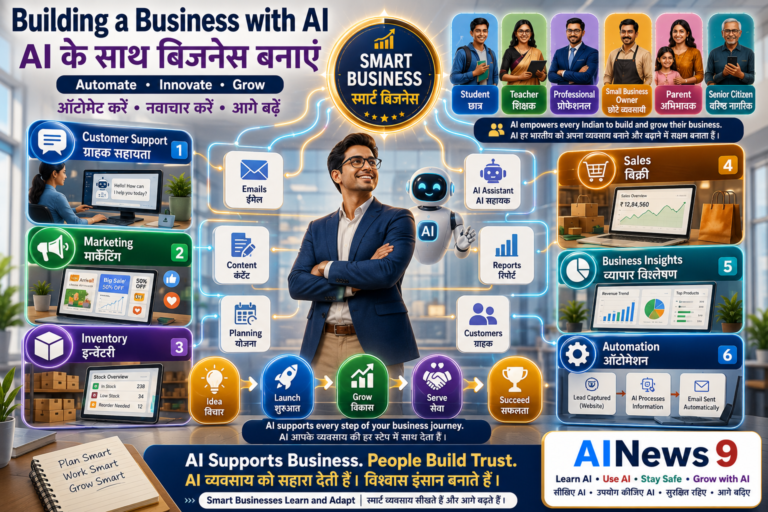
- 🏪 Small business owners exploring AI for growth
No technical knowledge or programming experience is required.
📖 What You’ll Learn
By the end of this lesson, you’ll be able to:
- Understand what Artificial Intelligence (AI) really means.
- Recognize where AI is already being used.
- Learn how AI works at a basic level.
- Understand why AI is becoming important for everyone.
- Separate AI myths from reality.
- Know exactly what to learn next.
⚡ Quick Summary
Artificial Intelligence (AI) enables computers and machines to perform tasks that normally require human intelligence, such as understanding language, recognizing images, learning from data, identifying patterns, and making recommendations.
AI is already part of our daily lives. Whether you’re using Google Maps to avoid traffic, unlocking your smartphone with Face ID, shopping online, or watching recommended videos on YouTube, AI is quietly working behind the scenes.
Learning AI is no longer optional for technology professionals alone. It is becoming an essential life skill for students, teachers, parents, professionals, and businesses.
📖 In This Lesson
Introduction
Artificial Intelligence is one of the most important technologies shaping our world today.
You hear about AI in the news, on social media, in schools, at workplaces, and even in everyday conversations.
But here’s something interesting:
You probably use Artificial Intelligence several times every day without even realizing it.
When Google Maps suggests a faster route, your banking app alerts you about a suspicious transaction, YouTube recommends a video, or your phone unlocks by recognizing your face, AI is working in the background.
Despite using AI every day, many people still wonder:
- What exactly is Artificial Intelligence?
- Is AI the same as robots?
- Can AI think like humans?
- Will AI replace jobs?
- Do I need to learn AI?
The good news is that Artificial Intelligence is much easier to understand than it sounds.
This guide explains AI using simple language, practical examples, and everyday situations that anyone can relate to.
By the end of this lesson, you’ll understand what AI is, why it matters, and how it fits into your daily life.
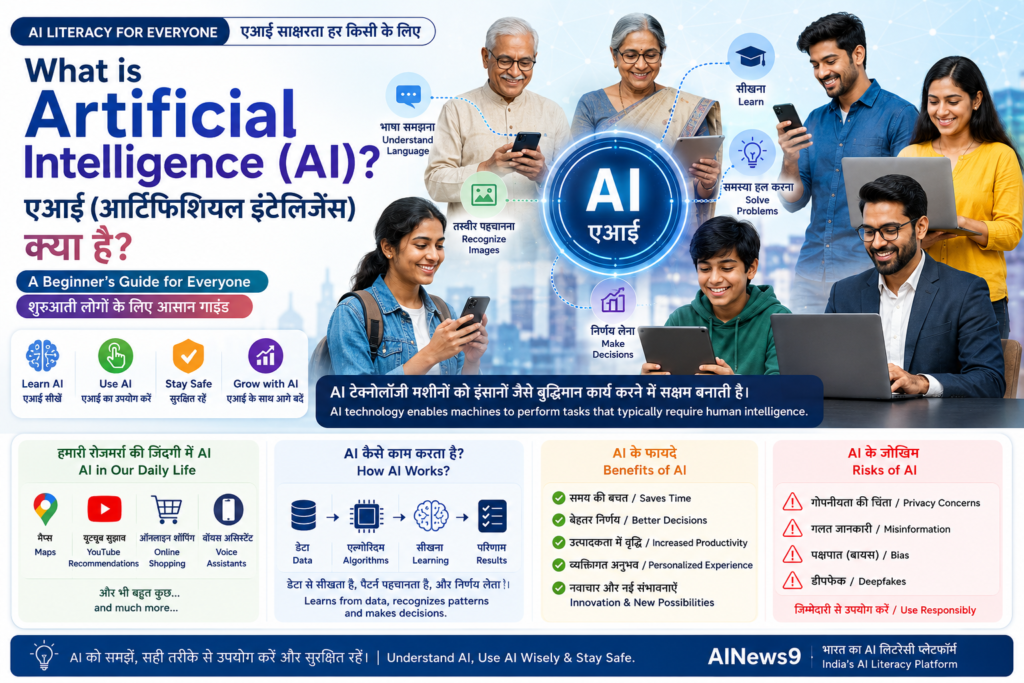
🤖 What is Artificial Intelligence?
Artificial Intelligence (AI) is the ability of computers and software to perform tasks that normally require human intelligence.
These tasks include:
- Learning from information
- Recognizing patterns
- Understanding language
- Solving problems
- Making recommendations
- Supporting decision-making
Unlike traditional computer programs that simply follow fixed instructions, AI systems learn from data and improve their performance over time.
Think of AI as a smart digital assistant that helps people work faster, make better decisions, and solve problems more efficiently.
🍎 A Simple Example
Imagine teaching a young child to recognize a mango.
You don’t explain biology or mathematics.
Instead, you show the child many pictures of mangoes.
After seeing enough examples, the child can recognize a mango they have never seen before.
Artificial Intelligence learns in a similar way.
Instead of memorizing rules, AI studies large amounts of data, identifies patterns, and then uses those patterns to make predictions or recommendations.
This ability to learn from experience is what makes AI different from traditional software.
💡 AI Is Already Around You
Many people believe they have never used Artificial Intelligence.
In reality, most of us interact with AI dozens of times every day.
Examples include:
- 📱 Face Unlock on smartphones
- 🗺 Google Maps route recommendations
- ▶ YouTube video recommendations
- 🛒 Shopping recommendations on Amazon and Flipkart
- 💳 UPI fraud detection by banks
- 📧 Gmail spam filtering
- 🎵 Music recommendations on Spotify
- 🛵 Ride suggestions in Uber and Ola
- 🍔 Food recommendations on Swiggy and Zomato
These applications quietly use AI to make everyday experiences smarter, faster, and more personalized.
🌍 Why Does Artificial Intelligence Matter?
Artificial Intelligence is changing the way people learn, work, communicate, and solve problems.
Rather than replacing people, AI helps individuals become more productive by automating repetitive tasks and providing useful insights.
Today, AI helps people:
- Save time
- Improve productivity
- Learn faster
- Make better decisions
- Analyze information quickly
- Access personalized digital services
Whether you’re a student preparing for exams, a teacher creating lesson plans, a professional writing reports, or a business owner serving customers, AI can become a valuable assistant.
📌 Remember
Artificial Intelligence is a tool.
Like the internet or a smartphone, its value depends on how wisely people choose to use it.
⚙️ How Does Artificial Intelligence Work?
Artificial Intelligence may sound complex, but the basic idea is surprisingly simple.
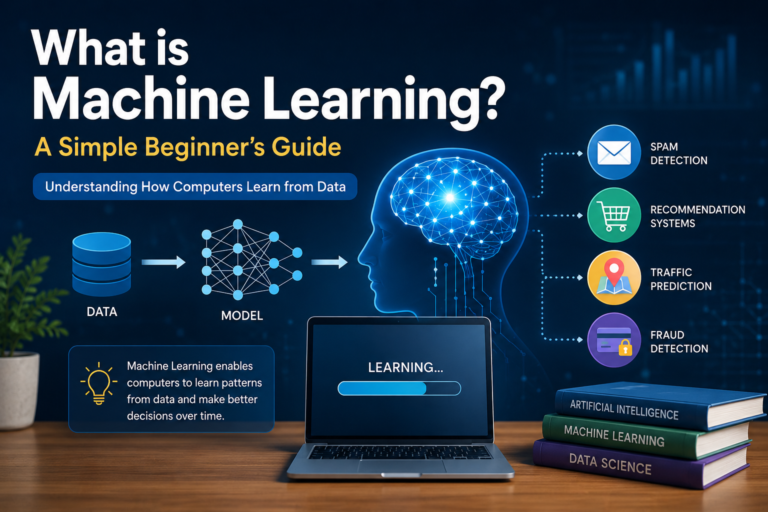
Every AI system generally follows three steps:
- Learn from Data
- Recognize Patterns
- Make Predictions or Decisions
Let’s understand this with a simple example.
Imagine you want to teach a computer to recognize cats.
Instead of writing thousands of rules such as:
- Cats have two ears.
- Cats have whiskers.
- Cats have tails.
You simply show the AI thousands of pictures of cats and non-cats.
Gradually, the AI learns the patterns that make a cat look like a cat.
When it later sees a completely new image, it can predict whether the image contains a cat.
This learning process is what makes Artificial Intelligence different from traditional software.
📊 Three Simple Steps
Step 1: Learning from Data
AI begins by studying large amounts of information called data.
This data may include:
- Images
- Text
- Videos
- Audio
- Medical records
- Weather information
- Financial transactions
The quality of the data directly affects how well an AI system performs.
Step 2: Finding Patterns
Once AI has enough data, it starts identifying patterns.
For example, it may learn that:
- Certain words often appear in spam emails.
- Similar symptoms are linked to specific diseases.
- People who watch one movie often enjoy another.
These patterns help AI understand relationships within the data.
Step 3: Making Predictions
After learning from data and identifying patterns, AI can make predictions or recommendations.
Examples include:
- Suggesting your next YouTube video
- Predicting traffic on Google Maps
- Detecting suspicious banking transactions
- Recommending products while shopping online
- Answering questions in AI chatbots
This ability to predict based on previous learning makes AI useful across many industries.
📌 Remember
AI does not think like humans.
It recognizes patterns and predicts the most likely answer based on what it has learned.
🌍 Where Do We Use Artificial Intelligence?
Artificial Intelligence has become part of everyday life.
Even if you have never opened an AI chatbot, you are probably using AI many times every day.
Here are some common examples.
| Everyday Activity | How AI Helps |
|---|---|
| 📱 Smartphones | Face Unlock, predictive typing, camera enhancement |
| 🗺 Navigation | Suggests the fastest route and predicts traffic |
| ▶ Video Streaming | Recommends movies and videos you may enjoy |
| 🛒 Online Shopping | Suggests products based on your interests |
| Filters spam and unwanted messages | |
| 💳 Banking | Detects suspicious transactions and fraud |
| 🎵 Music Apps | Recommends songs based on your listening history |
| 🛵 Ride-Hailing Apps | Matches drivers and predicts arrival times |
Artificial Intelligence is often invisible—but it is working continuously to improve your digital experience.
🇮🇳 Artificial Intelligence in India
India is rapidly becoming one of the world’s leading adopters of Artificial Intelligence.
AI is already helping improve services across many sectors.
🎓 Education
Students use AI to:
- Understand difficult concepts
- Prepare for exams
- Improve writing
- Learn new skills
Teachers use AI to create lesson plans, quizzes, presentations, and classroom activities.
🏥 Healthcare
Hospitals and healthcare professionals use AI to support:
- Disease detection
- Medical image analysis
- Patient monitoring
- Hospital management
AI helps doctors make faster, more informed decisions while the final diagnosis remains with medical professionals.
🌾 Agriculture
Farmers increasingly use AI for:
- Crop monitoring
- Weather forecasting
- Pest detection
- Soil analysis
These technologies help improve productivity while reducing costs.
🏦 Banking and Digital Payments
Banks and digital payment platforms use AI for:
- Fraud detection
- Customer support
- Risk assessment
- Personalized financial services
Every time a suspicious transaction is detected, AI is often working behind the scenes.
🛍 Everyday Digital Services
Millions of Indians interact with AI through:
- UPI payment apps
- Online shopping platforms
- Food delivery services
- Ride-hailing apps
- Digital customer support
- Smart search engines
Whether we notice it or not, AI has become part of everyday digital life in India.
🔗 Artificial Intelligence Is Just the Beginning
Artificial Intelligence is a broad field that includes many specialized technologies.
As you continue learning, you’ll come across terms such as:
- 🤖 Generative AI
- 🧠 Machine Learning
- 💬 Large Language Models (LLMs)
- 🤝 AI Agents
- ✍️ Prompt Engineering
These are not separate from AI—they are different branches within the broader world of Artificial Intelligence.
To keep this lesson focused, we’ll explore each topic in its own dedicated guide.
📚 Continue Your Learning
After completing this lesson, your recommended learning path is:
- What is Generative AI?
- What is Machine Learning?
- What are Large Language Models (LLMs)?
- What is ChatGPT?
- Prompt Engineering for Beginners
- What are AI Agents?
Each lesson builds on the previous one, helping you develop a strong understanding of Artificial Intelligence step by step.
✅ Benefits of Artificial Intelligence
Artificial Intelligence is helping people work smarter, learn faster, and solve problems more efficiently.
When used responsibly, AI becomes a powerful assistant rather than a replacement for human intelligence.
Some of the biggest benefits of AI include:
🚀 Saves Time
AI can automate repetitive tasks such as:
- Writing first drafts
- Organizing information
- Summarizing documents
- Scheduling activities
- Managing routine work
This allows people to spend more time on creative thinking and decision-making.
📚 Improves Learning
Students can use AI to:
- Understand difficult concepts
- Practice new skills
- Prepare for exams
- Improve writing
- Learn at their own pace
Teachers can create lesson plans, quizzes, presentations, and classroom activities more efficiently.
💼 Increases Productivity
Professionals use AI to:
- Draft reports
- Analyze data
- Prepare presentations
- Brainstorm ideas
- Summarize meetings
Instead of replacing professionals, AI helps them focus on higher-value work.
🏥 Supports Better Healthcare
AI assists healthcare professionals by helping analyze medical information, detect patterns, and support diagnosis.
Doctors continue making the final medical decisions, while AI provides faster insights.
🌍 Makes Technology More Accessible
AI enables features such as:
- Speech-to-text
- Text-to-speech
- Language translation
- Live captions
- Voice assistants
These technologies help millions of people access information more easily.
📌 Remember
Artificial Intelligence delivers the best results when it works with people, not instead of them.
⚠️ Challenges and Limitations of Artificial Intelligence
Although AI is powerful, it is not perfect.
Understanding its limitations helps people use AI responsibly.
Some important challenges include:
AI Can Be Wrong
AI may sometimes generate incorrect or misleading information.
Important decisions should always be verified using trusted sources.
AI Learns from Data
If the data used to train AI contains mistakes or bias, the AI may also produce biased or unfair results.
Developers continuously work to improve AI systems, but no AI is perfect.
Privacy Matters
Never share sensitive information with AI tools, including:
- Passwords
- Banking details
- Confidential business information
- Personal identity documents
Responsible AI use includes protecting your personal data.
AI Can Be Misused
AI can also be used to create:
- Fake images
- Fake videos (Deepfakes)
- Fake voices
- Online scams
- Misinformation
Learning how to identify AI-generated content is becoming an important digital skill.
📌 Good Practice
Always use AI to assist your thinking, not replace it.
Think critically.
Verify important information.
Make the final decision yourself.
❌ Common Myths About Artificial Intelligence
Artificial Intelligence is surrounded by many misconceptions.
Let’s separate fact from fiction.
| Myth | Reality |
|---|---|
| AI is a robot. | AI is software. Some robots use AI, but AI itself is not a robot. |
| AI thinks like humans. | AI recognizes patterns. It does not have emotions or consciousness. |
| AI knows everything. | AI can make mistakes and sometimes provide incorrect information. |
| AI will replace every job. | AI will change many jobs while also creating new opportunities. |
| AI is only for programmers. | Anyone can learn and use AI effectively. |
📌 Remember
The future belongs to people who understand how to work with AI, not against it.
🎯 Why AI Literacy Matters
A few years ago, knowing how to use the internet became an essential life skill.
Today, understanding Artificial Intelligence is following the same path.
AI literacy is not about becoming a software engineer.
It is about understanding:
- What AI can do
- What AI cannot do
- How to use AI responsibly
- How to identify misinformation
- How to make better decisions using AI
Whether you are a student, teacher, parent, professional, entrepreneur, or senior citizen, AI literacy will help you navigate the future with greater confidence.
The goal is not to fear AI.
The goal is to understand it, use it wisely, and benefit from it.
🌟 Lesson Summary
Artificial Intelligence is one of the most transformative technologies of our time.
By learning its fundamentals today, you are building a valuable skill that will help you in education, work, business, and everyday life.
🎯 Key Takeaways
Congratulations! You have completed the first lesson in the AINews9 Learn AI Series.
Before moving to the next lesson, remember these important points:
- Artificial Intelligence (AI) enables computers and machines to perform tasks that normally require human intelligence.
- AI learns from data, recognizes patterns, and makes predictions or recommendations.
- AI is already part of everyday life, often working quietly in the background.
- Most AI systems used today are examples of Narrow AI, designed to perform specific tasks.
- AI is a powerful assistant, but it still requires human judgment, ethics, and critical thinking.
- Understanding AI is becoming an essential skill for students, teachers, parents, professionals, and businesses.
- The best way to learn AI is to build your knowledge step by step.
❓ Frequently Asked Questions (FAQs)
What is Artificial Intelligence in simple words?
Artificial Intelligence (AI) is the ability of computers and software to perform tasks that normally require human intelligence, such as understanding language, recognizing images, learning from data, solving problems, and making recommendations.
Is AI the same as Machine Learning?
No.
Artificial Intelligence is the broader field of creating intelligent systems.
Machine Learning is one branch of AI that enables computers to learn from data without being explicitly programmed for every task.
You’ll explore this in the next lessons.
Is ChatGPT Artificial Intelligence?
Yes.
ChatGPT is an Artificial Intelligence application powered by Large Language Models (LLMs).
It can understand natural language and generate human-like responses to questions and prompts.
Where do we use AI every day?
You probably use AI many times every day through:
- Smartphones
- Search engines
- Navigation apps
- Online shopping
- Banking
- Healthcare
- Streaming platforms
- Customer support
- Digital payments
Many AI systems work quietly in the background without users even noticing them.
Will AI replace human jobs?
AI is changing the way many jobs are performed by automating repetitive tasks.
At the same time, it is creating new opportunities and new careers.
People who learn to work with AI are likely to benefit the most.
Do I need to know programming to use AI?
No.
Many AI tools are designed for everyone.
Students, teachers, parents, professionals, entrepreneurs, and senior citizens can all benefit from AI without writing code.
Is Artificial Intelligence safe?
AI can be extremely useful when used responsibly.
Always:
- Verify important information.
- Protect your personal data.
- Think critically.
- Avoid sharing confidential information with AI tools.
Responsible AI use is the key to using AI safely.
🎓 Your AI Learning Journey
You’ve completed Lesson 1 of the AINews9 Learn AI Series.
Continue building your AI knowledge with these lessons:
| Status | Lesson | Topic |
|---|---|---|
| ✅ Completed | Lesson 1 | What is Artificial Intelligence? |
| ⬜ Next | Lesson 2 | What is Generative AI? |
| ⬜ | Lesson 3 | What is Machine Learning? |
| ⬜ | Lesson 4 | What are Large Language Models (LLMs)? |
| ⬜ | Lesson 5 | What is ChatGPT? |
| ⬜ | Lesson 6 | Prompt Engineering for Beginners |
| ⬜ | Lesson 7 | What are AI Agents? |
Each lesson builds on the previous one, helping you develop a strong understanding of Artificial Intelligence step by step.
🌟 Final Thoughts
Artificial Intelligence is no longer a technology of the future.
It is already transforming the way we learn, work, communicate, create, and solve problems.
The purpose of this guide was not to make you an AI expert overnight.
It was to give you a strong foundation and the confidence to begin your AI learning journey.
Remember:
The future belongs not only to people who build AI—but also to people who understand how to use it wisely.
Every lesson you complete brings you one step closer to becoming AI literate.
Keep learning.
Keep exploring.
Stay curious.
📚 References
To learn more about Artificial Intelligence from trusted organizations, explore:
- NITI Aayog – National Strategy for Artificial Intelligence
- UNESCO – Recommendation on the Ethics of Artificial Intelligence
- OECD – AI Principles
🏢 About AINews9
AINews9 is India’s AI Literacy Platform.
Our mission is simple:
Making AI Simple, Useful & Safe for Every Indian.
We help:
- 🎓 Students
- 👩🏫 Teachers
- 👨👩👧 Parents
- 💼 Professionals
- 👴 Senior Citizens
- 🏪 Small Businesses
Through four learning pillars:
- 📘 Learn AI
- 🛠 Use AI
- 🛡 Stay Safe
- 📈 Grow with AI
Whether you’re taking your first step into Artificial Intelligence or expanding your existing knowledge, AINews9 is here to guide you with trusted, practical, and easy-to-understand content.
Thank you for completing Lesson 1.
➡️ Continue with Lesson 2: What is Generative AI?