What are Large Language Models (LLMs)? A Beginner’s Guide
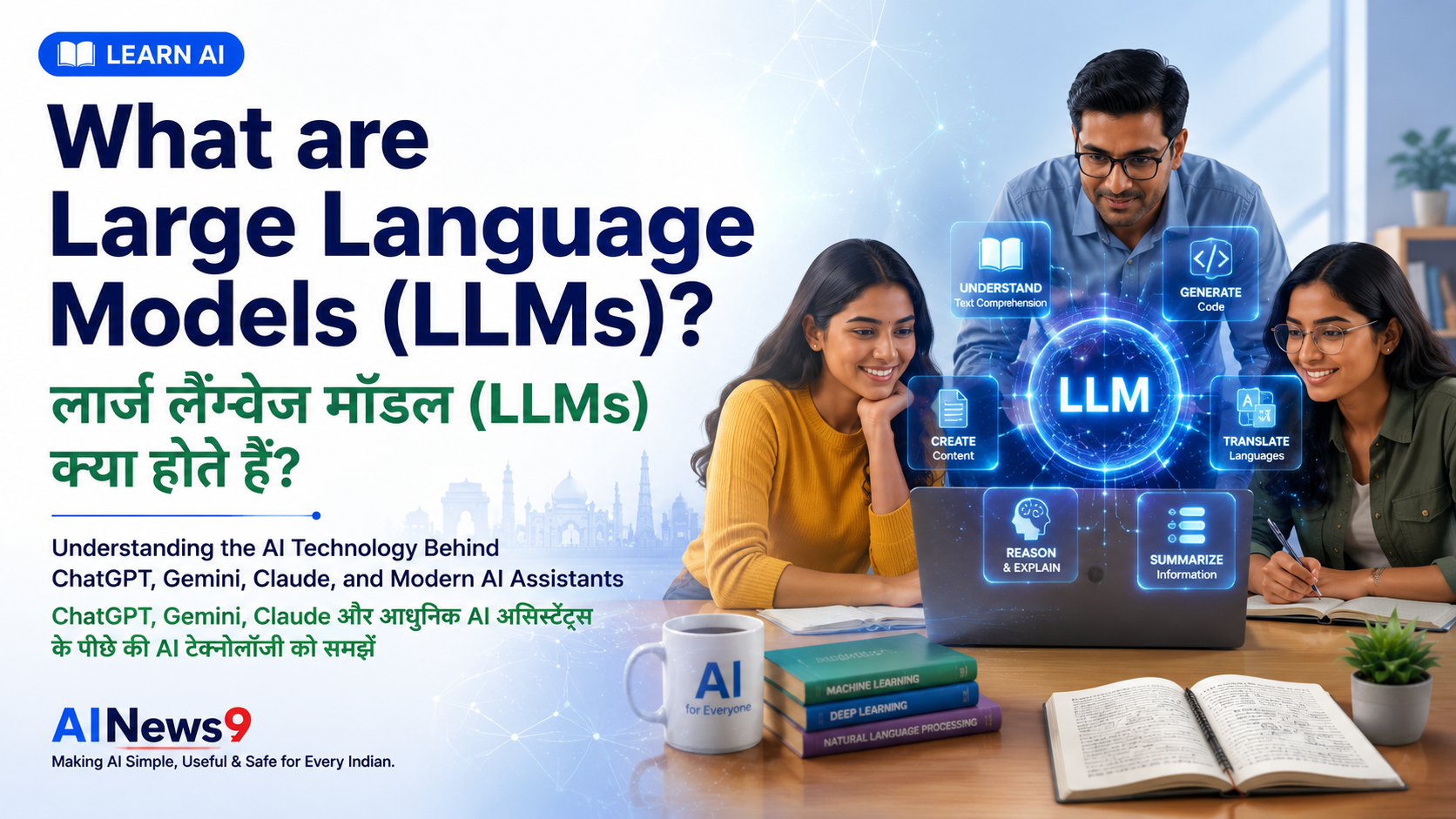
What are Large Language Models (LLMs)? Large Language Models are the AI technology behind ChatGPT, Microsoft Copilot, Google Gemini, Claude, and many other modern AI assistants. In this beginner-friendly guide, you’ll learn how they work in simple language.
👥 Who Should Read This?
This lesson is designed for anyone who wants to understand Large Language Models (LLMs) without getting lost in technical jargon.
It is especially helpful for:
- 🎓 Students exploring Artificial Intelligence and modern AI tools
- 👩🏫 Teachers introducing AI concepts in classrooms
- 👨👩👧 Parents helping children understand AI responsibly
- 💼 Professionals using AI to improve productivity
- 👴 Senior citizens curious about today’s AI assistants
- 🏪 Small business owners looking to use AI for everyday work
No programming knowledge is required.
📖 What You’ll Learn
By the end of this lesson, you’ll be able to:
- Understand what Large Language Models (LLMs) are.
- Learn why they are called “Large Language Models.”
- Discover how LLMs understand and generate human language.
- Explore where LLMs are used in everyday life.
- Understand how AI assistants such as ChatGPT, Microsoft Copilot, Google Gemini, and Claude are powered.
- Learn why LLMs are becoming one of the most important technologies in the AI era.
- Understand the role humans continue to play while using AI responsibly.
📚 In This Lesson
Introduction
In the previous article, you learned how Machine Learning enables computers to learn from data instead of relying only on fixed instructions.
Machine Learning gave computers the ability to recognize patterns, make predictions, and continuously improve through experience.
Now it’s time to explore one of the most important technologies built on top of Machine Learning— Large Language Models (LLMs).
Over the past few years, AI has become a part of everyday life.
Students use AI to simplify difficult subjects.
Teachers prepare lesson plans faster.
Professionals draft emails and reports in minutes.
Businesses create marketing content more efficiently.
Developers write and debug computer code with AI assistance.
Behind many of these remarkable capabilities is a Large Language Model.
Tools such as ChatGPT, Microsoft Copilot, Google Gemini, Claude, and many other AI assistants all rely on Large Language Models to understand human language and generate meaningful responses.
But what exactly is a Large Language Model?
Can AI really understand what we type?
How can a computer answer questions, explain science, translate languages, write stories, or even generate computer code?
Does it actually “understand” language the way humans do?
The answer is both fascinating and surprising.
Large Language Models do not think, reason, or understand the world like humans.
Instead, they learn patterns from enormous amounts of text and use those patterns to predict the most appropriate response based on your question.
Although the technology behind LLMs is highly advanced, the basic idea is much easier to understand than most people imagine.
In this lesson, we’ll explain Large Language Models using simple language, everyday examples, and practical comparisons so that anyone can understand how they work—and why they have become the foundation of today’s AI revolution.
🤖 What is a Large Language Model?
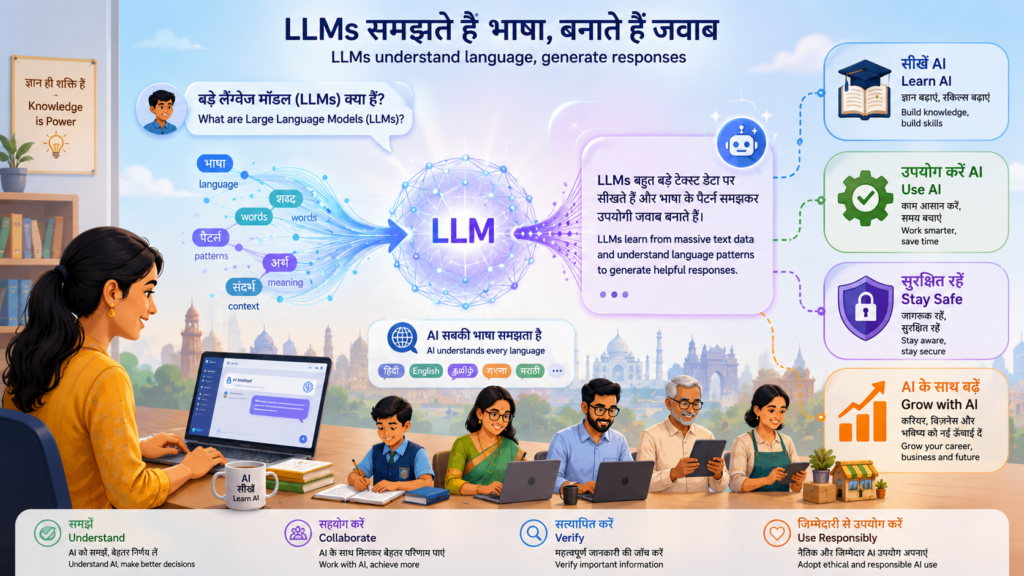
A Large Language Model (LLM) is a type of Artificial Intelligence that is designed to understand and generate human language.
Instead of following a fixed set of rules like traditional computer programs, an LLM learns by studying enormous amounts of text collected from books, articles, websites, research papers, and many other publicly available sources.
During this learning process, it discovers patterns in language.
It learns:
- Words and their meanings
- Grammar and sentence structure
- Relationships between ideas
- Context within conversations
- Different writing styles
- How people communicate
When you ask an LLM a question, it doesn’t search for a ready-made answer stored in a database.
Instead, it uses everything it learned during training to generate a completely new response that best matches your request.
This is why conversations with modern AI assistants often feel natural and human-like.
💡 A Simple Example
Imagine two students preparing for an exam.
The first student memorizes answers from a guidebook.
Whenever someone asks a question, the student searches through the book hoping to find the exact answer.
The second student has spent years reading many different books, understanding concepts, connecting ideas, and practicing explanations.
Now imagine both students are asked:
“Explain the water cycle to a 10-year-old.”
The first student may struggle if the exact answer isn’t available in the guidebook.
The second student understands the concept well enough to explain it using simple language and relatable examples.
A Large Language Model works much more like the second student.
Rather than searching for one fixed answer, it uses everything it has learned about language to generate a new explanation that matches your question.
That is why AI assistants can respond differently to different people—even when they are discussing the same topic.
🔍 Large Language Models vs Traditional Search Engines
Many people believe AI assistants work just like search engines.
They don’t.
Although both help users find information, they work in very different ways.
| Traditional Search Engine | Large Language Model |
|---|---|
| Searches existing web pages | Generates new responses |
| Shows links to websites | Provides direct explanations |
| Requires users to read multiple pages | Summarizes information into one response |
| Best for finding information | Best for understanding information |
| Search-based interaction | Conversation-based interaction |
Both technologies are valuable.
Search engines help you find information.
Large Language Models help you understand and work with information.
🌍 Where Do We Already Use Large Language Models?
Even if you’ve never heard the term Large Language Model, you’ve probably already used one.
Today, LLMs power many of the AI tools people use every day.
Examples include:
- 💬 AI chat assistants
- ✍️ Writing assistants
- 📧 Email drafting tools
- 🌐 Language translation
- 📄 Document summarization
- 💻 Coding assistants
- 📚 Study companions
- 📊 Presentation generators
- 💡 Brainstorming assistants
- 🤖 Customer support chatbots
From schools and offices to hospitals and small businesses, Large Language Models are quietly becoming part of everyday life.
🌟 Why Are Large Language Models Becoming So Popular?
Large Language Models have made Artificial Intelligence accessible to millions of people.
Instead of learning complicated software or programming languages, users simply describe what they need using everyday language.
For example:
- “Explain photosynthesis in simple language.”
- “Write a professional email.”
- “Summarize this report.”
- “Help me prepare for a job interview.”
- “Suggest ideas for my small business.”
Within seconds, an AI assistant can generate a helpful response.
This simplicity has made AI useful not only for technology experts but also for students, teachers, professionals, entrepreneurs, parents, and senior citizens.
For many people, talking to an AI assistant feels as natural as chatting with another person.
📌 Remember
Large Language Models do not understand language in the same way humans do.
They recognize patterns, predict words, and generate responses based on what they learned during training.
That is why they can sometimes make mistakes or produce incorrect information.
Human judgement, critical thinking, and fact-checking remain essential.
🔗 Connection to the Previous Article
So far in your AI learning journey, you’ve explored the building blocks of modern Artificial Intelligence.
You first learned what Artificial Intelligence is and how it enables computers to perform tasks that normally require human intelligence.
Next, you discovered Generative AI, which can create entirely new content such as text, images, music, videos, and computer code.
You then explored Machine Learning, the technology that enables computers to learn from data and improve through experience.
Now you’ve reached the next important milestone.
Large Language Models combine these technologies to help AI understand and generate human language, making modern AI assistants more useful than ever before.
In the next section, you’ll discover how Large Language Models actually work, why they are called “Large,” and how they generate answers that feel so natural during conversations.
⚙️ How Do Large Language Models Work?
At first glance, Large Language Models (LLMs) may seem almost magical.
You ask a question, and within seconds an AI assistant responds with an answer that often feels thoughtful, detailed, and natural.
But behind the scenes, there is no magic.
There is an incredible amount of mathematics, computing power, and Machine Learning working together to predict the most appropriate response.
The good news is that you don’t need to understand advanced mathematics or computer science to understand the basic idea.
Let’s break it down into a few simple steps.
🔄 How an LLM Generates a Response
Whenever you interact with an AI assistant, the process is surprisingly straightforward.
Step 1 — You Enter a Prompt
Everything begins with a prompt.
A prompt is simply the instruction, question, or request you give to the AI.
For example:
- Explain climate change in simple language.
- Write a professional email.
- Summarize this article.
- Suggest five business ideas.
The better your prompt, the better the response is likely to be.
Step 2 — The LLM Understands Your Request
After receiving your prompt, the LLM analyses your words and tries to understand:
- What you are asking
- The context of your request
- The writing style you expect
- The level of detail required
For example, compare these prompts:
Prompt 1
Explain gravity.
Prompt 2
Explain gravity to a 10-year-old using a simple real-life example.
Although both ask about gravity, the second prompt gives much clearer instructions.
As a result, the AI can produce a response that is better suited to the reader.
Step 3 — The Model Predicts the Next Word
This is where the real intelligence of an LLM comes into play.
Instead of searching for a stored answer, the model predicts the most likely next word based on everything it learned during training.
It repeats this prediction process thousands of times every second.
One word leads to the next.
Then another.
And another.
Within moments, those predicted words form complete sentences, paragraphs, and detailed explanations.
That is how an LLM generates a brand-new response for every prompt.
Step 4 — You Receive the Response
Finally, the generated response is displayed on your screen.
Depending on your request, the response may include:
- An explanation
- A summary
- A story
- Computer code
- A translation
- A table
- Ideas or suggestions
- Step-by-step guidance
Although the process happens almost instantly, millions—or even billions—of calculations occur behind the scenes before the answer reaches you.
🪙 Understanding Tokens
One of the most important ideas behind Large Language Models is the concept of tokens.
A token is a small piece of text that an AI model processes during reading and writing.
A token may be:
- A complete word
- Part of a word
- A number
- A punctuation mark
- A symbol
For example, consider the sentence:
Artificial Intelligence is changing the world.
Instead of reading the sentence exactly as humans do, an LLM breaks it into smaller pieces called tokens and processes them one by one.
This makes it easier for the model to understand language patterns and generate accurate responses.
You don’t need to count tokens while learning AI, but understanding that AI works with tokens instead of complete sentences helps explain why prompt length and response length matter.
🧠 Training vs Using an LLM
Many beginners think an LLM learns something new every time they ask a question.
That’s not how it works.
There are two very different stages.
| Training an LLM | Using an LLM |
|---|---|
| Happens before the AI is released | Happens every time you interact with it |
| Uses enormous amounts of text | Uses your prompt |
| Requires powerful computers and months of work | Takes only a few seconds |
| Teaches the model language patterns | Generates a response based on what it already learned |
Think of it like preparing for an exam.
During preparation, a student studies books, solves problems, and gains knowledge.
During the exam, the student does not continue learning new subjects.
Instead, they use what they already know to answer the questions.
Large Language Models work in a very similar way.
🏫 A Classroom Analogy
Imagine a teacher asks an entire class:
“Explain why plants need sunlight.”
Every student has studied the same textbook.
However, each student writes the answer slightly differently.
Some answers are short.
Some are detailed.
Some include examples.
Some use simpler language.
Large Language Models behave in a similar way.
When you ask a question, the AI doesn’t retrieve one fixed answer.
Instead, it generates a fresh response using everything it learned during training while adapting to your prompt.
That is why changing your prompt can produce a completely different answer—even when the topic remains the same.
🌍 Real-World Examples of Large Language Models
You may already interact with LLM-powered applications every day without realizing it.
🎓 Students
Students use LLMs to:
- Understand difficult concepts
- Prepare study notes
- Generate practice questions
- Improve writing skills
👩🏫 Teachers
Teachers use LLMs to:
- Create lesson plans
- Design classroom activities
- Generate quizzes
- Simplify complex topics
💼 Professionals
Professionals rely on LLMs for:
- Drafting emails
- Creating reports
- Summarizing meetings
- Preparing presentations
🏪 Small Business Owners
Businesses use LLMs to:
- Create marketing content
- Write product descriptions
- Respond to customer queries
- Brainstorm business ideas
💻 Developers
Software developers use LLMs to:
- Understand programming concepts
- Generate sample code
- Debug software
- Learn new technologies
🇮🇳 Large Language Models in India
India is rapidly becoming one of the world’s largest users of AI technologies.
Across the country, Large Language Models are helping people improve learning, productivity, and innovation.
Examples include:
- Students learning new subjects.
- Teachers preparing educational material.
- Professionals saving time on routine tasks.
- Startups building AI-powered products.
- Small businesses creating marketing content.
- Government and enterprises exploring AI-enabled digital services.
As India’s digital economy continues to grow, understanding Large Language Models is becoming an increasingly valuable skill for learners, professionals, and entrepreneurs alike.
📌 Remember
Large Language Models do not “know” everything.
They generate responses by recognizing patterns learned during training.
That is why they can sometimes produce inaccurate or outdated information.
Always verify important facts using trusted sources and apply your own judgement before making important decisions based on AI-generated content.
🌟 Benefits of Large Language Models
Large Language Models have changed the way people learn, communicate, and work with information.
Whether you’re a student, teacher, professional, entrepreneur, or simply curious about AI, LLMs can help make many everyday tasks faster and easier.
Let’s explore some of their biggest benefits.
⏱️ 1. Save Time
Many routine tasks that once took hours can now be completed in minutes.
For example, LLMs can help you:
- Draft emails
- Summarize long reports
- Create meeting notes
- Write presentations
- Organize ideas
Instead of starting from a blank page, you can begin with an AI-generated draft and improve it with your own knowledge.
📚 2. Make Learning Easier
Large Language Models act like personal learning assistants.
Students can ask questions in simple language and receive explanations tailored to their level of understanding.
For example:
- Explain photosynthesis to a Class 6 student.
- What is inflation in simple words?
- Help me prepare for my science exam.
Instead of reading several websites, learners can receive a clear explanation in one conversation.
✍️ 3. Improve Writing
Writing becomes much easier with AI assistance.
LLMs can help create:
- Emails
- Reports
- Articles
- Essays
- Meeting summaries
- Social media posts
- Business proposals
They don’t replace your ideas—they help you express them more effectively.
🌐 4. Break Language Barriers
Modern Large Language Models can understand and generate multiple languages.
They can help users:
- Translate documents
- Improve grammar
- Simplify difficult language
- Practice new languages
- Communicate with people around the world
For a country like India, where many languages are spoken, this makes information more accessible to millions of people.
💡 5. Boost Creativity
Sometimes the hardest part of any project is getting started.
LLMs can help generate ideas for:
- School projects
- Business plans
- Marketing campaigns
- Blog articles
- YouTube videos
- Presentations
Think of an LLM as a brainstorming partner that helps you overcome creative blocks.
💼 6. Increase Productivity
Professionals across industries are using LLMs to work more efficiently.
Common uses include:
- Preparing reports
- Creating presentations
- Drafting proposals
- Research assistance
- Organizing information
- Planning projects
Rather than replacing people, LLMs often help them focus on higher-value work.
⚠️ Limitations of Large Language Models
Despite their impressive capabilities, Large Language Models are not perfect.
Understanding their limitations is just as important as understanding their strengths.
❌ 1. They Can Produce Incorrect Information
One of the biggest misconceptions is that AI always provides correct answers.
In reality, LLMs sometimes generate responses that sound confident but are inaccurate.
For example, they may:
- State incorrect facts
- Provide outdated information
- Invent references
- Miscalculate figures
- Misinterpret complex questions
This is why important information should always be verified using trusted sources.
🧠 2. They Do Not Think Like Humans
Although AI conversations often feel natural, LLMs do not possess:
- Consciousness
- Emotions
- Personal experiences
- Common sense
- Human judgement
They recognize language patterns and generate responses—they do not truly understand the world in the way people do.
🔒 3. They Should Not Replace Experts
Large Language Models can support decision-making, but they should never replace qualified professionals in high-risk situations.
Always seek expert advice for:
- Medical decisions
- Legal matters
- Financial planning
- Safety-critical situations
AI is an assistant—not an authority.
🔐 4. Privacy Still Matters
Never share sensitive personal or confidential information with AI systems.
Avoid entering:
- Passwords
- Banking details
- Government identification numbers
- Medical records
- Confidential business information
Protecting your privacy is an important part of responsible AI use.
⚖️ 5. They May Reflect Bias
Large Language Models learn from vast collections of publicly available text.
If biases exist in the training data, AI responses may sometimes reflect those biases.
This is another reason why human judgement remains essential.
❌ Common Myths About Large Language Models
As AI becomes more popular, many misunderstandings have also emerged.
Let’s separate fact from fiction.
Myth 1: LLMs Know Everything
Reality
LLMs are powerful language models, but they are not all-knowing.
They can make mistakes and sometimes provide incomplete or incorrect information.
Myth 2: LLMs Are Always Correct
Reality
AI-generated responses should never be accepted blindly.
Important facts should always be verified using reliable sources.
Myth 3: LLMs Think Like Humans
Reality
LLMs generate responses by recognizing language patterns.
They do not possess emotions, beliefs, or consciousness.
Myth 4: AI Will Replace Everyone’s Job
Reality
Large Language Models will automate certain tasks, but human creativity, leadership, empathy, critical thinking, and decision-making remain irreplaceable.
The future is likely to involve people working alongside AI, not people being replaced by AI.
Myth 5: Large Language Models Are Only for Technology Experts
Reality
Anyone can benefit from learning how to use LLMs.
Today they are helping:
- Students
- Teachers
- Parents
- Professionals
- Entrepreneurs
- Researchers
- Small business owners
- Senior citizens
Understanding how to communicate with AI is quickly becoming an essential digital skill.
🛡️ Using Large Language Models Responsibly
The most successful AI users are not those who trust AI blindly.
They are the people who know when to use AI—and when to rely on their own judgement.
Follow these simple best practices:
- ✅ Ask clear and specific questions.
- ✅ Verify important information.
- ✅ Protect your privacy.
- ✅ Use AI to support your thinking—not replace it.
- ✅ Apply critical thinking before making important decisions.
- ✅ Respect copyright and intellectual property.
- ✅ Be transparent when AI has helped create content.
Responsible AI use allows people to enjoy the benefits of LLMs while reducing potential risks.
🚀 How Beginners Can Start Learning About Large Language Models
Getting started with LLMs is easier than many people think.
Step 1
Learn the basic concepts of Artificial Intelligence, Generative AI, Machine Learning, and Large Language Models.
Step 2
Try beginner-friendly AI assistants such as ChatGPT, Microsoft Copilot, Google Gemini, or Claude.
Step 3
Practice asking different kinds of questions.
Experiment with:
- Learning
- Writing
- Planning
- Brainstorming
- Problem-solving
You’ll quickly discover how different prompts produce different responses.
Step 4
Develop good prompting habits.
The clearer your instructions, the better the AI can help you.
Step 5
Continue building your AI literacy.
Technology is evolving rapidly, and understanding how AI works will help you use it confidently, safely, and responsibly in your studies, career, and everyday life.
🎯 Key Takeaways
Congratulations!
You now have a solid understanding of one of the most important technologies behind today’s Artificial Intelligence revolution.
Let’s quickly recap what you’ve learned.
- ✅ A Large Language Model (LLM) is an AI system designed to understand and generate human language.
- ✅ LLMs learn from enormous amounts of text rather than following fixed programming rules.
- ✅ They generate responses by predicting the most appropriate sequence of words based on patterns learned during training.
- ✅ Modern AI assistants such as ChatGPT, Microsoft Copilot, Google Gemini, and Claude are powered by Large Language Models.
- ✅ LLMs help people write, learn, translate, summarize, brainstorm, and solve problems more efficiently.
- ✅ Although LLMs are highly capable, they can sometimes generate incorrect or outdated information.
- ✅ Human judgement, critical thinking, and responsible AI use remain essential.
Understanding Large Language Models provides the foundation for learning how today’s most popular AI assistants actually work.
❓ Frequently Asked Questions (FAQs)
1. What does LLM stand for?
LLM stands for Large Language Model.
It is a type of Artificial Intelligence designed to understand, process, and generate human language.
2. Is ChatGPT a Large Language Model?
Not exactly.
ChatGPT is an AI assistant that is powered by a Large Language Model developed by OpenAI.
The LLM is the underlying technology, while ChatGPT is the application that people interact with.
3. Why are they called “Large” Language Models?
They are called “Large” because they are trained on enormous amounts of text and contain billions of internal parameters that help them recognize language patterns.
The word “Language” refers to their ability to understand and generate human language.
4. Can Large Language Models think like humans?
No.
LLMs do not possess emotions, consciousness, beliefs, or human understanding.
They generate responses by recognizing statistical patterns in language rather than thinking like people.
5. Can Large Language Models make mistakes?
Yes.
Although LLMs are highly capable, they can sometimes:
- Generate incorrect information
- Misunderstand complex instructions
- Provide outdated facts
- Produce responses that sound convincing but are inaccurate
Important information should always be verified.
6. Where are Large Language Models used?
LLMs are used in many AI-powered applications, including:
- AI chat assistants
- Writing assistants
- Translation tools
- Coding assistants
- Customer support systems
- Education platforms
- Productivity applications
Millions of people use LLM-powered tools every day.
7. Do I need to know programming to use an LLM?
No.
One of the biggest advantages of modern AI assistants is that users can simply communicate using everyday language.
Anyone can begin using LLM-powered tools without programming knowledge.
8. Why are Large Language Models important?
LLMs have made Artificial Intelligence much easier to use.
Instead of learning complicated software, people can simply ask questions, describe problems, and receive helpful responses in natural language.
They are becoming one of the most important technologies shaping education, business, research, and everyday life.
🎓 Continue Your AI Learning Journey
You’ve now explored another important building block of Artificial Intelligence.
So far, you’ve learned:
- ✅ What is Artificial Intelligence?
- ✅ What is Generative AI?
- ✅ What is Machine Learning?
- ✅ What are Large Language Models (LLMs)?
The next step is to explore one of the world’s most popular AI applications.
➡️ Next Article
What is ChatGPT?
In the next lesson, you’ll discover:
- What ChatGPT is
- Who created ChatGPT
- How ChatGPT works
- What ChatGPT can and cannot do
- How students, teachers, professionals, and businesses use ChatGPT
- Best practices for using ChatGPT safely and responsibly
Understanding ChatGPT will help you see how Large Language Models are applied in a real-world AI assistant that millions of people use every day.
📚 Recommended Resources
If you’d like to explore Large Language Models in greater detail, these trusted resources are an excellent place to continue learning:
- OpenAI – Learn about modern AI models and responsible AI development.
- Google AI – Explore Google’s research and educational resources on Artificial Intelligence.
- IBM Think – Read beginner-friendly articles explaining AI, Machine Learning, and Large Language Models.
These resources complement this lesson and provide reliable information for learners who wish to deepen their understanding of AI.
💬 Final Thought
Large Language Models have transformed the way people interact with technology.
For the first time, millions of people can communicate with computers using natural language instead of complex commands or programming languages.
Whether you’re asking a question, writing an email, summarizing a report, learning a new concept, or brainstorming ideas, Large Language Models are quietly working behind the scenes to make these experiences faster and more accessible.
But it’s important to remember that AI is a tool—not a replacement for human intelligence.
The most successful AI users will be those who combine the speed and capabilities of AI with curiosity, critical thinking, creativity, ethics, and good judgement.
Learning how Large Language Models work is not just about understanding technology.
It’s about becoming a more informed, confident, and responsible participant in an AI-powered world.
As AI continues to evolve, this knowledge will help you make better decisions, use AI more effectively, and prepare for the opportunities of the future.
About AINews9
AINews9 is India’s AI Literacy Platform with a mission to make Artificial Intelligence Simple, Useful & Safe for everyone.
Through beginner-friendly guides, practical tutorials, safety awareness, and real-world use cases, AINews9 helps students, teachers, parents, professionals, senior citizens, and small businesses confidently understand and use AI.
Whether you’re taking your first steps into Artificial Intelligence or expanding your AI knowledge, AINews9 is here to support your learning journey—one lesson at a time.
Next Article: What is ChatGPT? A Beginner’s Guide