What is ChatGPT? A Beginner’s Guide
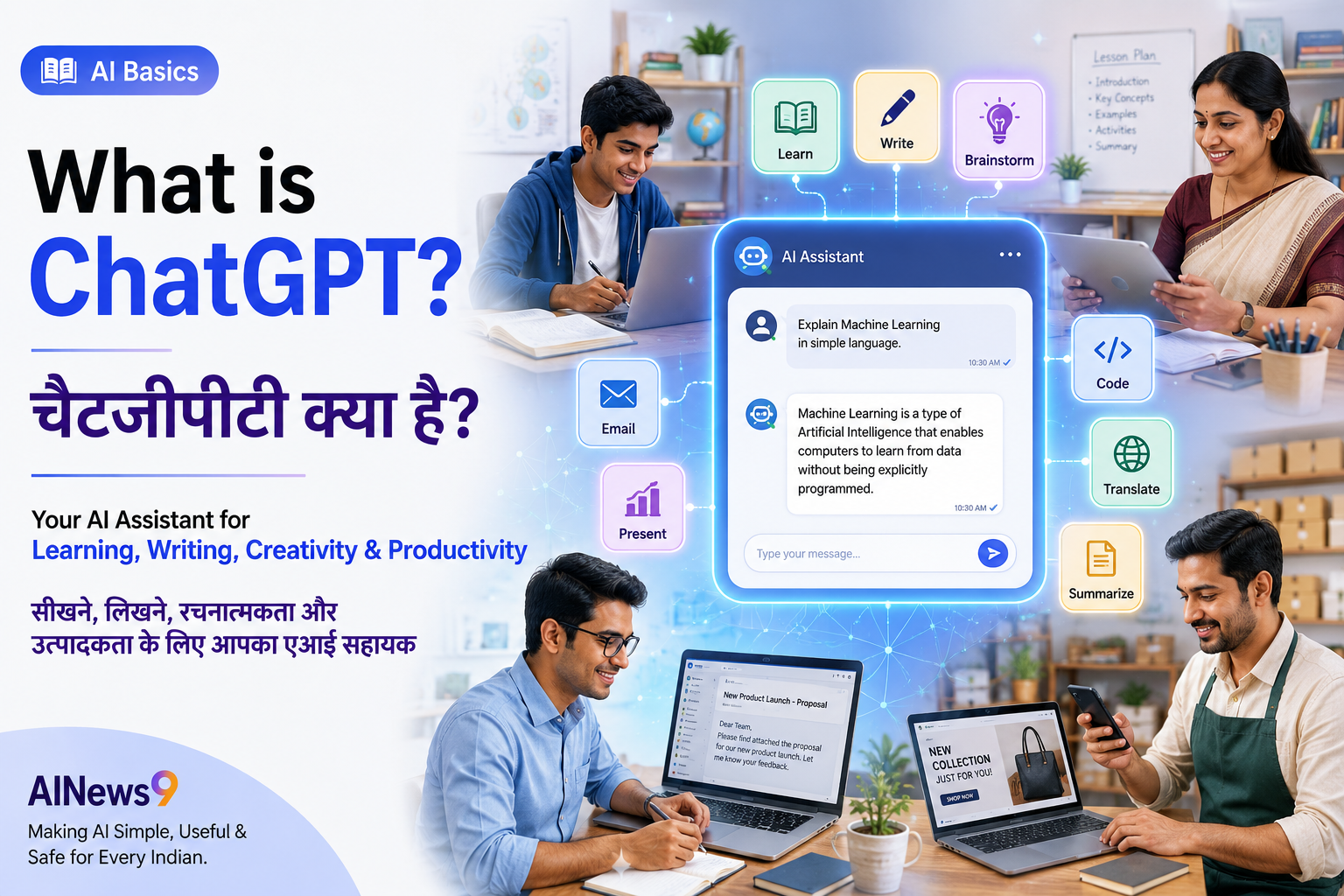
What is ChatGPT? ChatGPT is one of the world’s most popular AI assistants, helping millions of people learn, write, create content, solve problems, and boost productivity through natural conversations. In this beginner-friendly guide, you’ll discover what ChatGPT is, how it works, what it can and cannot do, and how students, teachers, professionals, parents, and businesses can use it safely and effectively.
👥 Who Should Read This?
This lesson is designed for anyone who wants to understand What is ChatGPT in simple, everyday language.
It is especially helpful for:
- 🎓 Students looking for a smarter way to learn and study
- 👩🏫 Teachers exploring AI-powered teaching and lesson planning
- 👨👩👧 Parents helping children use AI responsibly
- 💼 Professionals improving productivity at work
- 👴 Senior citizens curious about modern AI assistants
- 🏪 Small business owners looking to save time and grow their business
No technical background or programming knowledge is required.
📖 What You’ll Learn
By the end of this lesson, you’ll be able to:
- Understand What is ChatGPT.
- Learn who developed ChatGPT and why it became popular.
- Discover how ChatGPT works in simple language.
- Explore real-world uses of ChatGPT.
- Understand what ChatGPT can and cannot do.
- Learn how to use ChatGPT safely, responsibly, and effectively.
📚 In This Lesson
Introduction
Artificial Intelligence has changed dramatically over the past few years.
Instead of using complicated software or learning programming languages, people can now simply type a question and receive an intelligent response within seconds.
Whether it’s explaining a science topic, writing an email, preparing a presentation, generating computer code, or brainstorming business ideas, AI has become easier to use than ever before.
One name has become almost synonymous with this new era of Artificial Intelligence:
ChatGPT.
Millions of people around the world now use ChatGPT every day to learn, create, solve problems, and improve productivity.
Students use it to understand difficult subjects.
Teachers prepare lesson plans more efficiently.
Professionals draft reports, emails, and presentations.
Businesses generate marketing content and customer communications.
Developers use it to write and debug software.
Even people with no technical background are discovering how ChatGPT can make everyday tasks faster and easier.
But what exactly is ChatGPT?
Is it simply a chatbot?
Can it actually think like a human?
Does it know everything?
Can we trust every answer it provides?
Why has it become one of the fastest-growing technologies in history?
These are some of the most common questions people ask when they first hear about ChatGPT.
The good news is that understanding ChatGPT is much easier than many people imagine.
In this lesson, we’ll explain ChatGPT using simple language, practical examples, and real-life scenarios so that anyone can understand how it works, where it is useful, and how to use it responsibly.
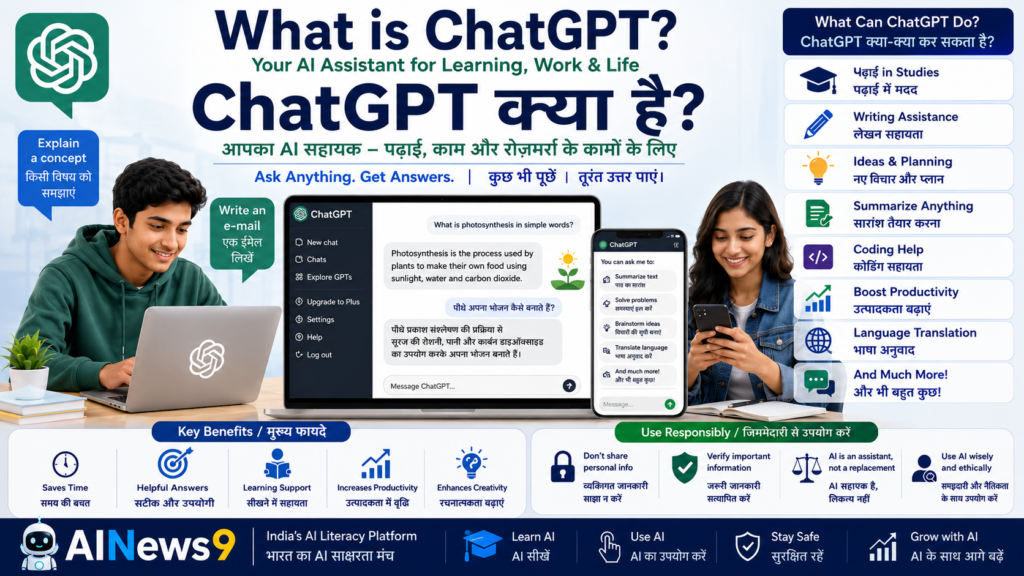
🤖 What is ChatGPT?
ChatGPT is an Artificial Intelligence assistant that allows people to communicate with a computer using natural language.
Instead of clicking through menus or entering complicated commands, you simply type—or even speak—your question.
ChatGPT then generates a response that is designed to be helpful, conversational, and easy to understand.
It can answer questions, explain concepts, write content, summarize information, translate languages, generate computer code, brainstorm ideas, and assist with hundreds of everyday tasks.
Although many people describe ChatGPT as a chatbot, it is much more than a traditional chatbot.
Traditional chatbots usually follow predefined rules and can answer only specific questions.
ChatGPT is powered by a Large Language Model (LLM) that enables it to understand context, generate original responses, and hold natural conversations on a wide range of topics.
Think of ChatGPT as a knowledgeable digital assistant that helps you learn, create, organize information, and solve problems through conversation.
🌍 Why Did ChatGPT Become So Popular?
Before ChatGPT, using Artificial Intelligence often required technical expertise or specialized software.
ChatGPT changed that.
For the first time, millions of people could interact with AI simply by asking questions in everyday language.
This made AI accessible to students, teachers, professionals, entrepreneurs, parents, and senior citizens alike.
Within a short period, ChatGPT became one of the fastest-growing consumer applications in history because people quickly discovered how useful it could be in their daily lives.
Its popularity continues to grow as new capabilities are added and more people learn how AI can help them study, work, create content, and solve problems.
👨💻 Who Developed ChatGPT?
ChatGPT was developed by OpenAI, an Artificial Intelligence research and technology company focused on creating AI systems that are useful, safe, and beneficial for humanity.
OpenAI introduced ChatGPT to the public in November 2022.
Its simple conversational interface attracted millions of users within days and sparked worldwide interest in Artificial Intelligence.
Since then, ChatGPT has continued to evolve with more capable AI models, improved reasoning abilities, better accuracy, support for images and voice, and many additional features.
Today, ChatGPT is used by individuals, schools, businesses, researchers, developers, and organizations across the world.
💡 A Simple Example
Imagine you have a personal tutor available 24 hours a day.
You can ask questions whenever you need help.
For example:
- “Explain photosynthesis in simple language.”
- “Write a professional email requesting leave.”
- “Summarize this article.”
- “Suggest ideas for my science project.”
- “Help me prepare for a job interview.”
Instead of searching through multiple websites, ChatGPT provides a clear response in one conversation.
You can then ask follow-up questions if something isn’t clear.
This conversational style is one of the biggest reasons why ChatGPT feels natural and easy to use.
🔍 ChatGPT vs Traditional Search Engines
Many beginners assume ChatGPT works just like a search engine.
In reality, they serve different purposes.
| Traditional Search Engine | ChatGPT |
|---|---|
| Finds existing web pages | Generates conversational responses |
| Shows multiple website links | Provides direct explanations |
| Requires users to compare sources | Summarizes information in one response |
| Best for finding information | Best for understanding and working with information |
| Search-based experience | Conversation-based experience |
Both are valuable tools.
Search engines help you discover information from across the web.
ChatGPT helps you understand information, generate ideas, and complete tasks through natural conversation.
🔗 Connection to the Previous Article
In the previous article, you learned about Large Language Models (LLMs) and discovered how they enable computers to understand and generate human language.
Now you’ve reached the next step in your AI learning journey.
ChatGPT is one of the world’s most popular applications powered by a Large Language Model.
Understanding ChatGPT helps you see how the concepts you’ve already learned—Artificial Intelligence, Generative AI, Machine Learning, and Large Language Models—come together in a practical tool that millions of people use every day.
In the next section, we’ll explore how ChatGPT works, what happens when you enter a prompt, and why it can generate responses that often feel surprisingly human.
⚙️ How Does ChatGPT Work?
When you type a question into ChatGPT, it may seem like you’re chatting with a human.
In reality, a remarkable series of AI processes takes place within seconds.
Although the technology behind ChatGPT is highly advanced, the basic workflow is surprisingly easy to understand.
Let’s explore what happens behind the scenes.
🔄 What Happens When You Ask ChatGPT a Question?
Every conversation with ChatGPT follows a simple sequence.
Step 1 — You Enter a Prompt
Everything begins with a prompt.
A prompt is simply the instruction, question, or request you give to ChatGPT.
For example:
- Explain gravity to a 12-year-old.
- Write a leave application.
- Summarize this article.
- Suggest business ideas.
- Help me prepare for an interview.
The quality of the response often depends on how clearly you explain what you need.
Clear prompts usually produce better results.
Step 2 — ChatGPT Understands Your Request
After receiving your prompt, ChatGPT analyses your words to understand:
- The topic you’re asking about
- The context of your request
- The type of response you expect
- The level of detail required
- The tone you want
For example, compare these two prompts.
Prompt 1
Explain climate change.
Prompt 2
Explain climate change to a Class 8 student using simple language and everyday examples.
The second prompt gives ChatGPT much more context.
As a result, it can generate a response that is more useful for the intended audience.
Step 3 — The AI Generates a Response
ChatGPT does not search for one perfect answer stored somewhere inside a database.
Instead, it generates a brand-new response based on patterns it learned during training.
It predicts one word at a time.
Each predicted word helps determine the next one.
Within a fraction of a second, thousands of these predictions combine to create complete sentences and paragraphs.
This is why ChatGPT can answer the same question in different ways depending on how you ask it.
Every conversation is unique.
Step 4 — You Continue the Conversation
One of ChatGPT’s biggest strengths is that it remembers the context of your conversation.
Instead of starting from scratch every time, you can ask follow-up questions.
For example:
You
Explain photosynthesis.
ChatGPT
(Provides an explanation.)
You
Can you explain it using a simple classroom example?
ChatGPT understands that “it” refers to photosynthesis and continues the conversation naturally.
This ability makes ChatGPT feel much more like talking to a knowledgeable assistant than using a traditional search engine.
🧠 What Makes ChatGPT So Intelligent?
ChatGPT is powered by a Large Language Model (LLM).
As you learned in the previous lesson, Large Language Models are trained using enormous amounts of text.
During training, the model learns:
- Vocabulary
- Grammar
- Language patterns
- Relationships between ideas
- Writing styles
- Context within conversations
It does not memorize answers to every possible question.
Instead, it learns how language works.
This allows ChatGPT to generate completely new responses rather than simply copying information.
That is why it can help with such a wide variety of tasks.
💬 What Can You Ask ChatGPT?
One of the reasons ChatGPT became so popular is its versatility.
People use it for hundreds of different purposes every day.
Some common examples include:
📚 Learning
- Explain difficult concepts
- Solve doubts
- Prepare study notes
- Practice interview questions
✍️ Writing
- Emails
- Reports
- Essays
- Articles
- Speeches
- Letters
💼 Work
- Meeting summaries
- Business proposals
- Presentations
- Brainstorming ideas
- Project planning
💻 Programming
- Learn coding
- Generate sample code
- Debug programs
- Understand technical concepts
🌍 Everyday Life
- Travel planning
- Meal ideas
- Event planning
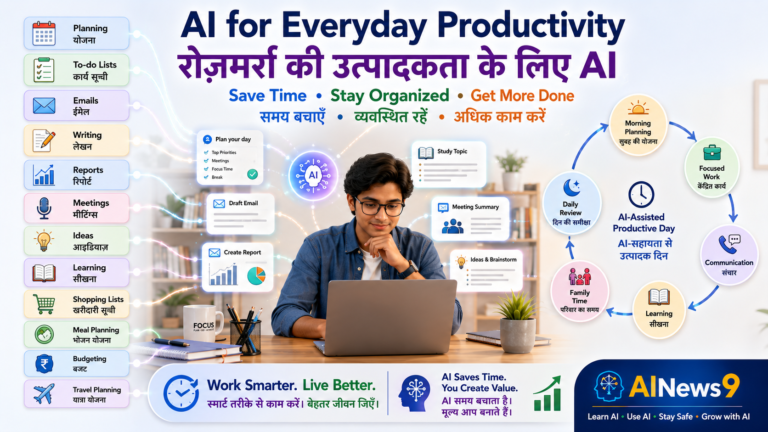
- Personal productivity
- Language translation
The possibilities continue to grow as AI technology evolves.
🌟 Real-Life Examples of ChatGPT
People from different backgrounds use ChatGPT in different ways.
🎓 Students
Students use ChatGPT to:
- Understand difficult lessons
- Revise concepts
- Create study plans
- Practice exam questions
👩🏫 Teachers
Teachers use ChatGPT to:
- Prepare lesson plans
- Create quizzes
- Simplify difficult topics
- Generate classroom activities
💼 Professionals
Professionals use ChatGPT to:
- Draft emails
- Prepare presentations
- Write reports
- Organize meeting notes
🏪 Small Business Owners
Business owners use ChatGPT to:
- Create marketing content
- Write product descriptions
- Draft customer emails
- Brainstorm business ideas
👨💻 Developers
Developers use ChatGPT to:
- Learn programming
- Debug code
- Understand software concepts
- Explore new technologies
🤖 Is ChatGPT Always Correct?
This is one of the most important questions every AI user should ask.
The answer is:
No.
Although ChatGPT is incredibly capable, it can sometimes:
- Provide incorrect facts
- Misunderstand questions
- Give outdated information
- Invent references or statistics
- Make calculation mistakes
This is why ChatGPT should be viewed as an intelligent assistant—not an unquestionable source of truth.
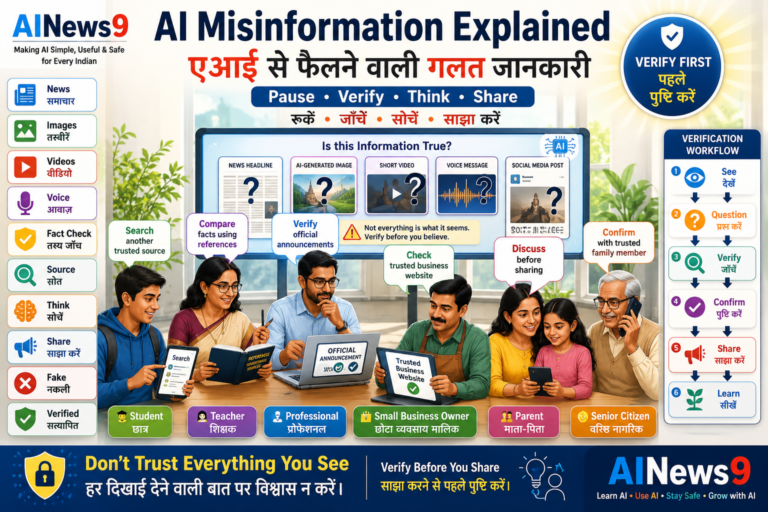
Always verify important information before making decisions related to health, finance, education, legal matters, or business.
📌 Remember
ChatGPT is designed to assist human thinking—not replace it.
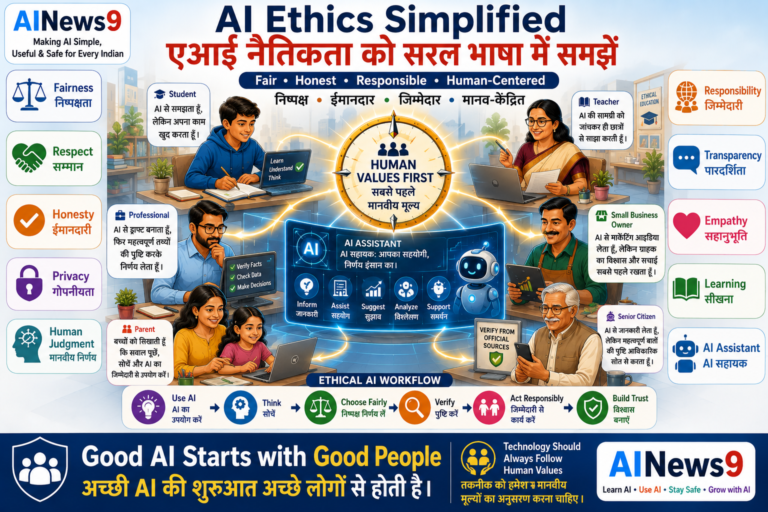
The best results come when people combine AI with their own knowledge, judgement, creativity, and critical thinking.
AI works best when humans remain in control.
🌟 Benefits of ChatGPT
ChatGPT has become one of the world’s most widely used AI applications because it helps people complete everyday tasks more efficiently.
Whether you’re learning a new subject, writing an email, preparing a presentation, or brainstorming ideas, ChatGPT can save time and improve productivity.
Let’s explore some of its biggest advantages.
⏱️ 1. Saves Time
Many routine tasks that once took hours can now be completed in minutes.
For example, ChatGPT can help you:
- Draft professional emails
- Summarize lengthy documents
- Prepare meeting notes
- Generate presentations
- Organize ideas
Instead of starting with a blank page, you can begin with an AI-generated draft and refine it using your own knowledge and experience.
📚 2. Makes Learning Easier
ChatGPT acts like a personal learning assistant that’s available whenever you need it.
Students can ask questions in simple language and receive explanations tailored to their level of understanding.
For example:
- Explain Newton’s Laws to a Class 8 student.
- What is inflation in simple words?
- Help me prepare for my history exam.
Instead of reading multiple websites, learners can receive a clear explanation in a single conversation.
✍️ 3. Improves Writing
Writing becomes much easier with AI assistance.
ChatGPT can help create:
- Emails
- Reports
- Essays
- Articles
- Meeting summaries
- Business proposals
- Social media posts
- Presentation outlines
It doesn’t replace your ideas—it helps you express them more effectively.
💡 4. Encourages Creativity
Sometimes the hardest part of any project is getting started.
ChatGPT can help generate ideas for:
- School projects
- Business plans
- Marketing campaigns
- Blog articles
- YouTube videos
- Speeches
- Presentations
Think of ChatGPT as a brainstorming partner that helps you overcome creative blocks.
🌐 5. Breaks Language Barriers
ChatGPT can understand and generate text in multiple languages.
It can help users:
- Translate documents
- Improve grammar
- Simplify difficult language
- Learn new languages
- Communicate more effectively
For a multilingual country like India, this makes information more accessible to millions of people.
💼 6. Boosts Productivity
Professionals across different industries use ChatGPT to work smarter.
Common uses include:
- Drafting emails
- Preparing reports
- Summarizing meetings
- Creating presentations
- Research assistance
- Brainstorming solutions
By automating repetitive tasks, ChatGPT allows people to focus on work that requires creativity, judgement, and decision-making.
⚠️ What ChatGPT Cannot Do
Although ChatGPT is a powerful AI assistant, it is not perfect.
Understanding its limitations is just as important as understanding its strengths.
❌ 1. It Can Produce Incorrect Information
One of the biggest misconceptions is that ChatGPT always provides accurate answers.
In reality, it can sometimes:
- State incorrect facts
- Invent references
- Misinterpret questions
- Provide outdated information
- Make calculation mistakes
This is why important information should always be verified using trusted sources.
🧠 2. It Does Not Think Like Humans
ChatGPT often sounds intelligent because it communicates naturally.
However, it does not possess:
- Consciousness
- Emotions
- Personal experiences
- Common sense
- Human judgement
It generates responses based on language patterns rather than genuine understanding.
🔒 3. It Should Not Replace Experts
ChatGPT can support learning and decision-making, but it should never replace qualified professionals in critical situations.
Always consult experts for:
- Medical advice
- Legal matters
- Financial planning
- Safety-critical decisions
AI is an assistant—not an authority.
🔐 4. Privacy Still Matters
Avoid sharing sensitive information with ChatGPT.
Never enter:
- Passwords
- Banking details
- Government identification numbers
- Medical records
- Confidential business information
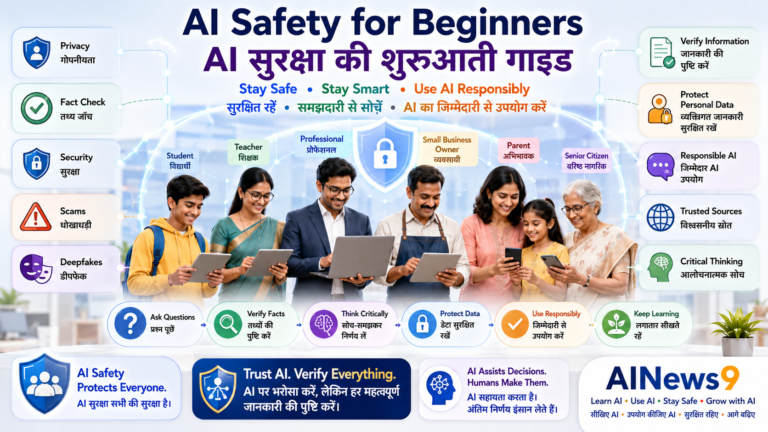
Protecting your privacy is an essential part of responsible AI use.
⚖️ 5. It May Occasionally Produce Biased Responses
ChatGPT learns from large collections of text.
Because of this, responses may sometimes reflect biases present in the training data.
Human judgement remains essential when interpreting AI-generated information.
❌ Common Myths About ChatGPT
As ChatGPT has become more popular, several myths have emerged.
Let’s separate fact from fiction.
Myth 1: ChatGPT Knows Everything
Reality
ChatGPT is highly capable, but it does not know everything.
It can sometimes provide incomplete, outdated, or incorrect information.
Myth 2: ChatGPT Is Always Correct
Reality
AI-generated responses should never be accepted blindly.
Always verify important information before relying on it.
Myth 3: ChatGPT Thinks Like Humans
Reality
ChatGPT predicts language patterns.
It does not think, feel, or understand the world the way people do.
Myth 4: ChatGPT Will Replace All Jobs
Reality
ChatGPT will automate certain tasks, but human creativity, empathy, leadership, ethics, and decision-making remain irreplaceable.
The future is more likely to involve people working alongside AI than AI replacing everyone.
Myth 5: ChatGPT Is Only for Technology Experts
Reality
Anyone can use ChatGPT.
Today it is helping:
- Students
- Teachers
- Parents
- Professionals
- Entrepreneurs
- Researchers
- Small business owners
- Senior citizens
Learning how to communicate effectively with AI is becoming an essential digital skill.
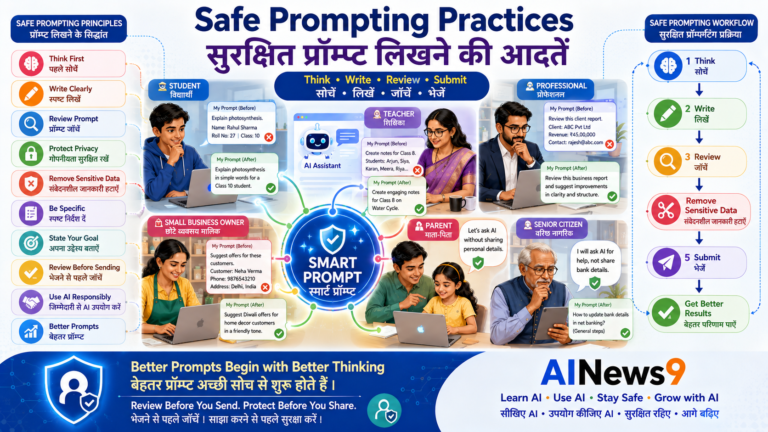
🛡️ How to Use ChatGPT Responsibly
Using ChatGPT wisely helps you get better results while avoiding common mistakes.
Follow these best practices:
- ✅ Ask clear and specific questions.
- ✅ Verify important information.
- ✅ Protect your personal and confidential data.
- ✅ Use ChatGPT to support your thinking—not replace it.
- ✅ Apply critical thinking before making important decisions.
- ✅ Be transparent when AI has helped create content.
- ✅ Respect copyright and intellectual property.
Responsible AI use helps people enjoy the benefits of ChatGPT while minimizing potential risks.
🚀 How Beginners Can Start Using ChatGPT
Getting started is easier than many people think.
Step 1
Create an account on the official ChatGPT platform.
Step 2
Start by asking simple questions.
For example:
- What is Machine Learning?
- Explain climate change in simple language.
- Help me write a professional email.
Step 3
Experiment with different types of prompts.
Try using ChatGPT for:
- Learning
- Writing
- Planning
- Brainstorming
- Research
- Productivity
You’ll quickly discover that better prompts usually lead to better responses.
Step 4
Practice regularly.
Like any tool, the more you use ChatGPT, the better you’ll understand how to communicate with it effectively.
Step 5
Continue building your AI literacy.
Learning how ChatGPT works—and understanding both its strengths and limitations—will help you use AI confidently, safely, and responsibly in your studies, career, and everyday life.
🎯 Key Takeaways
Congratulations!
You now understand one of the world’s most popular Artificial Intelligence applications.
Let’s quickly recap what you’ve learned about What is ChatGPT.
- ✅ ChatGPT is an AI-powered conversational assistant developed by OpenAI.
- ✅ It is powered by Large Language Models (LLMs) that understand and generate human language.
- ✅ ChatGPT can answer questions, explain concepts, generate content, summarize information, write code, and support many everyday tasks.
- ✅ Students, teachers, professionals, parents, entrepreneurs, and businesses use ChatGPT to improve learning and productivity.
- ✅ Although ChatGPT is highly capable, it can sometimes generate incorrect or outdated information.
- ✅ Human judgement, critical thinking, and responsible AI usage remain essential.
- ✅ Learning to communicate effectively with ChatGPT is becoming an important digital skill.
Understanding ChatGPT is an important step toward becoming AI literate and using Artificial Intelligence confidently in everyday life.
❓ Frequently Asked Questions (FAQs)
1. What is ChatGPT?
ChatGPT is an AI-powered conversational assistant developed by OpenAI. It understands natural language and helps users answer questions, generate content, learn new topics, write documents, brainstorm ideas, and complete many everyday tasks.
2. Who created ChatGPT?
ChatGPT was created by OpenAI, an Artificial Intelligence research and technology company.
The first public version of ChatGPT was released in November 2022, making AI accessible to millions of people worldwide.
3. Is ChatGPT free?
Yes.
ChatGPT offers a free version that is suitable for many everyday tasks.
There are also paid subscription plans that provide access to more advanced AI models, additional features, faster performance, and higher usage limits.
4. Is ChatGPT the same as Google?
No.
Although both help people find information, they work differently.
Google helps users discover information by showing links to websites.
ChatGPT generates conversational responses and explanations based on its AI model.
Many people use both tools together because they complement each other.
5. Can ChatGPT replace human intelligence?
No.
ChatGPT is designed to assist people—not replace them.
It cannot replace human creativity, emotions, ethics, judgement, or real-world experience.
The best results come when humans and AI work together.
6. Can students use ChatGPT?
Yes.
Students can use ChatGPT to:
- Understand difficult concepts
- Prepare study notes
- Practice interview questions
- Improve writing skills
- Brainstorm project ideas
However, students should use ChatGPT as a learning assistant rather than copying its responses without understanding them.
7. Is ChatGPT always correct?
No.
Like any AI system, ChatGPT can make mistakes.
It may occasionally generate incorrect facts, outdated information, or misleading responses.
Important information should always be verified using reliable sources.
8. Is ChatGPT safe to use?
Generally, yes—when used responsibly.
Avoid sharing sensitive information such as:
- Passwords
- Banking details
- Personal identification numbers
- Medical records
- Confidential business information
Protecting your privacy is an important part of responsible AI use.
9. Can ChatGPT create images?
Yes.
Depending on the version and features available, ChatGPT can help users create or edit images using AI image generation capabilities in addition to generating text.
10. What should I learn after ChatGPT?
Once you understand ChatGPT, the next logical step is learning about AI Agents.
AI Agents go beyond answering questions—they can plan tasks, use tools, make decisions within defined limits, and complete multi-step workflows.
🎓 Continue Your AI Learning Journey
Congratulations!
You’ve now completed another important milestone in your AI learning journey.
So far, you’ve explored:
- ✅ What is Artificial Intelligence?
- ✅ What is Generative AI?
- ✅ What is Machine Learning?
- ✅ What are Large Language Models (LLMs)?
- ✅ What is ChatGPT?
Each lesson has introduced a new building block of modern Artificial Intelligence.
The next step is to discover how AI is evolving from answering questions to performing tasks.
➡️ Next Article
What are AI Agents?
In the next lesson, you’ll learn:
- What AI Agents are
- How they differ from ChatGPT
- How AI Agents plan and complete tasks
- Real-world examples of AI Agents
- Benefits and limitations
- Why AI Agents are considered the next evolution of Artificial Intelligence
Understanding AI Agents will help you see where AI is heading in the years ahead.
📚 Recommended Resources for What is ChatGPT
To continue learning from trusted sources, explore these official resources:
- OpenAI – Learn more about ChatGPT and modern AI technologies.
- DeepLearning.AI – Access practical AI courses created by leading AI educators.
These resources complement this lesson and provide reliable information for learners who wish to deepen their understanding of AI.
💬 Final Thoughts about What is ChatGPT
ChatGPT has introduced millions of people to Artificial Intelligence by making it as simple as having a conversation.
Instead of learning complicated software or programming languages, anyone can now ask questions, generate ideas, solve problems, and explore new concepts using natural language.
This has transformed the way students learn, teachers teach, professionals work, entrepreneurs build businesses, and families interact with technology.
However, the true value of ChatGPT lies not in replacing human intelligence—but in enhancing it.
The most successful AI users are those who combine the speed of Artificial Intelligence with human creativity, ethics, critical thinking, and sound judgement.
As AI continues to evolve, learning how to use ChatGPT responsibly will become an increasingly valuable life skill.
By understanding both its capabilities and its limitations, you’ll be better prepared to use AI confidently, safely, and effectively in your personal, academic, and professional life.
About AINews9
AINews9 is India’s AI Literacy Platform with a mission to make Artificial Intelligence Simple, Useful & Safe for Every Indian.
Through beginner-friendly lessons, practical tutorials, AI safety awareness, and real-world examples, AINews9 helps students, teachers, parents, professionals, senior citizens, and small businesses confidently understand and use Artificial Intelligence.
Whether you’re taking your first steps into AI or expanding your knowledge of emerging technologies, AINews9 is here to support your learning journey—one lesson at a time.
After this Article “What is ChatGPT”
Next Article: What are AI Agents? A Beginner’s Guide