Avoiding AI Fraud: Practical Tips to Stay Safe Online
💳 A Practical Guide to Recognizing AI-Powered Financial Fraud, Identity Theft, and Online Deception
Avoiding AI Fraud:
Artificial Intelligence is making digital services faster and more convenient, but criminals are also using AI to make fraud more convincing. From voice cloning and fake customer support to identity theft and payment scams, AI-powered fraud is becoming increasingly sophisticated. The good news is that a few simple safety habits can significantly reduce your risk. In this guide, you’ll learn how AI fraud works, recognize common warning signs, and protect your money, identity, and personal information.
👥 Who Should Read This
This guide is especially useful for:
- 🎓 Students
- 👨👩👧 Parents
- 👩🏫 Teachers
- 💼 Professionals
- 👴 Senior Citizens
- 🏪 Small Business Owners
- 🌐 Anyone who uses online banking, UPI, digital wallets, or e-commerce services
No technical knowledge is required.
📖 What You’ll Learn
By the end of this guide, you’ll be able to:
- Understand what AI-powered fraud is.
- Learn how criminals misuse AI for financial crimes.
- Identify common warning signs.
- Protect your identity and digital payments.
- Verify suspicious requests before acting.
- Build safe financial habits for the AI era.
📚 In This Guide
💳 What Is AI Fraud?
AI fraud is the use of Artificial Intelligence to deceive people into revealing personal information, transferring money, or trusting fake identities.
Unlike traditional fraud, AI-powered fraud often appears more realistic because criminals can now generate:
- Human-like conversations
- Convincing emails
- Realistic voice recordings
- Fake identity documents
- Professional-looking invoices
- Personalized messages
The technology itself is not harmful.
The problem arises when criminals misuse AI to trick people into making costly mistakes.
Understanding these techniques is the first step toward protecting yourself.
🤖 How Criminals Use AI
Artificial Intelligence allows fraudsters to automate and improve many traditional scams.
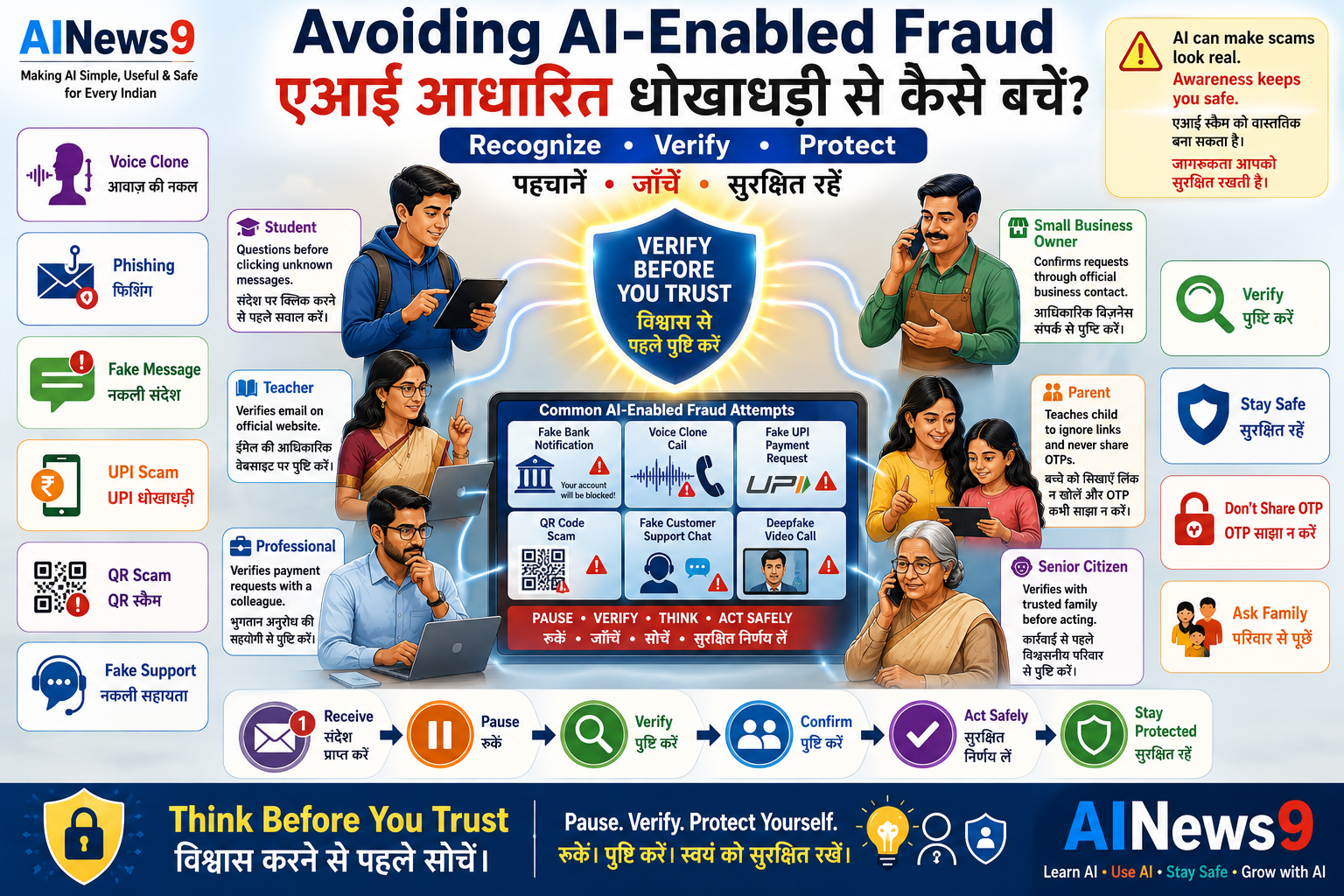
Some common examples include:
🎙️ Voice Cloning
AI can imitate someone’s voice using a short audio sample.
A scammer may pretend to be:
- A family member
- Your manager
- A bank representative
- A friend requesting urgent financial help
Always verify unexpected requests through another trusted communication channel.
📧 Fake Emails and Messages
AI can generate emails and messages that appear professional and convincing.
These messages may:
- Request urgent payments
- Ask you to update account details
- Direct you to fake websites
- Encourage you to click malicious links
Always verify unexpected requests before taking action.
🧾 Fake Invoices
Businesses are increasingly targeted with AI-generated invoices that closely resemble genuine supplier bills.
These invoices may include:
- Company logos
- Professional formatting
- Fake payment details
- Urgent payment requests
Always confirm payment requests directly with the supplier before transferring money.
👤 Identity Theft
Criminals may combine AI with stolen personal information to impersonate individuals online.
They may attempt to:
- Open fraudulent accounts
- Apply for financial services
- Access online accounts
- Convince others that they are someone else
Protecting your personal information makes identity theft much more difficult.
📱 Fake Customer Support
Some fraudsters create AI-powered chatbots or fake customer support accounts that appear to represent banks, courier companies, shopping websites, or technology providers.
Their goal is to collect:
- Passwords
- OTPs
- Banking details
- Personal information
Remember:
Legitimate organizations will never ask for your passwords or OTPs.
💰 Common Types of AI Fraud
AI is being used across many different types of financial fraud.
Some of the most common include:
- UPI payment fraud
- Fake banking calls
- Investment fraud
- Identity theft
- Online shopping fraud
- Fake QR code scams
- Business payment fraud
- Loan application fraud
- Fake customer support scams
- Employment-related payment fraud
Although the methods may differ, they all rely on one thing:
Convincing you to trust something that isn’t genuine.
💳 STOP • VERIFY • PAY™
Before sending money online, remember this simple AINews9 framework.
🛑 STOP
Never make financial decisions under pressure.
Fraudsters often create urgency to stop you from thinking clearly.
✅ VERIFY
Confirm:
- The person’s identity.
- The phone number.
- The bank account.
- The payment request.
- The organization involved.
Use an official contact number—not the one provided in the suspicious message.
💸 PAY
Only complete the payment after independent verification.
Taking a few extra minutes can prevent significant financial loss.
⚠️ Safety Alert
No genuine bank, government agency, or trusted company will ask you to share your OTP, banking password, UPI PIN, or complete a payment simply because you received a phone call, email, or message.
🛡️ AINews9 Safety Tip #1
Fraudsters want you to act quickly. Responsible digital users pause, verify, and then decide.
✅ Safe Practice
If you receive an unexpected request for money—even from someone who sounds familiar—end the conversation politely and contact the person using a phone number or communication method you already know is genuine.
Independent verification is one of the most effective ways to prevent AI-powered fraud.
🚩 Warning Signs of AI Fraud
AI-powered fraud often looks professional and convincing.
Fortunately, there are common warning signs that can help you identify suspicious requests before they become costly mistakes.
🚨 Unexpected Urgency
Fraudsters often try to create panic.
You may receive messages such as:
- “Your bank account will be blocked.”
- “Your UPI account has been suspended.”
- “Transfer money immediately.”
- “Your family member needs emergency help.”
Urgency is designed to stop you from thinking carefully.
Whenever someone pressures you to act immediately, pause and verify.
🎭 Requests That Feel Unusual
Be cautious if someone unexpectedly asks you to:
- Transfer money.
- Share your OTP.
- Reveal your banking password.
- Scan an unknown QR code.
- Download unfamiliar software.
- Click an unexpected link.
Even if the request appears to come from someone you know, verify it independently.
📱 Unknown Phone Numbers or Email Addresses
Scammers often use:
- Similar-looking email addresses.
- Unknown mobile numbers.
- Fake company names.
- Misspelled website addresses.
Always verify the sender before responding.
💸 Requests for Confidential Information
Legitimate organizations do not ask customers to reveal:
- OTPs
- UPI PINs
- ATM PINs
- Net banking passwords
- Credit card CVV numbers
Treat any such request as suspicious.
🔗 Suspicious Links and QR Codes
AI-generated messages may contain convincing links or QR codes.
Before clicking or scanning:
- Check the website address carefully.
- Verify who sent it.
- Avoid clicking shortened or unfamiliar links.
- Confirm payment requests independently.
One careless click can expose personal information.
🔒 How to Protect Yourself from AI-Powered Financial Crime
Good digital safety is built through simple daily habits.
The following practices greatly reduce the risk of becoming a victim.
✅ Verify Every Payment Request
Before sending money:
- Call the person directly.
- Confirm the account details.
- Verify the reason for payment.
- Don’t rely only on text messages or emails.
Independent verification is one of the strongest defenses against fraud.
✅ Enable Multi-Factor Authentication (MFA)
Whenever available, enable Multi-Factor Authentication for:
- Banking apps
- Email accounts
- Social media
- Digital wallets
- Business accounts
Even if someone learns your password, MFA provides an additional layer of protection.
✅ Protect Your Personal Information
Avoid sharing:
- Aadhaar number
- PAN details
- Passport information
- Banking credentials
- Personal identity documents
The less information criminals have, the harder it becomes to impersonate you.
✅ Keep Software Updated
Install updates for:
- Smartphones
- Computers
- Banking applications
- Web browsers
- Operating systems
Security updates often fix vulnerabilities that criminals may try to exploit.
💳 STOP • VERIFY • PAY™
Whenever money is involved:
🛑 STOP before reacting emotionally.
✅ VERIFY independently.
💸 PAY only after confirmation.
Following these three steps can prevent many financial frauds.
🎓 Safety Tips for Students
Students are increasingly using digital payments and online services.
Good habits include:
- Never sharing OTPs.
- Being cautious of fake scholarship offers.
- Verifying internship opportunities.
- Avoiding suspicious payment requests.
- Asking parents or teachers when unsure.
Learning financial safety early creates lifelong protection.
👨👩👧 Advice for Families
Families should openly discuss online fraud.
Simple family rules can include:
- Verify unexpected payment requests.
- Never share banking credentials.
- Confirm emergencies through a direct phone call.
- Teach children about online scams.
- Help senior family members verify suspicious messages.
Working together makes families safer.
💼 Best Practices for Professionals
Professionals may receive AI-generated fraud attempts targeting:
- Business payments
- Vendor invoices
- Executive impersonation
- Client communications
Before approving payments:
- Verify supplier details.
- Confirm unusual requests.
- Follow company approval processes.
- Double-check account changes.
Professional caution protects both individuals and organizations.
🏪 Protecting Small Businesses
Small businesses are frequent targets because they often process payments quickly.
Business owners should:
- Verify vendor invoices.
- Confirm banking changes by phone.
- Train employees to recognize fraud.
- Use role-based payment approvals.
- Enable account security features.
Good business processes reduce financial risk.
⚠️ Safety Alert
AI can make fraud appear more convincing, but it cannot replace independent verification. A simple phone call can prevent significant financial loss.
🛡️ AINews9 Safety Tip #2
When money is involved, trust should never replace verification. Even familiar voices, emails, or messages should be confirmed independently.
🌟 Everyday Financial Safety Habits
Develop these habits:
- Think before paying.
- Verify every unusual request.
- Protect your personal information.
- Keep your devices secure.
- Stay informed about new fraud techniques.
- Encourage family members to follow safe digital practices.
These small habits can prevent major financial problems.
✅ Safe Practice
If someone asks you to transfer money urgently, tell them:
“I’ll verify this request first and call you back.”
This simple response gives you time to think, confirm the request, and avoid acting under pressure.
🚫 Common Mistakes That Lead to Financial Fraud
Many victims of AI-powered fraud are not careless.
They are simply caught off guard by convincing messages, urgent requests, or realistic-looking conversations.
Understanding these common mistakes can help you avoid becoming a victim.
| ❌ Common Mistake | ✅ Better Practice |
|---|---|
| Acting immediately because someone says it’s an emergency | Stay calm and verify the request independently. |
| Trusting a familiar voice without verification | Call the person back using a known phone number. |
| Sharing OTPs or UPI PINs | Never share banking credentials with anyone. |
| Scanning unknown QR codes | Verify who sent the QR code and why. |
| Clicking links in unexpected messages | Visit the official website or app directly. |
| Approving payments without checking account details | Confirm the recipient before sending money. |
Remember:
Fraud succeeds when urgency replaces careful thinking.
🌟 Best Practices for Safe Digital Payments
Digital payments are fast and convenient—but they should always be made carefully.
Follow these habits every time you send money online.
✅ Verify Before Every Payment
Always confirm:
- The recipient’s identity.
- Bank account details.
- UPI ID.
- Payment amount.
- Purpose of the payment.
A quick verification can prevent significant financial loss.
✅ Use Official Banking Apps
Download banking and payment applications only from:
- Official app stores
- Your bank’s official website
Avoid installing apps from links received through SMS, email, or messaging apps.
✅ Enable Security Features
Protect your financial accounts by enabling:
- Multi-Factor Authentication (MFA)
- Device lock
- Biometric authentication
- Transaction alerts
These features provide additional protection even if someone learns your password.
✅ Review Transactions Regularly
Check your bank statements and payment history frequently.
Early detection allows you to report suspicious activity quickly.
💳 STOP • VERIFY • PAY™
Before every payment, remember:
🛑 STOP — Never rush.
✅ VERIFY — Confirm independently.
💸 PAY — Transfer money only after verification.
Making this a daily habit can protect you from many forms of AI-powered fraud.
🛡️ AINews9 Safety Tip #3
The safest payment is not the fastest payment—it’s the payment you make after careful verification.
🌍 Building Long-Term Financial Safety Habits
Technology will continue to evolve.
Fraud techniques will also become more sophisticated.
Fortunately, good habits remain effective regardless of how technology changes.
Develop these habits:
- Verify unusual requests.
- Protect personal information.
- Think before making payments.
- Keep devices updated.
- Learn about emerging fraud techniques.
- Encourage family members to follow safe digital practices.
Responsible habits are your strongest long-term defense.
📝 Key Takeaways
Congratulations!
You now understand how Artificial Intelligence is changing financial fraud—and how you can protect yourself.
Remember these important lessons:
- ✅ AI can make fraud more convincing.
- ✅ Never share OTPs, passwords, or UPI PINs.
- ✅ Verify payment requests independently.
- ✅ Be cautious of urgent financial requests.
- ✅ Confirm identities before transferring money.
- ✅ Protect your personal information.
- ✅ Use trusted banking applications.
- ✅ Follow the STOP • VERIFY • PAY™ framework.
❓ Frequently Asked Questions
1. What is AI fraud?
AI fraud involves the misuse of Artificial Intelligence to deceive people into revealing personal information, transferring money, or trusting fake identities.
Examples include voice cloning, fake customer support, AI-generated emails, and identity theft.
2. Can AI clone someone’s voice?
Yes.
Modern AI systems can create realistic voice imitations using a short audio sample.
Always verify unexpected requests through another trusted communication channel.
3. Is it safe to scan QR codes?
Only scan QR codes from trusted and verified sources.
Never scan unknown QR codes received through unsolicited messages or emails.
4. Can banks ask for OTPs or UPI PINs?
No.
Legitimate banks and payment providers will never ask for your OTP, UPI PIN, ATM PIN, or passwords.
5. How can I protect myself from AI fraud?
Follow these simple steps:
- Verify identities.
- Protect personal information.
- Never act under pressure.
- Use Multi-Factor Authentication.
- Review financial transactions regularly.
6. Are senior citizens more vulnerable to AI fraud?
Yes.
Fraudsters often target senior citizens through convincing phone calls and messages.
Family discussions and verification habits provide strong protection.
7. Can businesses also become victims?
Absolutely.
Businesses are frequently targeted through fake invoices, supplier impersonation, executive fraud, and payment diversion schemes.
Verification procedures are essential.
8. What is the simplest financial safety rule?
Remember:
STOP • VERIFY • PAY™
Never send money until you’ve independently confirmed the request.
📚 Trusted Resources
For trusted guidance on digital payment safety and cyber fraud, refer to:
- Reserve Bank of India (RBI) – Safe Digital Banking Guidelines
- National Cyber Crime Reporting Portal (India)
- CERT-In (Indian Computer Emergency Response Team)
- Google Safety Center
- Microsoft Security
- AINews9 Stay Safe Series
Always use official websites and verified customer support channels when seeking financial assistance.
💬 Final Thoughts
Artificial Intelligence is transforming banking, digital payments, and online services in many positive ways.
Unfortunately, it is also giving fraudsters new tools to make deception appear more convincing.
The best protection isn’t fear—it’s awareness.
By developing simple habits such as verifying requests, protecting personal information, and slowing down before making financial decisions, you can confidently enjoy the benefits of digital technology while reducing your risk.
Remember:
Technology may continue to evolve, but careful thinking, independent verification, and responsible decision-making will always remain your strongest protection against fraud.
🎓 Continue Your AI Journey
Continue building your AI knowledge with AINews9.
📘 Learn AI
- L001 – What is Artificial Intelligence?
- L002 – What is Generative AI?
- L003 – What is Machine Learning?
- L004 – What are Large Language Models (LLMs)?
- L005 – What is ChatGPT?
- L006 – What are AI Agents?
- L007 – What is Prompt Engineering?
- L008 – How Does AI Work?
- L009 – History of Artificial Intelligence
- L010 – AI Terminology Explained
🛠️ Use AI
- U001 – How Students Can Use AI Effectively
- U002 – How Teachers Can Use AI in Education
- U003 – How Professionals Can Use AI at Work
- U004 – How Small Businesses Can Use AI
- U005 – Beginner’s Guide to ChatGPT
- U006 – Beginner’s Guide to Gemini
- U007 – Beginner’s Guide to Claude
- U008 – Beginner’s Guide to NotebookLM
- U009 – AI for Everyday Productivity
- U010 – 10 Best AI Tools for Beginners
🛡️ Stay Safe
- S001 – AI Safety for Beginners
- S002 – What Are Deepfakes?
- S003 – AI Scams and How to Avoid Them
- S004 – AI Safety for Children & Parents
- S005 – AI and Data Privacy
- S006 – Safe Prompting Practices
- S007 – AI Misinformation: How to Identify Fake AI Content
- S008 – Avoiding AI Fraud: Practical Tips to Stay Safe Online ✅
- S009 – AI Ethics Explained
- S010 – AI Safety Checklist
About AINews9
AINews9 is India’s AI Literacy Platform dedicated to making Artificial Intelligence Simple, Useful & Safe for Every Indian.
We empower:
- 🎓 Students
- 👩🏫 Teachers
- 👨👩👧 Parents
- 💼 Professionals
- 👴 Senior Citizens
- 🏪 Small Business Owners
Through our four learning pillars:
- 📘 Learn AI
- 🛠️ Use AI
- 🛡️ Stay Safe
- 🚀 Grow with AI
Together, we’re helping every Indian build the knowledge, confidence, and financial awareness needed to use Artificial Intelligence safely and responsibly.