AI Scams and How to Avoid Them
🚨 A Simple & Practical Guide to Protecting Yourself from AI-Powered Fraud and Online Scams
Artificial Intelligence is making our lives easier in many ways—but it is also giving scammers new tools to deceive people.
Today, criminals can use AI to clone voices, create fake videos, write convincing phishing emails, impersonate trusted organizations, and launch sophisticated online scams.
The good news is that most AI scams can be prevented if you know what warning signs to look for.
At AINews9, we believe that you don’t need to fear AI—you need to understand it.
In this practical guide, you’ll learn how modern AI scams work, discover the most common fraud techniques, and explore simple steps you can take to protect yourself, your family, and your business.
👥 Who Should Read This
This guide is ideal for:
- 🎓 Students
- 👨👩👧 Parents
- 👩🏫 Teachers
- 💼 Professionals
- 👴 Senior Citizens
- 🏪 Small Business Owners
- 💳 Online Banking Users
- 📱 Social Media Users
No technical knowledge is required.
📖 What You’ll Learn
By the end of this guide, you’ll be able to:
- Understand how scammers use Artificial Intelligence.
- Recognize the most common AI-powered scams.
- Identify warning signs before becoming a victim.
- Learn practical ways to protect yourself.
- Know what to do if you encounter an AI scam.
📚 In This Guide
🤖 What Are AI Scams?
AI scams are fraudulent activities in which criminals use Artificial Intelligence to deceive people into sharing money, personal information, passwords, or confidential data.
Unlike traditional scams, AI-powered scams often appear much more convincing because AI can imitate:
- Human voices
- Photographs
- Videos
- Emails
- Text messages
- Chat conversations
This makes it harder to distinguish genuine communication from fraudulent attempts.
Fortunately, understanding how these scams work is the first step toward staying safe.
📈 Why Are AI Scams Increasing?
Artificial Intelligence tools are becoming more powerful, affordable, and widely available.
While this has created exciting opportunities for education, business, and productivity, it has also lowered the barrier for cybercriminals.
Today, scammers can generate professional-looking emails, clone voices, create fake videos, and automate conversations with very little effort.
Instead of sending poorly written scam messages, criminals can now create highly personalized attacks that appear genuine.
As AI technology improves, scams are becoming:
- More realistic
- More personalized
- Harder to detect
- Faster to create
- Easier to scale
This is why AI awareness has become an essential part of digital safety.
⚠️ Safety Alert
If a message creates urgency, fear, or excitement and asks you to act immediately, pause before responding. Scammers often rely on emotional pressure to prevent people from thinking carefully.
🚨 10 Common AI Scams You Should Know
Let’s explore the most common AI-enabled scams that people encounter today.
Understanding these examples will help you recognize suspicious situations before they become costly mistakes.
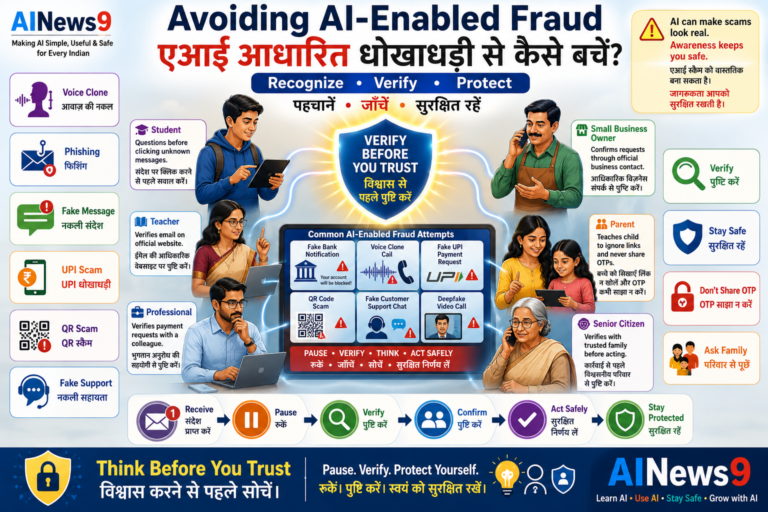
🎙️ 1. AI Voice Cloning Scam
One of the fastest-growing AI scams involves voice cloning.
Scammers use Artificial Intelligence to imitate the voice of a family member, friend, or colleague.
You may receive a phone call saying:
“I’m in an emergency. Please send money immediately.”
Because the voice sounds familiar, many people react emotionally instead of verifying the request.
🚩 Warning Signs
- Unexpected emergency requests.
- Pressure to act immediately.
- Requests for money or gift cards.
- Refusal to join a normal phone or video call.
✅ How to Stay Safe
- Hang up and call the person directly using a known phone number.
- Verify the situation with another family member.
- Never transfer money based on a single phone call.
🎭 2. Deepfake Video Scam
Scammers can create AI-generated videos that appear to show a trusted person speaking.
Examples include:
- Company executives
- Celebrities
- Government officials
- Family members
These videos may encourage viewers to:
- Invest money.
- Share personal information.
- Click malicious links.
- Believe false news.
🚩 Warning Signs
- Poor lip synchronization.
- Strange facial movements.
- Unverified social media accounts.
- Sensational claims without reliable sources.
✅ How to Stay Safe
- Verify the source.
- Look for official announcements.
- Confirm information using trusted news organizations.
📧 3. AI Phishing Emails
Traditional phishing emails were often easy to identify because they contained spelling mistakes or poor grammar.
AI has changed that.
Today’s phishing emails can be:
- Professionally written.
- Personalized.
- Grammatically correct.
- Convincing enough to appear legitimate.
These emails may pretend to come from:
- Banks
- Delivery companies
- Government departments
- Employers
- Online shopping websites
Their goal is usually to trick you into clicking malicious links or revealing sensitive information.
🚩 Warning Signs
- Requests to “verify your account.”
- Unexpected attachments.
- Suspicious links.
- Urgent payment requests.
✅ How to Stay Safe
- Never click links without checking the sender.
- Visit official websites directly instead of using links in emails.
- Enable multi-factor authentication wherever possible.
🛡️ AINews9 Safety Tip #1
Scammers succeed when people react quickly. The safest response is often the simplest one—pause, verify, and think before you click, reply, or send money.
✅ Safe Practice
Whenever someone asks for money, passwords, OTPs, banking details, or confidential information, verify the request through an independent communication channel before taking any action.
💬 4. Fake Customer Support Chatbots
Many companies now use AI chatbots to provide customer support.
Unfortunately, scammers have started creating fake AI chatbots that imitate well-known banks, e-commerce websites, courier companies, and technology brands.
These fake chatbots often appear on:
- Fake websites
- Social media advertisements
- Messaging apps
- Search engine advertisements
- Fraudulent customer support pages
Their goal is to collect:
- Banking information
- Credit card details
- OTPs
- Passwords
- Personal information
🚩 Warning Signs
- Asking for OTPs or passwords
- Requesting remote access to your computer or phone
- Poor website address (URL)
- Unverified customer support numbers
- Pressure to act immediately
✅ How to Stay Safe
- Visit the company’s official website directly.
- Use customer support numbers listed on official websites.
- Never share OTPs, PINs, or passwords.
- Verify website addresses carefully.
❤️ 5. AI Romance Scams
Romance scams have existed for years, but AI has made them far more convincing.
Scammers now use:
- AI-generated profile photos
- AI-enhanced conversations
- Voice cloning
- Fake video messages
They gradually build trust before asking for:
- Money
- Gifts
- Cryptocurrency
- Personal information
Many victims don’t realize they are speaking to a scammer until significant financial or emotional damage has occurred.
🚩 Warning Signs
- Refusing to meet in person
- Frequent excuses
- Requests for financial help
- Emotional pressure
- Extremely fast relationship development
✅ How to Stay Safe
- Never send money to someone you’ve never met.
- Verify identities through video calls.
- Discuss concerns with trusted family members.
- Be cautious if someone avoids real-life interaction.
💼 6. Fake Job Offer Scams
Artificial Intelligence allows scammers to create highly professional-looking job advertisements.
These fake opportunities may promise:
- High salaries
- Remote work
- Guaranteed selection
- Immediate joining
- Minimal qualifications
Victims are often asked to pay for:
- Registration
- Training
- Equipment
- Background verification
- Visa processing
Legitimate employers rarely ask candidates to pay money during recruitment.
🚩 Warning Signs
- Upfront payment requests
- Unrealistically high salaries
- No interview process
- Generic company email addresses
- Poor online presence
✅ How to Stay Safe
- Research the company.
- Apply through official career websites.
- Verify recruiter identities on LinkedIn.
- Never pay recruitment fees.
💸 7. AI Investment & Crypto Scams
AI-generated advertisements often feature fake videos of celebrities or business leaders recommending investment opportunities.
These advertisements promise:
- Guaranteed returns
- Zero risk
- Quick profits
- Exclusive investment opportunities
Once victims invest money, the scammers disappear.
🚩 Warning Signs
- Guaranteed profits
- “Limited-time” investment offers
- Celebrity endorsements without official confirmation
- Pressure to invest immediately
✅ How to Stay Safe
- Verify investment companies.
- Research independently.
- Consult licensed financial advisors.
- Never invest based on social media videos alone.
⚠️ Safety Alert
No legitimate investment can guarantee high returns without risk. If an offer sounds too good to be true, it probably is.
🎁 8. Giveaway & Lottery Scams
AI enables scammers to create convincing promotional campaigns.
You may receive messages claiming:
- You’ve won a smartphone.
- You’ve won a car.
- You’ve been selected for an exclusive giveaway.
- You’ve received an international lottery prize.
The scam usually asks for:
- Processing fees
- Banking information
- Identity documents
- OTPs
Remember:
You cannot win a competition you never entered.
🚩 Warning Signs
- Unexpected prizes
- Requests for payment
- Poor website quality
- Fake social media accounts
✅ How to Stay Safe
- Ignore unexpected prize messages.
- Verify promotions on official company websites.
- Never pay to claim a prize.
📱 9. WhatsApp & Social Media Impersonation
Scammers frequently create fake accounts pretending to be:
- Friends
- Family members
- Celebrities
- Company representatives
- Government officials
Using AI-generated profile pictures and realistic conversations, they attempt to gain trust.
They may ask for:
- Emergency financial help
- OTPs
- Account verification
- Donations
- Gift cards
🚩 Warning Signs
- Newly created accounts
- Different phone numbers
- Requests for secrecy
- Urgent financial requests
✅ How to Stay Safe
- Verify identities through a direct phone call.
- Don’t rely only on profile pictures.
- Report fake accounts.
🛒 10. Fake AI Shopping Websites
Scammers increasingly create professional-looking online stores using AI-generated product descriptions and images.
These fake websites often advertise:
- Massive discounts
- Limited-time offers
- Luxury products at unbelievable prices
After payment, customers receive:
- Counterfeit products
- Poor-quality items
- Nothing at all
🚩 Warning Signs
- Extremely low prices
- No customer reviews
- Poor contact information
- No return policy
- Newly registered websites
✅ How to Stay Safe
- Buy from trusted retailers.
- Read customer reviews.
- Use secure payment methods.
- Check website reputation before purchasing.
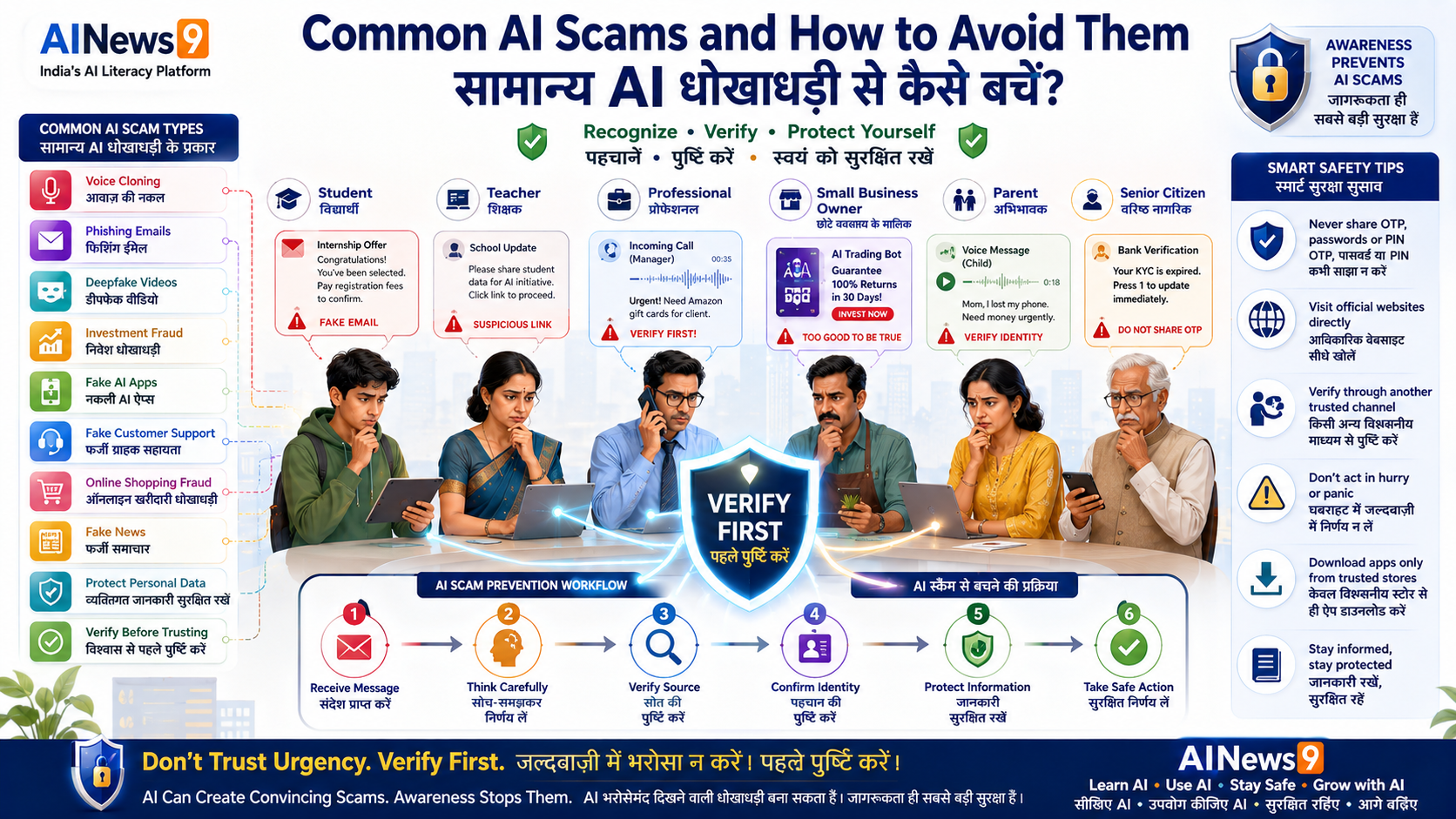
👨👩👧 AI Scam Safety for Different Users
Different people face different risks.
🎓 Students
- Be cautious of fake scholarship offers.
- Verify internship opportunities.
- Never share examination credentials.
👩🏫 Teachers
- Verify educational platform communications.
- Protect student records.
- Confirm unusual payment requests.
💼 Professionals
- Verify executive requests.
- Follow company security policies.
- Protect confidential business information.
👨👩👧 Parents
- Teach children about online scams.
- Monitor suspicious online interactions.
- Encourage open communication.
👴 Senior Citizens
Senior citizens are often targeted because scammers rely on trust and urgency.
Always:
- Verify unexpected calls.
- Consult family members before transferring money.
- Ignore pressure tactics.
🏪 Small Business Owners
Business owners should:
- Train employees to recognize scams.
- Verify supplier payment requests.
- Use multi-factor authentication.
- Protect customer information.
🛡️ AINews9 Safety Tip #2
Scammers may use Artificial Intelligence, but they still rely on one thing—earning your trust. Verify every unusual request before taking action.
✅ Safe Practice
Create a family safety rule:
No money transfers, password sharing, or confidential information should ever be shared without independent verification through a trusted communication channel.
This simple habit can prevent many AI-enabled scams.
🛡️ Best Practices to Protect Yourself from AI Scams
The good news is that you don’t need to be a cybersecurity expert to stay safe from AI-powered scams.
Most scams can be prevented by following a few simple habits consistently.
Let’s look at the best practices every AI user should adopt.
✅ Verify Before You Trust
Scammers often create messages that look genuine.
Before believing any unexpected communication:
- Verify the sender’s identity.
- Contact the person or organization through an official phone number or website.
- Be cautious of urgent requests.
- Trust verification—not assumptions.
Remember:
A two-minute verification can prevent a major financial loss.
✅ Never Share Sensitive Information
No legitimate organization will ask you to share confidential information through email, WhatsApp, SMS, or AI chatbots.
Never share:
- Passwords
- OTPs
- ATM PINs
- CVV numbers
- Aadhaar details
- PAN details
- Banking passwords
- Confidential business information
If someone asks for this information, treat it as a warning sign.
✅ Enable Multi-Factor Authentication (MFA)
Even if someone steals your password, Multi-Factor Authentication (MFA) adds an additional layer of security.
Whenever possible:
- Enable MFA.
- Use authentication apps.
- Keep recovery information updated.
This simple step can prevent unauthorized access to your accounts.
✅ Keep Software Updated
Many scams exploit outdated software.
Regularly update:
- Smartphones
- Computers
- Browsers
- Banking apps
- Operating systems
Updates often include important security improvements.
🛡️ AINews9 Safety Tip #3
Technology changes quickly—but one safety habit never goes out of date: verify before you trust.
🚫 Common Mistakes That Help Scammers
Many victims don’t lose money because scammers are highly skilled.
They lose money because they react too quickly.
Avoid these common mistakes.
| ❌ Common Mistake | ✅ Better Practice |
|---|---|
| Acting immediately during emergencies | Pause and verify |
| Trusting familiar voices automatically | Confirm through another communication channel |
| Clicking links without checking | Visit official websites directly |
| Sharing OTPs | Never share OTPs with anyone |
| Believing guaranteed investment returns | Research independently |
| Ignoring security warnings | Take warnings seriously |
Remember:
Scammers succeed when people react emotionally instead of thinking carefully.
🚨 What Should You Do If You Become a Victim?
Even careful people can become victims of sophisticated scams.
If you suspect you’ve been targeted:
1️⃣ Stop Communication
End the conversation immediately.
Do not continue chatting, emailing, or transferring money.
2️⃣ Contact Your Bank
If financial information has been shared:
- Block cards if necessary.
- Freeze suspicious transactions.
- Inform your bank immediately.
Quick action can reduce financial loss.
3️⃣ Change Your Passwords
Update passwords for:
- Banking
- Social media
- Shopping websites
If possible, enable Multi-Factor Authentication.
4️⃣ Report the Scam
Report fraudulent activity through the appropriate cybercrime reporting channels in your country.
Reporting scams helps protect others from becoming victims.
5️⃣ Inform Family Members
If scammers have impersonated you or a family member, let your contacts know.
This can prevent additional people from being deceived.
⚠️ Safety Alert
Feeling embarrassed is normal—but staying silent allows scammers to target more people. Report suspicious activity as soon as possible.
🌍 Building a Scam-Resistant Mindset
Technology alone cannot stop scams.
The strongest protection is developing the right mindset.
Responsible AI users:
- Think critically.
- Verify information.
- Stay calm under pressure.
- Protect their personal information.
- Continue learning about new scam techniques.
The goal isn’t to become suspicious of everything.
The goal is to become thoughtful before taking action.
📝 Key Takeaways
Congratulations!
You now understand how Artificial Intelligence is changing the landscape of online scams.
Here are the most important lessons to remember:
- ✅ AI scams are becoming more convincing.
- ✅ Voice cloning and deepfakes can imitate real people.
- ✅ Verify unexpected requests independently.
- ✅ Never share passwords, OTPs, or banking information.
- ✅ Be cautious of urgent requests involving money.
- ✅ Enable Multi-Factor Authentication whenever possible.
- ✅ Report scams to help protect others.
- ✅ Staying informed is your best defense.
❓ Frequently Asked Questions
1. What is an AI scam?
An AI scam is a fraud in which criminals use Artificial Intelligence to make scams appear more convincing.
Examples include voice cloning, deepfake videos, phishing emails, fake chatbots, and impersonation scams.
2. Can AI really copy someone’s voice?
Yes.
Modern AI systems can create realistic voice clones using only a short audio sample.
This is why it’s important to verify unexpected phone calls requesting money or confidential information.
3. Are AI scams becoming more common?
Yes.
As AI tools become more accessible, scammers are increasingly using them to automate and improve traditional fraud techniques.
4. How can I recognize an AI scam?
Look for:
- Urgent requests
- Emotional pressure
- Requests for money
- Requests for OTPs or passwords
- Suspicious links
- Unverified websites
- Unusual communication channels
When in doubt, verify independently.
5. Should I trust AI-generated customer support?
Only if it is available through an official company website or verified application.
Never trust customer support links received through unsolicited messages.
6. What should I do if I accidentally shared my banking details?
Immediately contact your bank, block your cards if necessary, change passwords, and report the incident.
Quick action can reduce potential losses.
7. Can senior citizens protect themselves from AI scams?
Absolutely.
Simple habits such as verifying unexpected requests, discussing suspicious messages with family members, and never acting under pressure provide strong protection.
8. What is the best defense against AI scams?
The best defense is simple:
Pause • Verify • Think
Those three habits prevent many scams before they succeed.
📚 Trusted Resources
Learn more about online safety and scam prevention from trusted organizations:
- National Cyber Crime Reporting Portal (India)
- RBI – Safe Digital Banking Guidelines
- Google Safety Center
- Microsoft Security
- OpenAI Safety Resources
- AINews9 Stay Safe Series
Always rely on official sources for financial and cybersecurity guidance.
💬 Final Thoughts
Artificial Intelligence is making many aspects of life easier—but it is also changing the way scammers operate.
Fortunately, technology alone does not determine whether a scam succeeds.
Human awareness does.
By staying informed, thinking critically, verifying unusual requests, and protecting your personal information, you can confidently enjoy the benefits of AI while avoiding many of its risks.
Remember:
Scammers use Artificial Intelligence to appear smarter. You stay safer by becoming more informed.
Knowledge, awareness, and careful decision-making remain your strongest protection.
🎓 Continue Your AI Journey
Continue building your AI knowledge with AINews9.
📘 Learn AI
- L001 – What is Artificial Intelligence?
- L002 – What is Generative AI?
- L003 – What is Machine Learning?
- L004 – What are Large Language Models (LLMs)?
- L005 – What is ChatGPT?
- L006 – What are AI Agents?
- L007 – What is Prompt Engineering?
- L008 – How Does AI Work?
- L009 – History of Artificial Intelligence
- L010 – AI Terminology Explained
🛠️ Use AI
- U001 – How Students Can Use AI Effectively
- U002 – How Teachers Can Use AI in Education
- U003 – How Professionals Can Use AI at Work
- U004 – How Small Businesses Can Use AI
- U005 – Beginner’s Guide to ChatGPT
- U006 – Beginner’s Guide to Gemini
- U007 – Beginner’s Guide to Claude
- U008 – Beginner’s Guide to NotebookLM
- U009 – AI for Everyday Productivity
- U010 – 10 Best AI Tools for Beginners
🛡️ Stay Safe
- S001 – AI Safety for Beginners
- S002 – What Are Deepfakes?
- S003 – AI Scams and How to Avoid Them ✅
- S004 – AI Misinformation
- S005 – AI & Data Privacy
- S006 – Safe Prompting Practices
- S007 – AI for Children & Parents
- S008 – Responsible AI Use
- S009 – AI Ethics Explained
- S010 – AI Safety Checklist
🚀 Grow with AI
- G001 – AI Skills for Everyone
- G002 – AI Career Roadmap
- G003 – AI Career Opportunities
- G004 – AI Certifications
- G005 – Future AI Skills
- G006 – Future of Work in the AI Era
- G007 – AI Entrepreneurship
- G008 – AI for Business Growth
- G009 – Building an AI Mindset
- G010 – Your AI Learning Journey
Every lesson helps you become a smarter, safer, and more confident AI user.
🏛️ About AINews9
AINews9 is India’s AI Literacy Platform dedicated to making Artificial Intelligence Simple, Useful & Safe for Every Indian.
We empower:
- 🎓 Students
- 👩🏫 Teachers
- 👨👩👧 Parents
- 💼 Professionals
- 👴 Senior Citizens
- 🏪 Small Business Owners
Through our four learning pillars:
- 📘 Learn AI
- 🛠️ Use AI
- 🛡️ Stay Safe
- 🚀 Grow with AI
Together, let’s build an AI-literate India where every citizen can recognize opportunities, avoid AI-powered risks, and use Artificial Intelligence safely and responsibly.