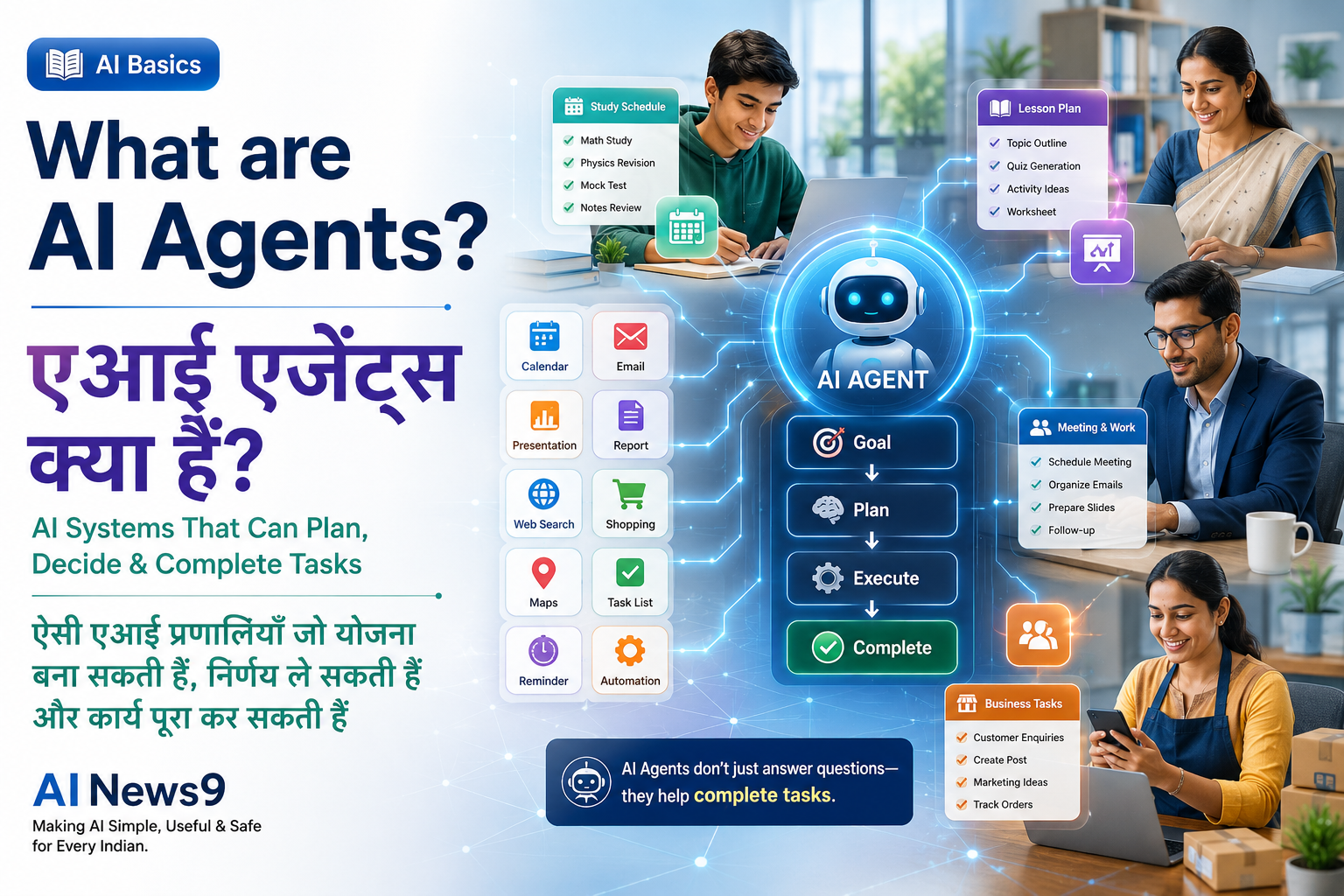
What are AI Agents? A Beginner’s Guide
📝 SEO Introduction
What are AI Agents? AI Agents are intelligent software systems that can understand goals, make decisions, use tools, and perform tasks with minimal human guidance. In this beginner-friendly guide, you’ll learn what AI Agents are, how they work, how they differ from ChatGPT, and why they represent the next evolution of Artificial Intelligence.
👥 Who Should Read This?
This lesson is designed for anyone who wants to understand What are AI Agents in simple, practical language without requiring a technical background.
It is especially useful for:
- 🎓 Students curious about the future of Artificial Intelligence
- 👩🏫 Teachers exploring next-generation AI tools
- 👨👩👧 Parents helping children understand emerging technologies
- 💼 Professionals looking to automate repetitive work
- 👴 Senior citizens interested in the future of AI assistants
- 🏪 Small business owners exploring AI-powered productivity
No programming or technical knowledge is required.
📖 What You’ll Learn
By the end of this lesson, you’ll be able to:
- Understand what are AI Agents?
- Learn how AI Agents differ from chatbots and AI assistants.
- Discover how AI Agents plan, reason, and perform tasks.
- Explore real-world applications of AI Agents.
- Understand the benefits and limitations of AI Agents.
- Learn how AI Agents are shaping the future of work and everyday life.
📚 In This Lesson
Introduction
Over the past few lessons, you’ve explored the building blocks of modern Artificial Intelligence.
You learned what Artificial Intelligence is, how Generative AI creates new content, how Machine Learning enables computers to learn from data, how Large Language Models (LLMs) understand human language, and how ChatGPT helps people interact with AI through natural conversations.
Now it’s time to explore the next major evolution in AI.
Meet AI Agents.
Unlike traditional AI tools that simply answer questions or generate content, AI Agents are designed to take action.
They can understand a goal, create a plan, use digital tools, make decisions, complete multiple steps, and adapt their approach based on new information.
Imagine asking an AI:
“Plan my family vacation, compare hotel prices, prepare a travel itinerary, create a packing checklist, and remind me one week before departure.”
Instead of simply giving advice, an AI Agent could carry out each of those tasks for you.
This ability to move from conversation to action is what makes AI Agents one of the most exciting developments in Artificial Intelligence today.
Technology companies around the world are investing heavily in AI Agents because they have the potential to transform how we work, learn, shop, communicate, and manage our daily lives.
Although AI Agents sound advanced, the underlying idea is surprisingly simple.
Think of them as intelligent digital assistants that don’t just answer your questions—they can also perform useful work on your behalf.
In this lesson, you’ll learn what AI Agents are, how they work, how they differ from ChatGPT, and why many experts believe they represent the future of AI.
🤖 What are AI Agents?
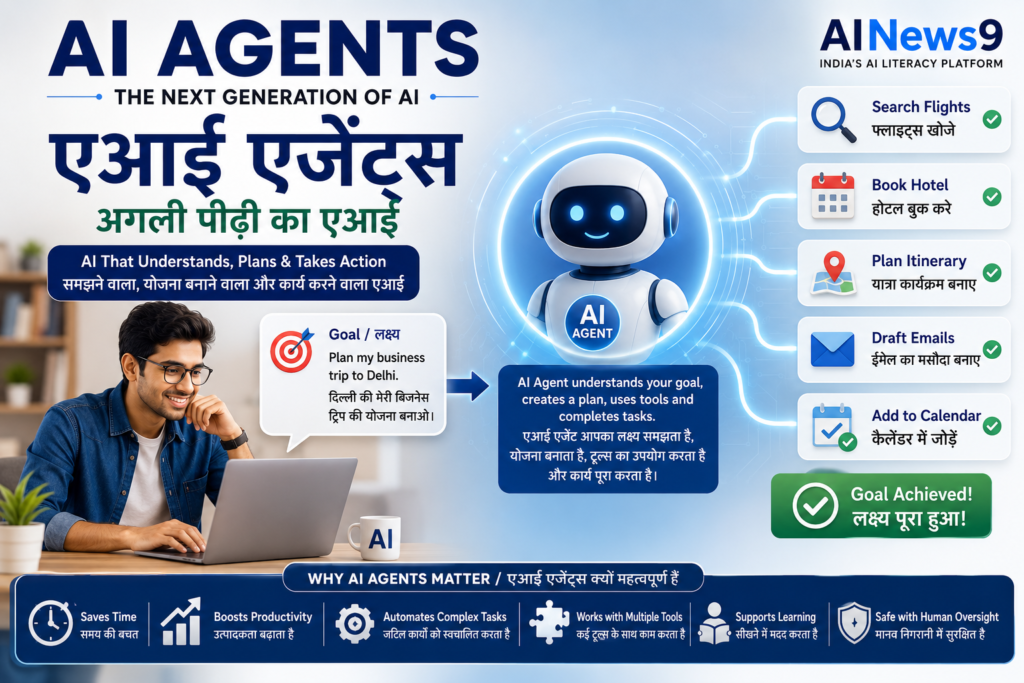
An AI Agent is an intelligent software system that can understand an objective, make decisions, use available tools, and perform tasks to achieve a specific goal with limited human intervention.
Unlike a traditional chatbot that simply responds to questions, an AI Agent can:
- Understand what you want to accomplish.
- Break a large task into smaller steps.
- Decide the best sequence of actions.
- Use digital tools or external services.
- Review its progress.
- Adjust its actions when necessary.
- Continue working until the objective is completed.
In simple words:
An AI Assistant answers questions. An AI Agent completes tasks.
That is the biggest difference.
💡 A Simple Everyday Example
Imagine you ask two different AI systems the same request:
“Help me organize my birthday party.”
A Traditional AI Assistant
It may suggest:
- Theme ideas
- Decoration tips
- Food recommendations
- Invitation wording
You still need to organize everything yourself.
An AI Agent
It could potentially:
- Create a guest list.
- Design digital invitations.
- Find suitable venues.
- Compare prices.
- Build a budget.
- Schedule reminders.
- Prepare a shopping checklist.
- Recommend entertainment options.
Instead of only providing information, the AI Agent works toward completing your goal.
This is why AI Agents are often described as the next generation of Artificial Intelligence.
🌍 Why Are AI Agents Becoming So Popular?
Artificial Intelligence is moving beyond answering questions.
People increasingly want AI that can help complete work, not just explain it.
Businesses want AI to automate repetitive processes.
Professionals want AI to manage routine tasks.
Students want AI to organize study plans.
Small business owners want AI to handle customer communication and marketing.
AI Agents make this possible by combining intelligence with action.
As AI technology becomes more capable, AI Agents are expected to become valuable digital assistants across education, healthcare, finance, customer service, software development, and many other industries.
🔗 Connection to the Previous Lesson
In the previous lesson, you learned about ChatGPT, one of the world’s most popular AI assistants.
ChatGPT is excellent at understanding questions, generating text, explaining concepts, and helping people think through problems.
AI Agents build on these capabilities.
Instead of only generating responses, they can plan, reason, use tools, and complete multi-step tasks to help users achieve real-world goals.
Understanding AI Agents is the next important step in your AI learning journey because they represent where Artificial Intelligence is rapidly heading.
⚙️ How Do AI Agents Work?
At first glance, an AI Agent may appear to work just like ChatGPT.
You type a request.
The AI understands it.
Then something happens.
However, behind the scenes, AI Agents perform much more than simply generating text.
Instead of answering a single question, they work toward achieving a goal.
Let’s understand this process step by step.
🔄 What Happens When You Give an AI Agent a Task?
AI Agents generally follow a simple workflow.
Step 1 — Understand the Goal
Everything begins with a goal or objective.
For example:
- Plan a five-day trip to Goa.
- Organize my weekly study schedule.
- Create a marketing campaign for my bakery.
- Compare laptop prices under ₹60,000.
- Summarize today’s AI news.
Unlike traditional software, AI Agents first understand what you want to achieve, not just the words you typed.
Step 2 — Break the Goal into Smaller Tasks
Once the objective is clear, the AI Agent divides it into manageable steps.
Imagine asking:
“Plan my vacation.”
An AI Agent might automatically create a checklist like:
- Decide destination
- Check travel dates
- Compare flight prices
- Search hotels
- Estimate budget
- Prepare itinerary
- Create packing checklist
- Set reminders
This process is called task planning.
Breaking large problems into smaller tasks helps the AI Agent work more efficiently.
Step 3 — Decide What to Do Next
Unlike ordinary chatbots, AI Agents make decisions throughout the process.
For example:
- Should I search for more information?
- Should I compare two options?
- Should I ask the user another question?
- Have I completed this task?
- Do I need to repeat a step?
This ability to make decisions makes AI Agents feel much more intelligent and flexible.
Step 4 — Use Digital Tools
One of the biggest differences between AI Agents and traditional AI assistants is their ability to use tools.
Depending on their design, AI Agents may interact with:
- Web search
- Calendars
- Documents
- Spreadsheets
- Databases
- Business applications
- Maps
- Online shopping services
- Project management software
Instead of simply saying:
“You should send this email.”
An AI Agent may actually prepare the email for your review—or even send it after you approve it.
This is where AI moves from advice to action.
Step 5 — Review the Results
Good AI Agents don’t stop after completing one step.
They evaluate their own progress.
For example, they may ask:
- Did I achieve the goal?
- Is any information missing?
- Do I need another tool?
- Should I improve the result?
This continuous feedback process helps AI Agents produce better outcomes.
Step 6 — Complete the Task
Finally, the AI Agent delivers the completed result.
Depending on the request, it might produce:
- A finished report
- A travel itinerary
- A shopping comparison
- A meeting summary
- A business presentation
- A completed workflow
The user receives the outcome instead of just general guidance.
🧠 What Makes AI Agents Different?
Several technologies work together to make AI Agents more capable than traditional chatbots.
These include:
- Large Language Models (LLMs)
- Planning algorithms
- Memory
- Reasoning
- Tool usage
- Workflow automation
- Decision-making systems
Together, these capabilities enable AI Agents to perform tasks that would normally require multiple software applications or significant human effort.
🤖 AI Agent vs AI Assistant
Many beginners confuse AI Agents with AI assistants like ChatGPT.
Although they are related, they are not the same.
| AI Assistant | AI Agent |
|---|---|
| Primarily answers questions | Works toward completing goals |
| Generates text and ideas | Plans and executes tasks |
| Waits for each instruction | Can perform multiple connected steps |
| Limited use of external tools | Can use tools, services, and applications |
| Supports conversations | Supports workflows and automation |
Think of it this way:
An AI Assistant is like an expert advisor.
An AI Agent is like an intelligent assistant who can both advise you and help complete the work.
🌍 Real-World Examples of AI Agents
AI Agents are beginning to appear across many industries.
Here are a few examples.
🎓 Education
Students may use AI Agents to:
- Build personalized study plans
- Track learning progress
- Generate quizzes
- Schedule revision sessions
- Recommend learning resources
💼 Business
Businesses may use AI Agents to:
- Respond to customer enquiries
- Prepare reports
- Analyze sales data
- Schedule meetings
- Automate repetitive workflows
🏥 Healthcare
Healthcare organizations are exploring AI Agents that can help with:
- Appointment scheduling
- Patient communication
- Medical documentation
- Administrative tasks
Human healthcare professionals remain responsible for diagnosis and treatment decisions.
🏪 Small Businesses
Entrepreneurs may use AI Agents to:
- Create social media content
- Manage inventory
- Respond to customers
- Generate invoices
- Track business performance
👨💻 Software Development
Developers increasingly use AI Agents to:
- Write code
- Test software
- Identify bugs
- Generate documentation
- Automate repetitive programming tasks
AI Agents help developers work faster while humans continue making important technical decisions.
📌 Remember
An AI Agent doesn’t simply answer a question.
It understands a goal, creates a plan, uses available tools, evaluates progress, and works toward completing the task.
That ability to plan, act, and adapt is what makes AI Agents one of the most exciting developments in modern Artificial Intelligence.
🌟 Benefits of AI Agents
AI Agents represent one of the biggest advancements in Artificial Intelligence because they go beyond simply answering questions.
Instead of acting as passive assistants, AI Agents actively help people achieve goals by planning, reasoning, using tools, and completing tasks.
Let’s explore some of their biggest advantages.
⏱️ 1. Save Time
Many everyday activities involve repetitive work.
For example:
- Scheduling meetings
- Organizing documents
- Preparing reports
- Managing emails
- Searching for information
- Creating presentations
AI Agents can automate many of these tasks, allowing people to focus on work that requires creativity and decision-making.
📈 2. Improve Productivity
Instead of switching between multiple applications, AI Agents can perform several connected tasks within a single workflow.
For example, an AI Agent could:
- Research a topic
- Summarize the findings
- Create presentation slides
- Draft an email
- Schedule a meeting
This significantly reduces manual effort.
🧠 3. Make Better Decisions
AI Agents can collect information from different sources, compare options, and organize data before presenting recommendations.
For example, when purchasing a laptop, an AI Agent could:
- Compare specifications
- Check prices
- Read customer reviews
- Recommend the best value
The final decision still belongs to the user.
🤝 4. Personalize User Experiences
AI Agents can adapt to individual preferences.
For example, a learning AI Agent may:
- Track your progress
- Recommend lessons
- Adjust difficulty levels
- Suggest revision topics
This creates a more personalized learning experience.
🌍 5. Work Across Multiple Applications
Unlike traditional software that operates in isolation, AI Agents can interact with multiple tools.
They may work with:
- Calendars
- Documents
- Web browsers
- Spreadsheets
- Business applications
- Cloud storage
This enables them to complete complex workflows more efficiently.
💼 6. Support Businesses
Businesses can use AI Agents to automate routine operations such as:
- Customer support
- Marketing campaigns
- Appointment scheduling
- Report generation
- Inventory tracking
- Sales analysis
Employees can then focus on strategic work instead of repetitive administrative tasks.
⚠️ Limitations of AI Agents
Although AI Agents are powerful, they are not perfect.
Understanding their limitations helps users apply them responsibly.
❌ 1. They Can Make Mistakes
AI Agents may:
- Misunderstand instructions
- Choose an unsuitable action
- Produce incorrect information
- Miss important details
Human supervision remains essential.
🔒 2. Privacy Must Be Protected
AI Agents often work with personal or business information.
Users should never provide:
- Passwords
- Banking details
- Government identification numbers
- Confidential business data
- Sensitive personal information
Always use trusted AI platforms and follow good cybersecurity practices.
⚖️ 3. They Should Not Make Critical Decisions Alone
AI Agents can support decision-making, but they should not independently make decisions involving:
- Healthcare
- Legal advice
- Financial investments
- Public safety
- National security
Qualified professionals and human judgement remain indispensable.
🌐 4. They Depend on Available Information
If an AI Agent receives incomplete or inaccurate information, its recommendations may also be incomplete or inaccurate.
As the saying goes:
Better input usually produces better output.
🧑⚖️ 5. Human Oversight Is Essential
Even highly capable AI Agents require human review.
People remain responsible for:
- Setting objectives
- Reviewing results
- Approving important actions
- Ensuring ethical use
The future of AI is expected to involve humans working alongside AI Agents, not humans being replaced by them.
❌ Common Myths About AI Agents
As AI Agents become more popular, many misconceptions have also emerged.
Let’s separate myth from reality.
Myth 1: AI Agents Can Think Like Humans
Reality
AI Agents can reason about tasks and make decisions based on available information, but they do not possess consciousness, emotions, or human understanding.
Myth 2: AI Agents Will Replace Everyone’s Job
Reality
AI Agents are more likely to automate repetitive tasks than replace entire professions.
People who learn to work effectively with AI Agents are likely to become more productive and valuable.
Myth 3: AI Agents Never Make Mistakes
Reality
Like other AI systems, AI Agents can make errors.
Their work should always be reviewed before important decisions are made.
Myth 4: AI Agents Are Only for Large Companies
Reality
Today, AI Agents are becoming accessible to students, teachers, freelancers, professionals, entrepreneurs, and small businesses.
Many AI-powered tools already include agent-like capabilities.
Myth 5: AI Agents Are the Same as ChatGPT
Reality
ChatGPT is primarily an AI assistant designed for conversation and content generation.
An AI Agent goes a step further by planning tasks, using tools, making decisions, and completing workflows to achieve a goal.
🛡️ Using AI Agents Responsibly
As AI Agents become more capable, responsible use becomes increasingly important.
Follow these best practices:
- ✅ Clearly define the task or objective.
- ✅ Review AI-generated work before using it.
- ✅ Protect sensitive personal and business information.
- ✅ Verify important decisions with trusted sources.
- ✅ Keep humans involved in critical decisions.
- ✅ Respect privacy, ethics, and intellectual property.
- ✅ Use AI to enhance human abilities—not replace them.
Responsible AI use ensures that technology benefits individuals, businesses, and society.
🚀 How Beginners Can Start Exploring AI Agents
You don’t need to be a programmer to begin learning about AI Agents.
Here are a few simple steps:
Step 1
Understand the basics of Artificial Intelligence, Generative AI, Machine Learning, Large Language Models, and ChatGPT.
You’ve already completed these foundations in the Learn AI series.
Step 2
Experiment with AI assistants and observe how they can perform increasingly complex tasks.
Notice the difference between answering questions and completing workflows.
Step 3
Explore beginner-friendly AI Agent platforms as they become available.
Many modern AI applications are gradually introducing agent-like capabilities.
Step 4
Practice giving clear goals instead of simple questions.
For example, instead of asking:
“What should I study?”
Try asking:
“Create a two-week study plan for my mathematics exam with daily revision goals.”
You’ll begin to experience the difference between conversational AI and task-oriented AI.
Step 5
Continue learning.
AI Agents are evolving rapidly and are expected to become one of the most important technologies shaping the future of education, work, business, and everyday life.
🎯 Key Takeaways
Congratulations!
You’ve now learned about one of the fastest-growing areas of Artificial Intelligence.
Let’s quickly recap the most important points about What are AI Agents?
- ✅ AI Agents are intelligent software systems that work toward achieving goals—not just answering questions.
- ✅ They can understand objectives, create plans, make decisions, use tools, and complete multi-step tasks.
- ✅ AI Agents are different from traditional chatbots and AI assistants because they focus on taking action.
- ✅ They are already being used in education, business, healthcare, software development, and customer service.
- ✅ AI Agents can significantly improve productivity by automating repetitive work.
- ✅ Although powerful, AI Agents still require human supervision and responsible use.
- ✅ Understanding AI Agents prepares you for the next generation of Artificial Intelligence.
AI Agents represent an exciting shift from AI that simply knows information to AI that can help accomplish real-world tasks.
❓ Frequently Asked Questions (FAQs)
1. What are AI Agents?
AI Agents are intelligent software systems that can understand goals, make decisions, use available tools, and complete tasks with limited human guidance.
2. Are AI Agents the same as ChatGPT?
No.
ChatGPT is primarily an AI assistant designed for conversation and content generation.
AI Agents go further by planning tasks, making decisions, using external tools, and working toward completing objectives.
3. Do AI Agents think like humans?
No.
AI Agents do not possess emotions, consciousness, or human understanding.
They analyze information, follow instructions, and make decisions based on their programming, available data, and AI models.
4. Where are AI Agents used?
AI Agents are increasingly used in:
- Education
- Customer support
- Business automation
- Software development
- Healthcare administration
- Finance
- Research
- Personal productivity
Their applications continue to expand as AI technology evolves.
5. Can AI Agents work without humans?
Not completely.
Although AI Agents can perform many tasks independently, humans are still responsible for defining goals, reviewing outputs, approving important actions, and ensuring ethical use.
6. Are AI Agents safe?
AI Agents can be safe when used responsibly.
Users should:
- Protect sensitive information.
- Verify important outputs.
- Keep humans involved in critical decisions.
- Use trusted AI platforms.
Responsible use is essential.
7. Will AI Agents replace jobs?
AI Agents are expected to automate many repetitive tasks.
However, they are more likely to change how people work rather than replace all jobs.
Professionals who learn to work effectively with AI Agents will be better prepared for the future workplace.
8. Do AI Agents use Large Language Models (LLMs)?
Many modern AI Agents use Large Language Models to understand language and communicate naturally.
However, they also combine planning, reasoning, memory, and tool usage to complete tasks.
9. Can beginners learn AI Agents?
Absolutely.
You do not need programming knowledge to understand the basic concepts.
Learning how AI Agents work is becoming an important digital skill for students, professionals, and businesses.
10. What should I learn after AI Agents?
The next step is learning Prompt Engineering.
Prompt Engineering teaches you how to communicate effectively with AI systems and AI Agents so you can achieve better results.
🎓 Continue Your AI Learning Journey
Congratulations!
You’ve now completed another major milestone in your AI literacy journey.
So far, you’ve learned:
- ✅ What is Artificial Intelligence?
- ✅ What is Generative AI?
- ✅ What is Machine Learning?
- ✅ What are Large Language Models (LLMs)?
- ✅ What is ChatGPT?
- ✅ What are AI Agents?
Together, these lessons explain the foundation of modern Artificial Intelligence and prepare you for practical AI applications.
➡️ Next Article
What is Prompt Engineering?
In the next lesson, you’ll learn:
- What prompts are
- Why prompts matter
- How AI understands instructions
- Techniques for writing better prompts
- Common prompting mistakes
- Real-world prompt examples
- Tips for getting better AI responses
Prompt Engineering is one of the most valuable skills for anyone using modern AI tools.
📚 Recommended Resources
To continue learning from trusted sources, explore these official resources:
- Microsoft AI – Discover how AI Agents are transforming productivity.
- DeepLearning.AI – Access AI courses covering agents, LLMs, and Generative AI.
These resources complement this lesson and provide reliable information for learners who wish to deepen their understanding.
💬 Final Thoughts
Artificial Intelligence is evolving rapidly.
The first generation of AI helped computers recognize patterns.
The next generation learned to generate text, images, and other content.
Now, AI is entering a new phase where intelligent systems can plan, reason, use tools, and complete tasks on behalf of people.
This is the promise of AI Agents.
Whether you’re a student organizing study plans, a teacher preparing lessons, a professional managing projects, or a small business owner automating daily work, AI Agents have the potential to become valuable digital partners.
At the same time, responsible use remains essential.
Human creativity, ethics, judgement, and oversight will continue to play a central role in ensuring AI benefits society.
By understanding AI Agents today, you’re preparing yourself for one of the most important technological shifts of the coming decade.
About AINews9
AINews9 is India’s AI Literacy Platform with a mission to make Artificial Intelligence Simple, Useful & Safe for Every Indian.
Through beginner-friendly lessons, practical tutorials, AI safety awareness, and real-world examples, AINews9 helps students, teachers, parents, professionals, senior citizens, and small businesses confidently understand and use Artificial Intelligence.
Whether you’re just beginning your AI journey or expanding your knowledge of emerging technologies, AINews9 is here to help you learn, use, stay safe, and grow with AI.
Next Article: What is Prompt Engineering? A Beginner’s Guide