AI Safety for Beginners
🛡️ A Simple & Practical Guide to Using Artificial Intelligence Safely, Responsibly, and Confidently
AI Safety for Beginners
Artificial Intelligence is transforming the way we learn, work, communicate, and solve problems.
Millions of people now use AI every day to write emails, prepare presentations, learn new skills, summarize information, and improve productivity.
AI offers incredible opportunities—but learning how to use it safely is just as important as learning how to use it effectively.
Just as we learn road safety before driving a car and digital safety before using the internet, understanding AI safety helps us use this powerful technology with confidence.
The good news is that you don’t need to be a technology expert to stay safe.
By developing a few simple habits, you can protect your privacy, recognize misleading AI content, verify important information, and use Artificial Intelligence responsibly in your everyday life.
At AINews9, we believe that you don’t need to fear AI—you need to understand it. An informed user is a safer, smarter, and more confident AI user.
In this practical guide, you’ll learn the essential AI safety principles every beginner should know before making Artificial Intelligence a trusted part of work, learning, business, and everyday life.
👥 Who Should Read This
This guide is ideal for:
- 🎓 Students
- 👩🏫 Teachers
- 👨👩👧 Parents
- 💼 Professionals
- 👴 Senior Citizens
- 🏪 Small Business Owners
- 🌐 Anyone beginning their AI journey
No technical background is required.
📖 What You’ll Learn
By the end of this guide, you’ll be able to:
- Understand what AI safety means.
- Recognize the most common AI risks.
- Protect your personal information while using AI.
- Understand why AI can sometimes make mistakes.
- Verify AI-generated information before trusting it.
- Develop safe and responsible AI habits.
- Use AI confidently in everyday life.
📚 In This Guide
🛡️ What Is AI Safety?
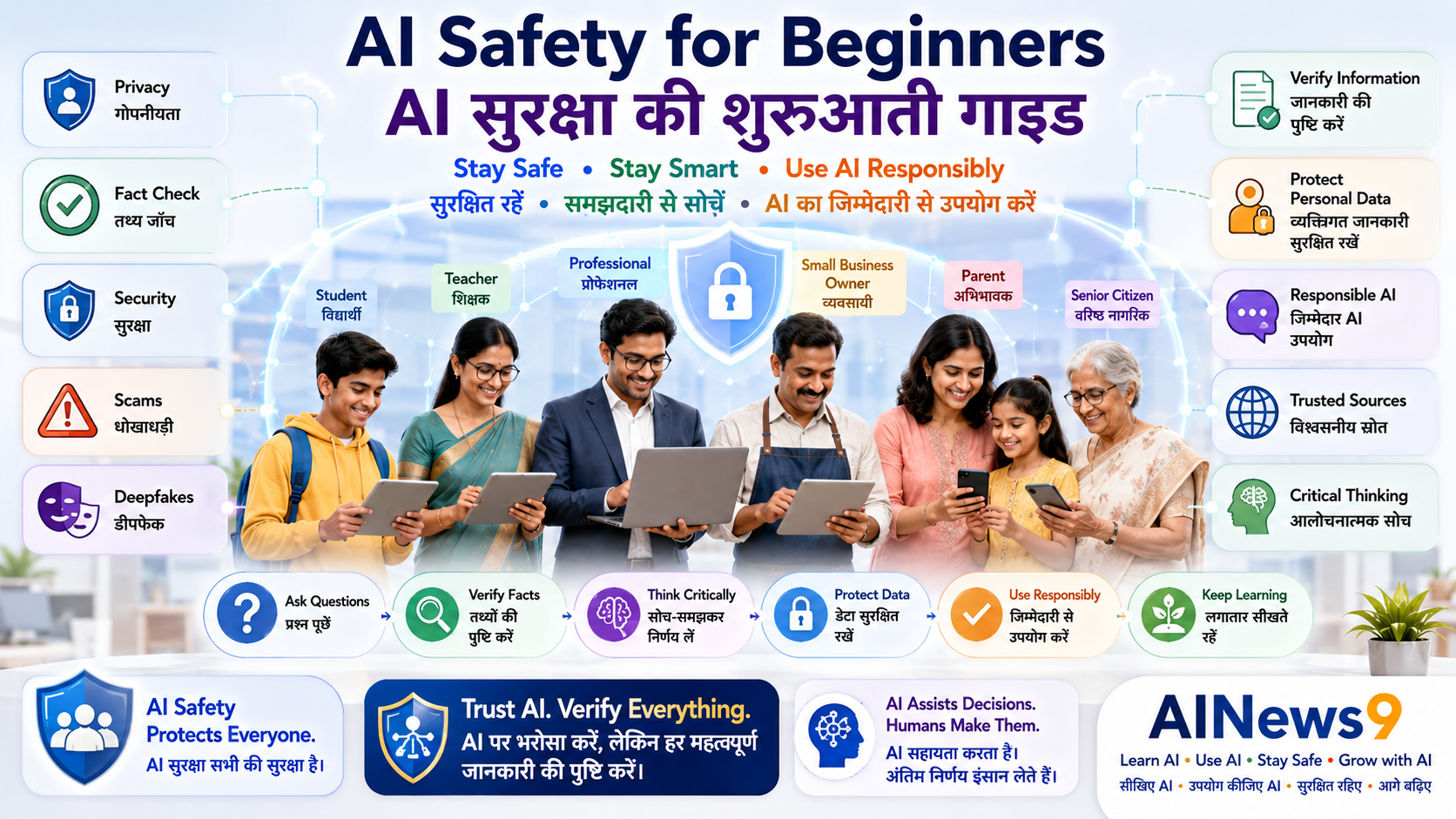
AI safety means using Artificial Intelligence in a way that is safe, responsible, trustworthy, and beneficial for yourself and others.
It is not about avoiding AI.
It is about understanding both its strengths and its limitations so you can use it wisely.
AI safety includes practices such as:
- Protecting personal and confidential information
- Verifying AI-generated answers before relying on them
- Recognizing fake or AI-generated content
- Using AI ethically and responsibly
- Applying human judgment to important decisions
Just as we learn road safety before driving and internet safety before going online, learning AI safety helps us make informed decisions in an AI-powered world.
🌍 Why AI Safety Matters
Artificial Intelligence is becoming deeply integrated into everyday life.
People now use AI to:
- Learn new skills
- Write emails and reports
- Generate presentations
- Translate languages
- Plan travel
- Create marketing content
- Analyze documents
- Search for information
- Support business decisions
As AI becomes more capable, people naturally begin to trust it more.
However, AI is not always correct.
Unlike a search engine that points you to existing sources, many AI systems generate responses based on patterns learned from enormous amounts of information.
While these responses are often useful, they can occasionally be:
- Incorrect
- Outdated
- Misleading
- Incomplete
- Fabricated
Blindly trusting AI without verification can result in:
- Poor academic work
- Business mistakes
- Incorrect financial decisions
- Privacy risks
- Spread of misinformation
- Falling victim to scams
Understanding AI safety helps you enjoy the benefits of AI while reducing these risks.
⚖️ AI Is a Powerful Assistant—Not a Perfect Expert
One of the biggest misconceptions about Artificial Intelligence is that it “knows everything.”
In reality, AI is better understood as a highly capable digital assistant—not an all-knowing expert.
AI can help you:
- Explain concepts
- Generate ideas
- Draft documents
- Summarize information
- Organize content
- Brainstorm solutions
However, AI cannot replace:
- Human judgment
- Critical thinking
- Real-world experience
- Professional expertise
- Ethical decision-making
For important decisions involving health, finance, law, education, or business, AI should support your thinking—not replace it.
⚠️ Safety Alert
Never assume that an AI-generated answer is correct simply because it sounds confident.
Always verify important information using trusted and authoritative sources.
🚦 AI Safety Starts with Good Habits
The good news is that you don’t need advanced technical knowledge to stay safe.
Most AI-related risks can be reduced by developing a few simple habits.
These include:
- Thinking before sharing personal information
- Asking clear and responsible questions
- Verifying important AI-generated content
- Using trusted AI platforms
- Recognizing that AI can make mistakes
- Applying your own judgment before acting on AI advice
Small habits practiced consistently can significantly improve your AI safety.
🌟 The Three Principles of Safe AI Use
Whenever you use an AI assistant, remember these three simple principles.
1️⃣ Think Critically
Don’t assume every AI response is correct.
Ask yourself:
- Does this make sense?
- Can I verify this information?
- Should I confirm it from another trusted source?
2️⃣ Protect Your Privacy
Avoid sharing:
- Passwords
- OTPs
- Banking information
- Aadhaar numbers
- PAN details
- Medical records
- Confidential company information
- Personal identity documents
Treat AI conversations with the same level of care you would use when sharing information online.
3️⃣ Stay Responsible
Use AI to help people—not to deceive, cheat, manipulate, or harm others.
Responsible AI use builds trust and ensures that this technology benefits everyone.
🛡️ AINews9 Safety Tip #1
Never share passwords, OTPs, banking details, Aadhaar numbers, confidential business information, or sensitive personal documents with public AI tools unless you fully understand how your data will be handled.
Protecting your personal information is the first and most important step toward responsible AI use.
✅ Safe Practice
Before acting on AI-generated advice related to health, finance, legal matters, or education, verify the information using trusted sources or consult a qualified professional.
⚠️ Common AI Risks Every Beginner Should Know
Artificial Intelligence can be an incredibly helpful assistant, but it is not perfect.
Like any technology, AI has limitations and can sometimes be misused.
Understanding these risks doesn’t mean you should stop using AI.
Instead, it helps you use AI more safely, more confidently, and more responsibly.
Let’s explore the most common AI risks that every beginner should understand.
🤔 AI Hallucinations Explained
One of the biggest surprises for new AI users is that AI can sometimes generate information that sounds completely believable—but is actually wrong.
This phenomenon is known as an AI hallucination.
An AI hallucination happens when an AI system confidently produces information that is:
- Incorrect
- Misleading
- Fabricated
- Outdated
- Unsupported by reliable evidence
For example, AI may:
- Invent facts that don’t exist.
- Create fake references or research papers.
- Misquote famous people.
- Provide incorrect statistics.
- Confuse dates or historical events.
- Generate inaccurate technical explanations.
The challenge is that AI often presents these answers with confidence, making them appear trustworthy.
This is why you should never assume that an AI-generated answer is automatically correct.
⚠️ Safety Alert
AI is designed to generate helpful responses—not guaranteed facts.
Always verify important information before using it in assignments, business decisions, financial planning, or professional work.
🛡️ AINews9 Safety Tip #2
If an AI response could affect your health, finances, education, legal matters, or career, verify the information using trusted and authoritative sources before acting on it.
🎭 Deepfakes and AI-Generated Content
Artificial Intelligence can now create incredibly realistic:
- Images
- Videos
- Voices
- Music
- Presentations
- Human faces
While these technologies have many positive uses, they can also be misused to deceive people.
Examples include:
- Fake celebrity videos
- Fake political speeches
- Voice cloning scams
- AI-generated fake news
- Identity impersonation
- Fraudulent social media posts
These realistic fake media files are commonly known as deepfakes.
Some deepfakes are created for entertainment or education.
Others are intentionally designed to spread misinformation or commit fraud.
As AI technology improves, identifying fake content becomes increasingly difficult.
Before believing or sharing sensational content:
- Check the original source.
- Verify the information with trusted news organizations.
- Look for multiple independent confirmations.
- Be cautious of emotionally charged or shocking content.
Remember:
If something looks unbelievable, verify it before believing it.
✅ Safe Practice
Before forwarding AI-generated images or videos on WhatsApp or social media, confirm that they come from a trusted and verified source.
🔒 Protecting Your Privacy
Privacy is one of the most important aspects of AI safety.
Many AI assistants process the information that users provide.
Before typing anything into a public AI tool, ask yourself:
“Would I be comfortable sharing this information publicly?”
If the answer is “No,” you probably shouldn’t enter it.
Avoid sharing:
- Passwords
- OTPs
- Aadhaar numbers
- PAN details
- Passport information
- Banking details
- Credit card numbers
- Medical records
- Income tax documents
- Confidential company files
- Customer databases
- Personal identity documents
Remember that once sensitive information is shared online, you may lose control over how it is stored or processed.
🛡️ AINews9 Safety Tip #3
If you wouldn’t post it publicly on the internet, don’t share it with a public AI assistant unless you clearly understand its privacy and data usage policies.
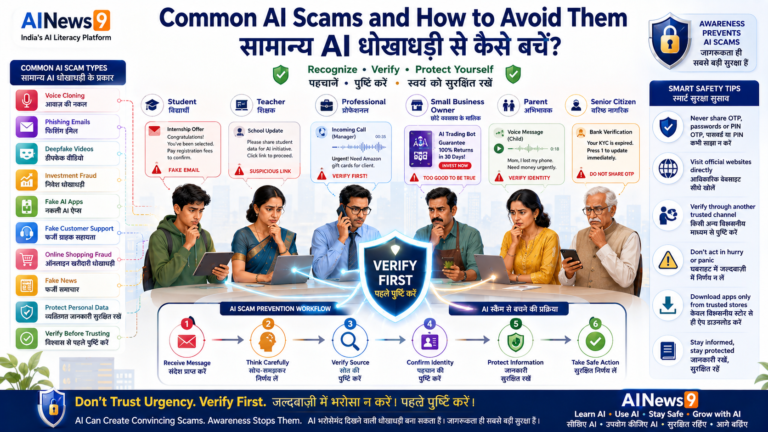
📱 AI Scams and Online Fraud
Cybercriminals are increasingly using Artificial Intelligence to make scams appear more convincing.
Common examples include:
- AI-generated phishing emails
- Fake customer support messages
- Voice cloning scams
- Deepfake video calls
- Fake investment opportunities
- AI-generated job offers
- Fraudulent advertisements
Many of these scams create a false sense of urgency.
For example:
- “Your bank account has been blocked.”
- “Verify your identity immediately.”
- “Your parcel is waiting.”
- “Claim your prize now.”
- “Your payment has failed.”
These messages are designed to make you react without thinking.
Whenever you receive an unexpected message:
- Don’t click suspicious links.
- Verify through official websites.
- Never share OTPs.
- Contact the organization using its official phone number or website.
⚠️ Safety Alert
Government agencies, banks, and reputable companies will never ask you to share your OTP, password, or PIN through email, SMS, WhatsApp, or an AI chatbot.
⚖️ AI Bias
Artificial Intelligence learns from data created by humans.
If that data contains errors, stereotypes, or historical biases, AI responses may sometimes reflect them.
This is called AI bias.
Bias can appear in:
- Hiring recommendations
- Image generation
- Search results
- Language translation
- Content suggestions
- Automated decision-making
This doesn’t mean AI is intentionally unfair.
It simply means that AI should not be treated as the final authority.
Responsible AI users consider multiple viewpoints and apply their own judgment before making important decisions.
🚨 Overdependence on AI
AI is designed to assist people—not replace them.
One of the biggest mistakes beginners make is depending on AI for everything.
Examples include:
- Copying homework without understanding it.
- Accepting every AI answer without checking it.
- Letting AI make important personal decisions.
- Relying entirely on AI for creative thinking.
While AI can save time, your own knowledge, creativity, and critical thinking remain your greatest strengths.
Think of AI as your assistant—not your replacement.
🛡️ AINews9 Safety Tip #4
Use AI to learn, understand, and improve—not simply to copy answers. The more you think for yourself, the more valuable AI becomes.
👨👩👧 AI Safety for Different Users
Different people use AI in different ways.
Here are some practical safety recommendations.
🎓 Students
Students should:
- Use AI to understand concepts.
- Verify academic information.
- Avoid submitting AI-generated work without review.
- Follow school or college AI policies.
- Learn—not just copy.
👩🏫 Teachers
Teachers should:
- Verify AI-generated lesson plans.
- Protect student privacy.
- Encourage critical thinking.
- Teach responsible AI use.
- Explain AI limitations.
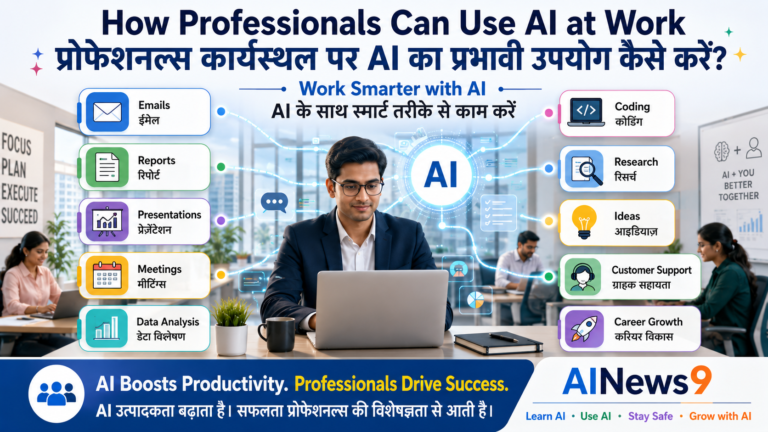
💼 Professionals
Professionals should:
- Follow organizational AI policies.
- Avoid uploading confidential documents.
- Protect customer information.
- Verify AI-generated reports.
- Use AI to support—not replace—professional judgment.
👨👩👧 Parents
Parents should:
- Teach children responsible AI use.
- Discuss online safety.
- Encourage curiosity and learning.
- Monitor younger children’s AI usage.
- Explain that AI can make mistakes.
👴 Senior Citizens
Senior citizens should:
- Be cautious of AI-generated scams.
- Verify unexpected phone calls or messages.
- Never share financial information.
- Ask trusted family members if something seems suspicious.
🏪 Small Business Owners
Business owners should:
- Protect customer data.
- Verify AI-generated marketing content.
- Avoid uploading confidential contracts.
- Review legal and financial information before acting on it.
🛡️ AINews9 Safety Tip #5
When you’re unsure whether an AI response is correct, pause and verify it. Spending a few extra minutes checking important information can prevent costly mistakes and protect your privacy.
🌟 Best Practices for Responsible AI Use
Using Artificial Intelligence safely isn’t about avoiding AI.
It’s about developing good habits that help you get the best results while protecting yourself and others.
Here are some practical best practices that every beginner should follow.
✅ Think Before You Trust
AI can produce impressive answers, but it is not always correct.
Before accepting important information, ask yourself:
- Is this information logical?
- Can I verify it from another trusted source?
- Is the source reliable?
- Could this answer be outdated?
Critical thinking is your best protection against misinformation.
✅ Protect Your Personal Information
Never enter sensitive personal or business information into a public AI tool unless you fully understand how the information will be stored and used.
Always keep private information private.
Examples include:
- Passwords
- OTPs
- Aadhaar numbers
- PAN details
- Banking information
- Medical records
- Confidential company documents
- Customer information
Protecting your privacy should become a lifelong digital habit.
✅ Verify Before You Share
AI-generated content can spread quickly through social media, messaging apps, and email.
Before forwarding any AI-generated content:
- Verify the original source.
- Check whether trusted organizations have confirmed it.
- Read beyond the headline.
- Think before sharing.
Helping stop misinformation is everyone’s responsibility.
✅ Use AI to Learn—Not to Cheat
Artificial Intelligence is an excellent learning companion.
Use it to:
- Understand concepts.
- Practice problems.
- Generate revision notes.
- Improve writing.
- Brainstorm ideas.
Avoid using AI simply to copy answers without understanding them.
Real learning happens when AI supports your thinking—not replaces it.
🛡️ AINews9 Safety Tip #6
The safest AI users are those who stay curious, ask questions, verify information, and continue learning. Responsible AI use is a habit—not a one-time action.
🚫 Common Beginner Mistakes
Many new AI users make similar mistakes when they first start using Artificial Intelligence.
Being aware of these mistakes can help you avoid them.
| ❌ Common Mistake | ✅ Better Practice |
|---|---|
| Trusting every AI response | Verify important information |
| Sharing confidential information | Protect your privacy |
| Copying AI-generated work without understanding it | Use AI as a learning assistant |
| Believing AI knows everything | Remember that AI has limitations |
| Sharing unverified AI-generated content | Verify before forwarding |
| Depending entirely on AI | Combine AI with your own thinking |
Remember:
Artificial Intelligence is at its best when combined with human intelligence.
🌍 Building Good AI Habits
Responsible AI users follow a simple routine every time they use AI.
Before Using AI
- Know your objective.
- Choose a trusted AI platform.
- Avoid entering sensitive information.
While Using AI
- Ask clear questions.
- Review the response carefully.
- Ask follow-up questions if needed.
After Using AI
- Verify important facts.
- Edit AI-generated content.
- Apply your own judgment.
- Cite sources where appropriate.
Following this routine helps you use AI safely and effectively.
📝 Key Takeaways
Congratulations!
You’ve completed your introduction to AI safety.
Here are the most important lessons to remember.
- ✅ AI is powerful, but not perfect.
- ✅ AI can sometimes generate incorrect or misleading information.
- ✅ Never share sensitive personal or business information with public AI tools.
- ✅ Verify important AI-generated content before acting on it.
- ✅ Be cautious of AI-generated scams and deepfakes.
- ✅ Human judgment remains essential.
- ✅ Use AI ethically and responsibly.
- ✅ Continue learning as AI technology evolves.
These simple principles will help you become a confident and responsible AI user.
❓ Frequently Asked Questions
1. Is Artificial Intelligence safe to use?
Yes.
Artificial Intelligence is generally safe when used responsibly.
The key is understanding its limitations, protecting your privacy, and verifying important information.
2. Can AI make mistakes?
Absolutely.
AI can generate incorrect information, misunderstand questions, or produce outdated answers.
Always verify information that affects important decisions.
3. Should I trust everything AI says?
No.
AI is an excellent assistant, but it should not be treated as an unquestionable authority.
Use your own judgment and confirm important facts.
4. Is it safe to share personal information with AI?
Avoid sharing sensitive personal information such as passwords, OTPs, banking details, Aadhaar numbers, or confidential business documents with public AI systems.
5. What are AI hallucinations?
AI hallucinations are responses where an AI system confidently generates incorrect or fabricated information.
This is why fact-checking is important.
6. What are deepfakes?
Deepfakes are realistic AI-generated images, videos, or audio recordings designed to imitate real people.
Some are harmless, while others may be used to spread misinformation or commit fraud.
7. Can children use AI safely?
Yes.
With guidance from parents and teachers, children can use AI responsibly for learning, creativity, and education.
Adults should encourage critical thinking and safe online behaviour.
8. How can I become a responsible AI user?
Follow these simple principles:
- Think critically.
- Verify information.
- Protect your privacy.
- Use trusted AI platforms.
- Continue learning.
- Use AI ethically.
📚 Trusted Resources
To learn more about responsible AI, explore these trusted resources:
- OpenAI Safety Resources
- Google AI Safety Center
- Microsoft Responsible AI
- UNESCO Guidance on Generative AI in Education
- AINews9 Learn AI Series
Always rely on trusted organizations for important AI guidance and updates.
💬 Final Thoughts
Artificial Intelligence is one of the most transformative technologies of our time.
It has the potential to improve education, healthcare, business, creativity, productivity, and everyday life.
However, the future of AI depends not only on the technology itself—but also on how responsibly people choose to use it.
The goal isn’t to fear Artificial Intelligence.
The goal is to understand it.
By thinking critically, protecting your privacy, verifying important information, and using AI ethically, you can enjoy the benefits of AI while avoiding many of its risks.
Remember:
Artificial Intelligence becomes truly powerful when it is guided by human wisdom, responsibility, and good judgment.
Every responsible AI user contributes to building a safer and more trustworthy digital future.
🎓 Continue Your AI Journey
Continue building your AI knowledge with AINews9.
Learn AI
- L001 – What is Artificial Intelligence?
- L002 – What is Generative AI?
- L003 – What is Machine Learning?
- L004 – What are Large Language Models (LLMs)?
- L005 – What is ChatGPT?
- L006 – What are AI Agents?
- L007 – What is Prompt Engineering?
- L008 – How Does AI Work?
- L009 – History of Artificial Intelligence
- L010 – AI Terminology Explained
Use AI
- U001 – How Students Can Use AI Effectively
- U002 – How Teachers Can Use AI in Education
- U003 – How Professionals Can Use AI at Work
- U004 – How Small Businesses Can Use AI
- U005 – Beginner’s Guide to ChatGPT
- U006 – Beginner’s Guide to Gemini
- U007 – Beginner’s Guide to Claude
- U008 – Beginner’s Guide to NotebookLM
- U009 – AI for Everyday Productivity
- U010 – 10 Best AI Tools for Beginners
Stay Safe
- S001 – AI Safety for Beginners ✅
- S002 – AI Scams and Online Fraud
- S003 – Deepfakes Explained
- S004 – AI Misinformation
- S005 – AI & Data Privacy
- S006 – Safe Prompting Practices
- S007 – AI for Children & Parents
- S008 – Responsible AI Use
- S009 – AI Ethics Explained
- S010 – AI Safety Checklist
Grow with AI
- G001 – AI Skills for Everyone
- G002 – AI Career Roadmap
- G003 – AI Career Opportunities
- G004 – AI Certifications
- G005 – Future AI Skills
- G006 – Future of Work in the AI Era
- G007 – AI Entrepreneurship
- G008 – AI for Business Growth
- G009 – Building an AI Mindset
- G010 – Your AI Learning Journey
Every lesson helps you become a more confident, responsible, and future-ready AI user.
🏛️ About AINews9
AINews9 is India’s AI Literacy Platform with a mission to make Artificial Intelligence Simple, Useful & Safe for Every Indian.
We empower:
- 🎓 Students
- 👩🏫 Teachers
- 👨👩👧 Parents
- 💼 Professionals
- 👴 Senior Citizens
- 🏪 Small Business Owners
Our four learning pillars guide every article:
- 📘 Learn AI
- 🛠️ Use AI
- 🛡️ Stay Safe
- 🚀 Grow with AI
Together, let’s build an AI-literate India—where every citizen can use AI with confidence, responsibility, and purpose.