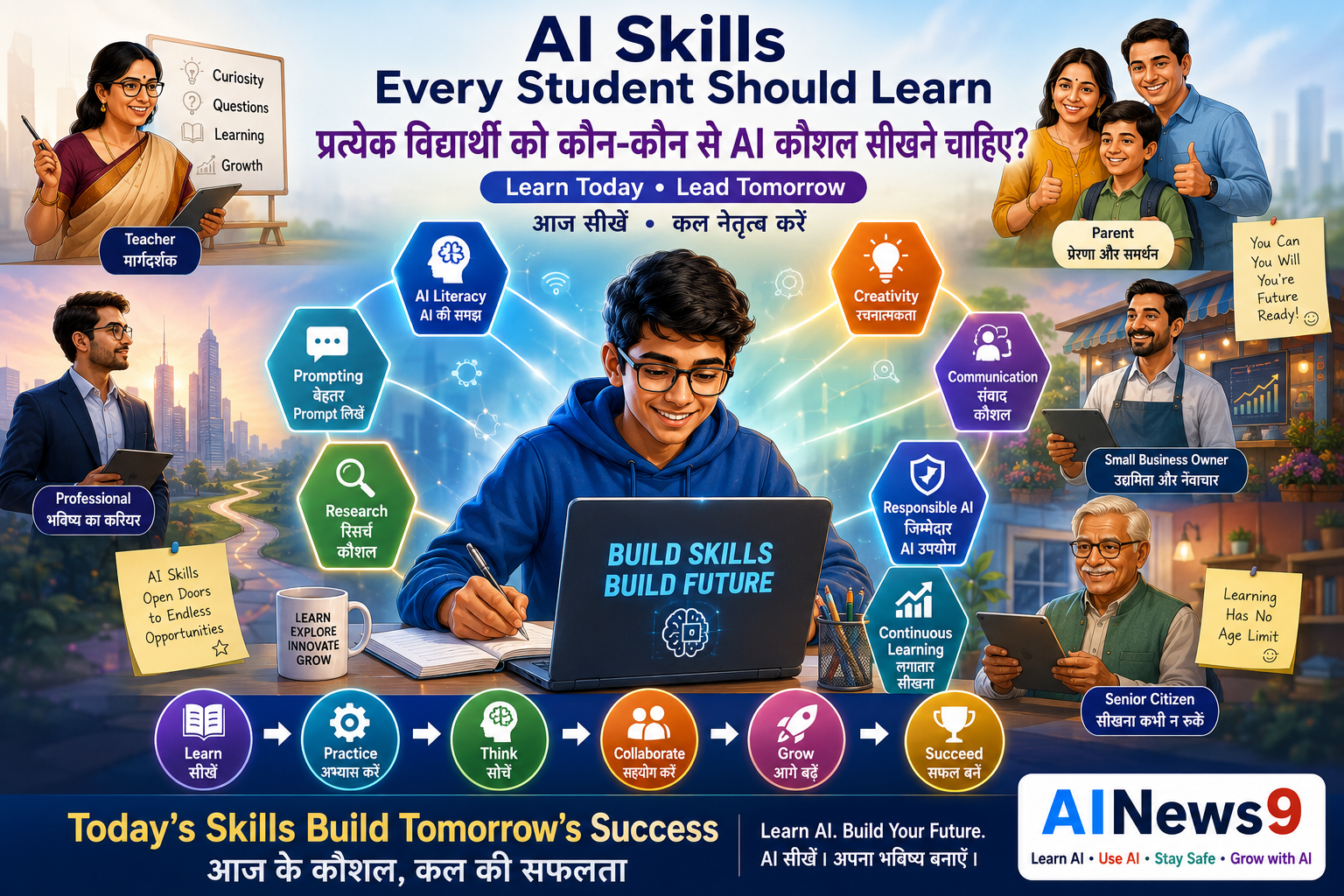
AI Skills Every Student Should Learn
🎓 Build Future-Ready Skills with Artificial Intelligence
Technology is changing faster than ever, and Artificial Intelligence is becoming part of almost every profession. Whether you dream of becoming a doctor, engineer, teacher, designer, entrepreneur, or scientist, AI will likely become one of the tools you use every day. The good news is that you don’t need to become an AI expert. By learning a few essential AI skills today, you can prepare yourself for tomorrow’s opportunities and build confidence for the future.
👥 Who Should Read This?
This guide is ideal for:
- 🎓 School Students
- 🎓 College Students
- 👨👩👧 Parents
- 👩🏫 Teachers
- 🎯 Career Counsellors
- 🌐 Anyone helping students prepare for an AI-powered future
No technical background or coding experience is required.
📖 What You’ll Learn
By the end of this guide, you’ll be able to:
- Understand why AI skills are becoming essential.
- Learn the most important AI skills every student should develop.
- Discover which human skills AI cannot replace.
- Explore free resources to start learning.
- Follow a simple roadmap to build future-ready AI skills.
📚 In This Guide
🎯 Why Every Student Should Learn AI Skills
Every major technological revolution has created new opportunities.
The internet changed how we communicate.
Smartphones changed how we access information.
Now, Artificial Intelligence is changing how we learn, work, and solve problems.
This doesn’t mean students should fear AI.
Instead, they should learn how to use it wisely.
Students who understand AI will have an advantage because they’ll know how to learn faster, work smarter, and solve problems more effectively.
Think of AI as a powerful learning companion.
It won’t replace your curiosity, creativity, or hard work—but it can help you develop those qualities even faster.
The future won’t belong to students who compete with AI. It will belong to students who know how to work with AI.
🌍 How AI Is Changing Education and Careers
Artificial Intelligence is already transforming classrooms and workplaces around the world.
Today, students use AI to:
- Explain difficult concepts.
- Practice languages.
- Improve writing.
- Learn programming.
- Brainstorm project ideas.
- Create presentations.
- Prepare for interviews.
Professionals use AI to save time, analyze information, write reports, and improve productivity.
As these tools become more common, employers will increasingly value people who know how to use AI effectively and responsibly.
Learning AI skills today isn’t just about using new technology.
It’s about preparing for careers that will continue to evolve over the next decade.
🚀 AI Skills Every Student Should Learn
You don’t need to master dozens of AI tools.
Instead, focus on building a strong foundation of practical skills that will remain valuable even as technology changes.
In the next section, we’ll explore the 10 essential AI skills every student should start developing today.
🌟 AINews9 Growth Insight
Learning AI is becoming as important as learning how to use the internet was twenty years ago.
Students who start early won’t just understand technology—they’ll be better prepared to shape the future.
🚀 The 10 AI Skills Every Student Should Learn
You don’t need to become an AI engineer to benefit from Artificial Intelligence.
Instead, focus on developing practical skills that will help you learn faster, think better, and prepare for future careers.
Here are the ten AI skills every student should start building today.
1️⃣ AI Literacy
AI Literacy means understanding the basics of Artificial Intelligence.
You don’t need to know complex mathematics or programming.
Simply understand:
- What AI is.
- What AI can do.
- What AI cannot do.
- Where AI is used in everyday life.
Example:
Knowing the difference between ChatGPT, Gemini, and traditional search engines.
Why it matters:
Understanding AI helps you use it confidently instead of feeling overwhelmed.
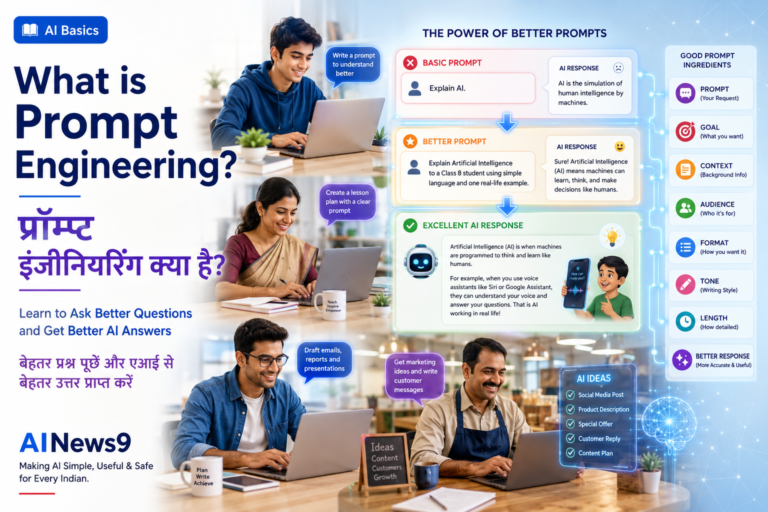
2️⃣ Prompt Writing
AI works best when you ask clear questions.
Learning how to write better prompts helps you get better answers.
Good prompts are:
- Clear
- Specific
- Well-structured
- Goal-oriented
Example:
Instead of asking:
“Explain photosynthesis.”
Ask:
“Explain photosynthesis for a Class 8 student using a simple real-life example.”
Why it matters:
Better prompts produce better results.
3️⃣ Critical Thinking
AI is helpful—but it isn’t always correct.
Students should learn to:
- Question AI answers.
- Compare multiple sources.
- Identify mistakes.
- Think independently.
Why it matters:
The smartest students don’t believe everything AI says.
They evaluate it.
4️⃣ Fact Verification
AI can sometimes generate outdated or incorrect information.
Before using AI-generated content for:
- Homework
- Projects
- Research
- Presentations
Always verify important facts using trusted sources.
Why it matters:
Good students verify before they trust.
5️⃣ Digital Communication
AI can help students communicate more effectively.
Examples include:
- Writing emails.
- Improving grammar.
- Summarizing notes.
- Preparing presentations.
- Learning new languages.
Remember:
AI improves communication—it doesn’t replace your own voice.
🛡️ AINews9 Growth Tip #1
Don’t try to learn every AI tool.
Learn transferable skills like asking better questions, thinking critically, verifying information, and communicating effectively.
These skills will remain valuable even as AI tools continue to evolve.
6️⃣ Creativity with AI
AI is a powerful creativity partner.
It can help students:
- Generate new ideas.
- Create presentations.
- Write stories and poems.
- Design posters.
- Create images.
- Brainstorm science projects.
Example:
A student preparing a science exhibition can use AI to generate project ideas, improve the presentation, and create simple diagrams.
Why it matters:
AI can spark creativity, but your imagination makes the final work unique.
7️⃣ Data Literacy
The future belongs to students who can understand and use data.
AI often presents information through:
- Charts
- Tables
- Graphs
- Reports
- Dashboards
Learning how to read and interpret data helps students make better decisions.
Example:
Instead of simply looking at exam scores, students can use AI to identify strengths, weaknesses, and learning patterns.
Why it matters:
Data helps you make informed decisions instead of relying on guesswork.
8️⃣ Problem Solving
One of the biggest advantages of AI is its ability to help solve problems.
Students can use AI to:
- Break large problems into smaller steps.
- Explore different solutions.
- Understand difficult concepts.
- Plan projects.
- Brainstorm ideas.
However, AI should guide your thinking—not replace it.
Example:
If you’re struggling with a maths problem, ask AI to explain the steps rather than requesting only the final answer.
Why it matters:
Employers value people who can solve problems—not just use software.
9️⃣ Responsible AI Use
Learning AI also means learning how to use it responsibly.
Good AI habits include:
- Respecting privacy.
- Verifying important information.
- Avoiding plagiarism.
- Using AI honestly.
- Giving credit to original creators.
- Thinking critically before sharing AI-generated content.
Responsible AI users earn trust.
Why it matters:
Technology changes quickly, but honesty and integrity never go out of style.
🔟 Continuous Learning
Artificial Intelligence evolves every month.
New tools, new features, and new opportunities appear regularly.
Students who stay curious and continue learning will always have an advantage.
Simple ways to keep learning include:
- Reading AI news.
- Exploring new AI tools.
- Taking free online courses.
- Practicing with AI every week.
- Following trusted AI educators.
Why it matters:
The most valuable skill of the future is the ability to keep learning.
🧠 Skills AI Cannot Replace
Artificial Intelligence is powerful, but it doesn’t replace what makes us human.
The following skills will remain valuable in almost every career:
- ❤️ Empathy
- 💡 Creativity
- 🧠 Critical Thinking
- 🗣️ Communication
- 🤝 Teamwork
- 🌟 Leadership
- ⚖️ Ethics and Integrity
- 🔍 Curiosity
AI can support these skills.
It cannot replace them.
Students who combine human skills with AI skills will be better prepared for the future than those who rely on AI alone.
🛠️ A Simple AI Learning Roadmap
You don’t need to learn everything at once.
Follow this simple roadmap.
🌱 Step 1 – Build the Basics
- Understand what AI is.
- Learn how to write good prompts.
- Practice using ChatGPT or Gemini.
🌿 Step 2 – Build Practical Skills
- Create presentations.
- Improve writing.
- Summarize notes.
- Practice problem-solving.
🌳 Step 3 – Prepare for the Future
- Learn AI tools related to your interests.
- Build projects.
- Stay updated with new AI developments.
- Continue improving your human skills.
Small, consistent progress is more valuable than trying to learn everything in one week.
🌟 Free Resources for Students
Getting started with AI doesn’t have to be expensive.
Explore these beginner-friendly resources:
- 🤖 ChatGPT
- 💎 Gemini
- 📚 NotebookLM
- 🎓 Khan Academy
- 💻 Microsoft Learn
- 🌍 Google AI Essentials
- 📖 AINews9 Learn AI Series
Start with one tool.
Master it.
Then explore others.
🎒 AI Skills by Age Group
🧒 Middle School Students
Focus on:
- AI awareness
- Safe AI use
- Asking good questions
- Creativity
🎓 High School Students
Focus on:
- Prompt writing
- Research
- Presentations
- Fact verification
- Responsible AI
🎓 College Students
Focus on:
- Productivity
- Career preparation
- AI tools for your field
- Portfolio building
- Professional communication
Each stage builds on the previous one.
🚀 The AINews9 Future Skills Promise™
The future belongs to lifelong learners.
I Promise That I Will:
✅ Keep learning as AI evolves.
✅ Use AI to understand—not shortcut—my education.
✅ Verify important information before trusting it.
✅ Combine AI with creativity and critical thinking.
✅ Use AI responsibly and ethically.
✅ Keep improving my skills throughout my career.
📝 Key Takeaways
Remember these important lessons:
- ✅ AI skills are becoming essential for future careers.
- ✅ You don’t need to become an AI expert to benefit from AI.
- ✅ Prompt writing, critical thinking, and fact verification are foundational skills.
- ✅ Human qualities like creativity, empathy, and leadership remain irreplaceable.
- ✅ Small, consistent learning habits create long-term success.
- ✅ Students who learn with AI will be better prepared for tomorrow’s opportunities.
❓ Frequently Asked Questions
1. Do I need coding to learn AI?
No.
Many AI tools are designed for beginners and require no programming knowledge.
2. Which AI skill should I learn first?
Start with AI Literacy and Prompt Writing.
They provide the foundation for everything else.
3. Which AI tools are best for students?
Beginner-friendly tools include ChatGPT, Gemini, and NotebookLM.
Choose one tool, learn it well, and then explore others.
4. Can AI replace students?
No.
AI is a learning assistant—not a replacement for curiosity, effort, or critical thinking.
5. How much time should I spend learning AI?
Even 20–30 minutes each week can help you build valuable AI skills over time.
📚 Trusted Resources
Continue learning through trusted sources:
- OpenAI Learning Resources
- Google AI Essentials
- Microsoft Learn
- Khan Academy
- AINews9 Learn AI Series
💬 Final Thoughts
Every generation experiences a technology that changes the world.
For your generation, that technology is Artificial Intelligence.
The students who succeed won’t necessarily be the ones who know the most about AI.
They’ll be the ones who stay curious, keep learning, think critically, and use AI to become better learners and better problem-solvers.
Remember:
Your greatest competitive advantage isn’t Artificial Intelligence. It’s your willingness to keep learning.
🎓 Continue Your AI Journey
Now that you’ve learned the essential AI skills every student should develop, continue your journey with the next lesson:
📘 Learn AI
- L001 – What is Artificial Intelligence?
- L002 – What is Generative AI?
- L003 – What is Machine Learning?
- L004 – What are Large Language Models (LLMs)?
- L005 – What is ChatGPT?
- L006 – What are AI Agents?
- L007 – What is Prompt Engineering?
- L008 – How Does AI Work?
- L009 – History of Artificial Intelligence
- L010 – AI Terminology Explained
🛠️ Use AI
- U001 – How Students Can Use AI Effectively
- U002 – How Teachers Can Use AI in Education
- U003 – How Professionals Can Use AI at Work
- U004 – How Small Businesses Can Use AI
- U005 – Beginner’s Guide to ChatGPT
- U006 – Beginner’s Guide to Gemini
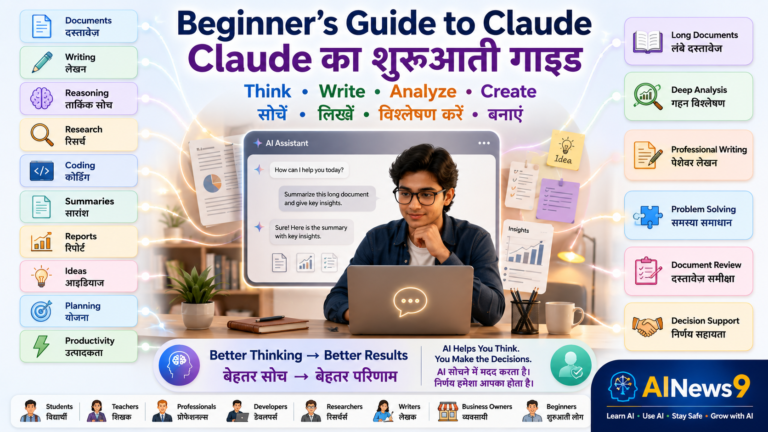
- U007 – Beginner’s Guide to Claude
- U008 – Beginner’s Guide to NotebookLM
- U009 – AI for Everyday Productivity
- U010 – 10 Best AI Tools for Beginners
🛡️ Stay Safe
- S001 – AI Safety for Beginners
- S002 – What Are Deepfakes?
- S003 – AI Scams and How to Avoid Them
- S004 – AI Safety for Children & Parents
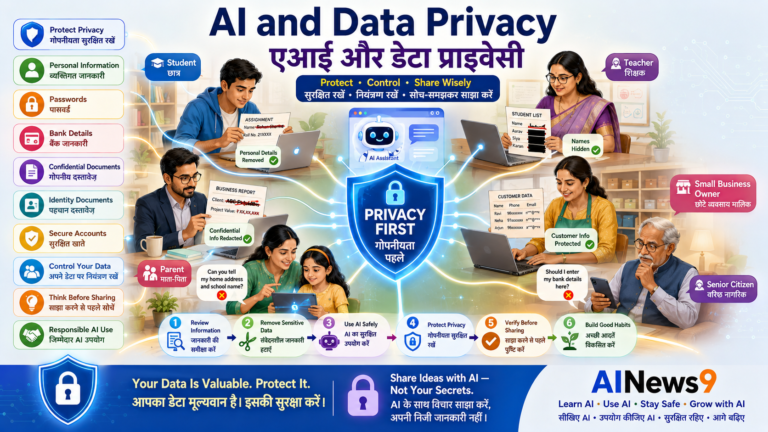
- S005 – AI and Data Privacy
- S006 – Safe Prompting Practices
- S007 – AI Misinformation: How to Identify Fake AI Content
- S008 – Avoiding AI Fraud: Practical Tips to Stay Safe Online
- S009 – Responsible AI Use: Best Practices for Everyone
- S010 – AI Ethics Simplified
🚀 Grow with AI
- G001 – AI Skills Every Student Should Learn ✅
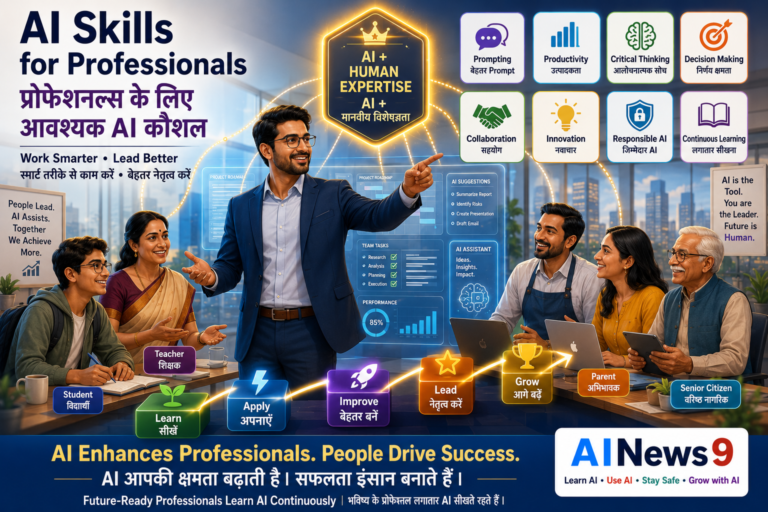
- G002 – AI Skills for Professionals
- G003 – AI Career Paths Explained
- G004 – Top AI Certifications
- G005 – Building a Business with AI
- G006 – Future of Work in the AI Era
- G007 – AI Freelancing Opportunities
- G008 – AI for Business Growth
- G009 – AI Careers for Students
- G010 – How to Stay Relevant in an AI-Driven World
Discover how professionals across different industries are using Artificial Intelligence to improve productivity, solve problems, and build future-ready careers.
About AINews9
AINews9 is India’s AI Literacy Platform dedicated to making Artificial Intelligence Simple, Useful & Safe for Every Indian.
Through our four learning pillars—
- 📘 Learn AI
- 🛠️ Use AI
- 🛡️ Stay Safe
- 🚀 Grow with AI
—we help students, teachers, parents, professionals, senior citizens, and businesses build the knowledge and confidence needed to thrive in an AI-powered world.