Responsible AI Use: Best Practices for Everyone
🤝 A Practical Guide to Using Artificial Intelligence Ethically, Responsibly, and Respectfully
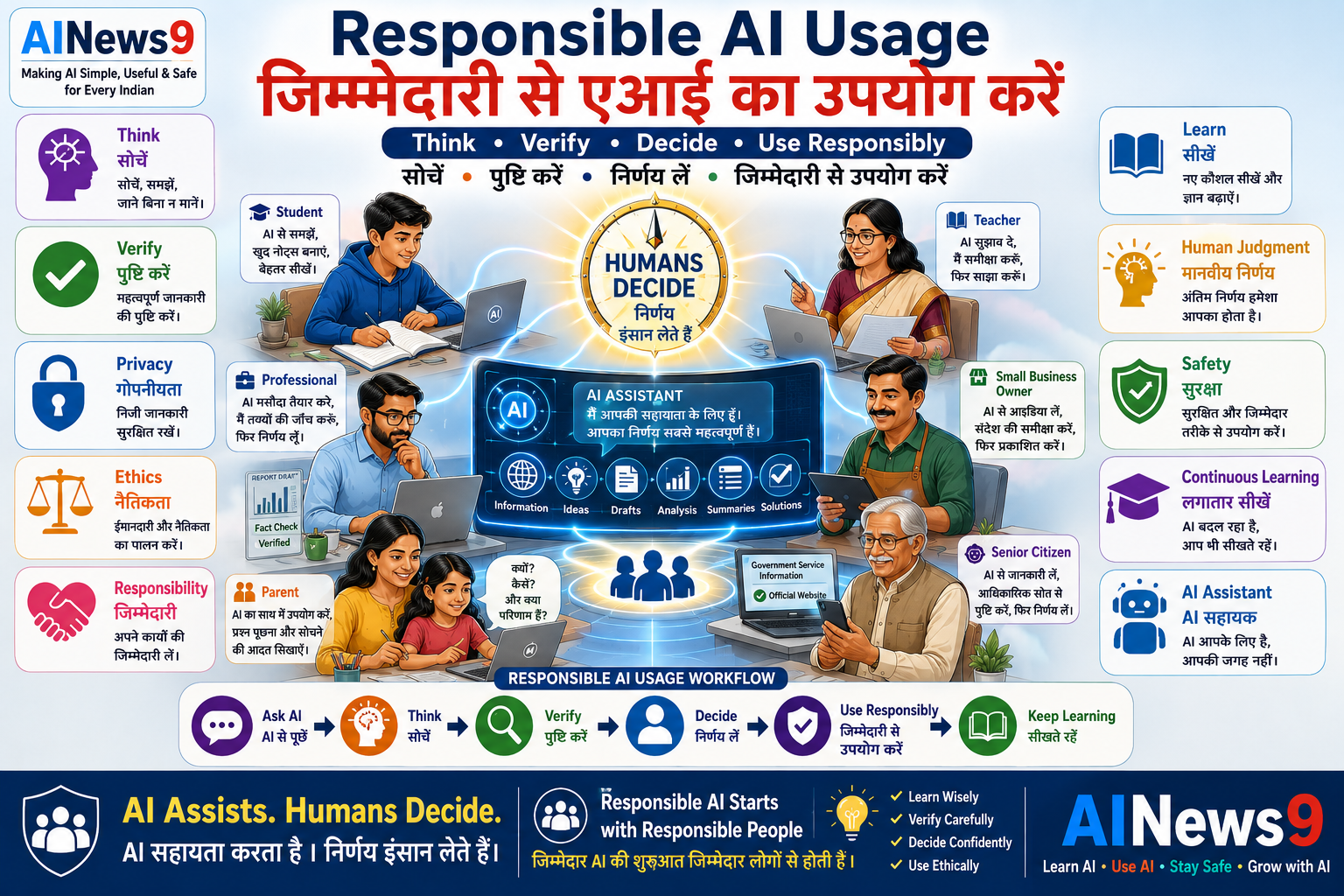
Artificial Intelligence is becoming part of everyday life—from learning and work to creativity and communication. Like any powerful tool, AI delivers the best results when used responsibly. Responsible AI use means making thoughtful decisions, respecting others, protecting privacy, and verifying important information before acting on it. In this guide, you’ll learn practical habits that will help you use AI wisely, ethically, and confidently in your daily life.
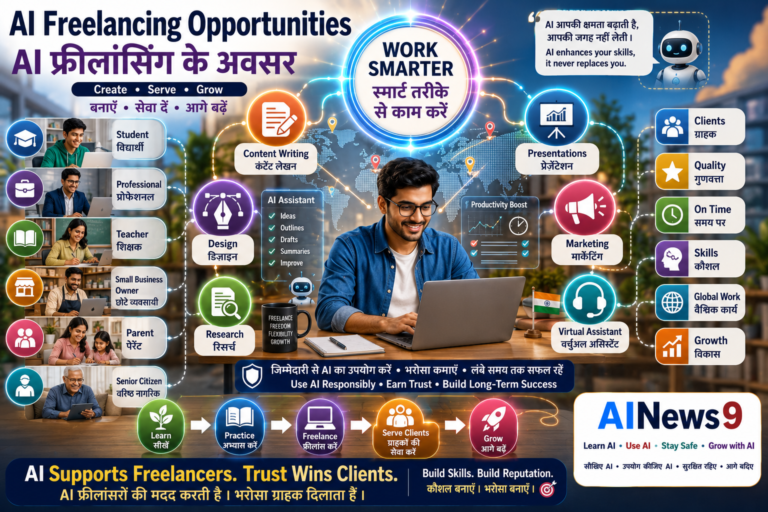
👥 Who Should Read This
This guide is ideal for:
- 🎓 Students
- 👨👩👧 Parents
- 👩🏫 Teachers
- 💼 Professionals
- 👴 Senior Citizens
- 🏪 Small Business Owners
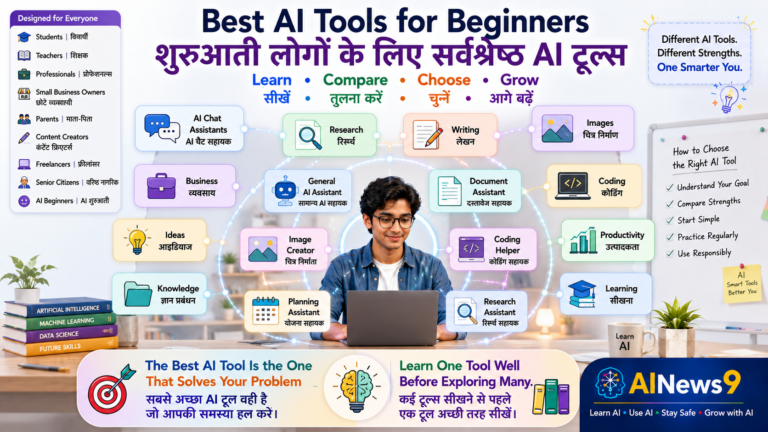
- 🌐 Anyone who uses AI tools such as ChatGPT, Gemini, Claude, Microsoft Copilot, or other AI assistants
No technical knowledge is required.
📖 What You’ll Learn
By the end of this guide, you’ll be able to:
- Understand what responsible AI use means.
- Learn why responsible AI matters.
- Develop healthy AI habits.
- Avoid common mistakes when using AI.
- Respect privacy, copyright, and other people’s work.
- Become a responsible digital citizen in the AI era.
📚 In This Guide
🤝 What Does Responsible AI Use Mean?
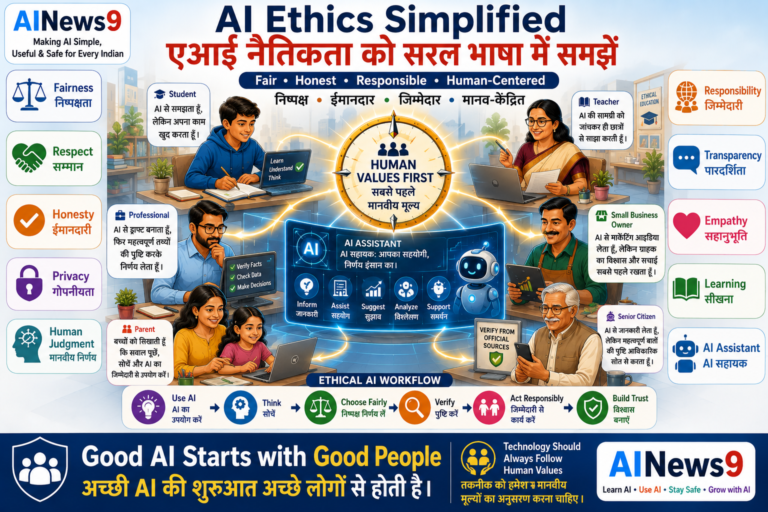
Responsible AI use means using Artificial Intelligence in a way that is safe, honest, respectful, and beneficial.
AI is a powerful assistant, but it should support your thinking—not replace it.
Being a responsible AI user means:
- Learning instead of cheating.
- Verifying important information.
- Respecting other people’s privacy.
- Protecting confidential information.
- Using AI to solve problems and create value.
- Thinking critically before accepting AI-generated answers.
Technology becomes more valuable when it is used with good judgment.
🌍 Why Responsible AI Matters
Artificial Intelligence is influencing many aspects of modern life.
People use AI to:
- Learn new skills.
- Write emails and reports.
- Create presentations.
- Solve technical problems.
- Generate ideas.
- Translate languages.
- Improve productivity.
Because AI is becoming more common, our choices as users matter more than ever.
Responsible AI use helps:
- Build trust.
- Reduce misinformation.
- Protect privacy.
- Encourage fairness.
- Support learning.
- Improve decision-making.
Every responsible action contributes to a healthier digital environment.
✅ Principles of Responsible AI Use
The following principles can help anyone use AI more responsibly.
🎯 Use AI to Learn, Not to Replace Learning
AI should help you understand concepts, explore ideas, and improve your skills.
Instead of asking AI to complete all your work, use it to:
- Explain difficult topics.
- Practice new skills.
- Improve your writing.
- Generate ideas.
- Learn more efficiently.
Real learning happens when you understand the answer.
🔍 Verify Important Information
AI can make mistakes.
Before using AI-generated information for:
- School assignments
- Office work
- Financial decisions
- Medical topics
- Legal matters
Always verify the information using trusted sources.
Critical thinking remains essential.
🔒 Respect Privacy
Never share:
- Passwords
- Banking details
- Identity documents
- Confidential business information
- Other people’s personal information
Responsible AI users protect both their own privacy and the privacy of others.
📚 Respect Copyright and Original Work
AI can help you create content, but that doesn’t mean you should copy or claim someone else’s work as your own.
Whenever appropriate:
- Write in your own words.
- Credit original sources.
- Respect intellectual property.
- Avoid plagiarism.
AI should enhance creativity—not replace honesty.
🤝 Use AI to Help, Not Harm
Artificial Intelligence should never be used to:
- Harass people.
- Spread misinformation.
- Create harmful content.
- Mislead others.
- Encourage discrimination.
- Support illegal activities.
Responsible AI creates positive impact.
🛡️ AINews9 Responsible AI Principle
Artificial Intelligence becomes truly valuable when it is guided by human responsibility, honesty, and good judgment.
🚫 Unhealthy AI Habits to Avoid
Sometimes people misuse AI without realizing the consequences.
Avoid habits such as:
- Copying AI-generated answers without understanding them.
- Using AI to cheat in exams or assignments.
- Sharing confidential information with public AI tools.
- Believing every AI response without verification.
- Creating fake or misleading content.
- Depending on AI for every decision.
Healthy AI habits help you become more capable—not more dependent.
⚠️ Safety Alert
AI is a powerful assistant, but you remain responsible for your decisions, actions, and the content you choose to create or share.
🛡️ AINews9 Safety Tip #1
Responsible AI users don’t ask, “Can AI do this?” They also ask, “Should AI be used this way?”
✅ Safe Practice
The next time you use AI, ask yourself:
“Is this helping me learn, improve, or solve a problem responsibly?”
If the answer is Yes, you’re likely using AI in the right way.
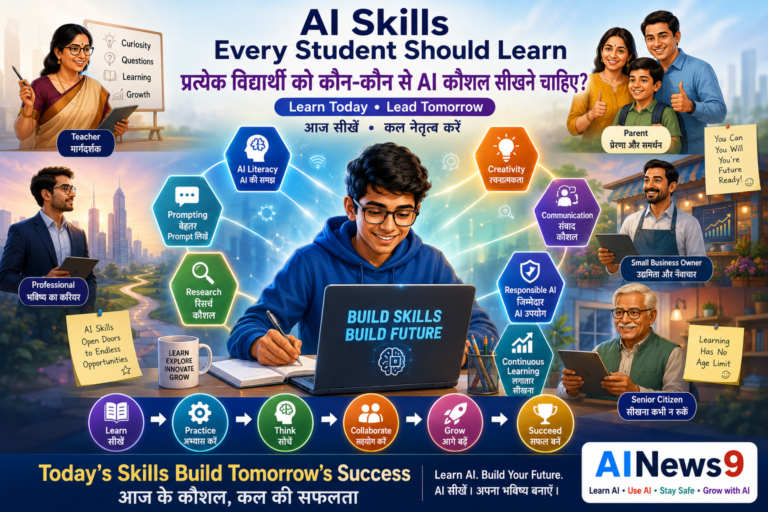
🎓 Responsible AI for Students
AI can become an excellent learning companion when used correctly.
Use AI to:
- Understand difficult concepts.
- Practice solving problems.
- Improve writing and communication.
- Learn coding and new skills.
- Prepare for exams through practice questions.
- Explore new ideas and subjects.
Avoid using AI to:
- Complete homework without understanding it.
- Cheat during exams.
- Submit AI-generated work as your own.
- Copy answers without verification.
Remember:
AI should strengthen your learning—not replace it.
👨👩👧 Responsible AI for Families
Families play an important role in helping children develop healthy AI habits.
Parents can encourage children to:
- Ask questions instead of copying answers.
- Verify information from trusted sources.
- Protect personal information.
- Respect others online.
- Discuss unusual AI-generated content openly.
- Use AI for creativity and learning rather than shortcuts.
When families learn together, children develop confidence and digital responsibility.
👩🏫 Responsible AI for Teachers
Teachers can use AI to save time while improving learning experiences.
Responsible uses include:
- Creating lesson plans.
- Generating quiz questions.
- Preparing classroom activities.
- Explaining complex topics.
- Personalizing learning resources.
- Improving educational content.
Teachers should also help students:
- Think critically.
- Verify AI-generated information.
- Understand AI’s limitations.
- Use AI ethically and responsibly.
AI should support teaching—not replace the teacher’s expertise and guidance.
💼 Responsible AI in the Workplace
AI is transforming how professionals work.
Common responsible uses include:
- Drafting emails.
- Creating presentations.
- Summarizing reports.
- Brainstorming ideas.
- Writing code.
- Improving productivity.
Before using AI at work:
- Follow your organization’s AI policy.
- Protect confidential information.
- Verify AI-generated content.
- Review important documents carefully.
- Maintain professional accountability.
Remember:
You remain responsible for the work you submit—even when AI helps create it.
🏪 Responsible AI for Small Businesses
Small businesses can use AI to improve efficiency without compromising trust.
Examples include:
- Creating marketing content.
- Writing product descriptions.
- Drafting customer emails.
- Planning social media campaigns.
- Analyzing business trends.
- Improving customer support.
Business owners should always:
- Protect customer information.
- Verify business decisions.
- Respect copyright.
- Be transparent when appropriate.
- Review AI-generated content before publishing.
Responsible businesses build stronger customer trust.
🌟 Everyday Responsible AI Habits
Good AI habits develop over time.
Simple daily practices include:
- Verify important information.
- Think before sharing AI-generated content.
- Respect privacy.
- Protect confidential information.
- Credit original creators.
- Continue learning.
- Use AI to improve your own skills.
Responsible AI use is built through consistent small actions.
🤝 The AINews9 Responsible AI Pledge™
Responsible AI begins with personal responsibility.
Take a moment to read this pledge.
I Pledge That I Will:
✅ Use AI to learn, create, and solve problems responsibly.
✅ Verify important information before believing or sharing it.
✅ Respect the privacy of myself and others.
✅ Protect confidential and personal information.
✅ Respect copyright and acknowledge original work.
✅ Think critically instead of blindly trusting AI.
✅ Use AI to help people—not to mislead or harm them.
✅ Continue learning as AI technology evolves.
This pledge represents the values of a responsible AI user.
⚠️ Safety Alert
Artificial Intelligence can support your decisions, but it should never replace your judgment, integrity, or responsibility.
🛡️ AINews9 Safety Tip #2
Responsible AI is not about using AI more often—it’s about using AI more wisely.
✅ Safe Practice
Before relying on any AI-generated response, ask yourself:
- Have I understood this?
- Have I verified important facts?
- Would I confidently explain this in my own words?
If the answer is Yes, AI has supported your learning rather than replacing it.
🚫 Common Mistakes in Responsible AI Use
Most people don’t misuse AI intentionally.
Instead, problems often arise because users rely on AI too much or use it without thinking critically.
Avoid these common mistakes.
| ❌ Common Mistake | ✅ Better Practice |
|---|---|
| Trusting every AI response without verification | Verify important information using reliable sources. |
| Copying AI-generated work without understanding it | Learn from AI and write in your own words. |
| Sharing confidential information with AI | Remove personal or sensitive information before using AI. |
| Using AI to cheat | Use AI to understand concepts and improve your skills. |
| Publishing AI-generated content without reviewing it | Read, edit, and verify all AI-generated content. |
| Depending on AI for every decision | Combine AI assistance with your own judgment and experience. |
Remember:
Responsible AI users remain in control. AI is a helpful assistant—not the final decision-maker.
🌟 Best Practices for Responsible AI Use
Responsible AI use is based on thoughtful decisions rather than technical expertise.
Develop these habits whenever you use AI.
✅ Think Critically
AI can provide useful suggestions, but not every answer will be accurate or appropriate.
Ask yourself:
- Does this make sense?
- Is there evidence to support it?
- Can I verify this elsewhere?
Critical thinking remains your greatest strength.
✅ Keep Learning
Artificial Intelligence evolves rapidly.
Stay informed by:
- Reading trusted resources.
- Exploring new AI features.
- Understanding AI limitations.
- Learning about emerging risks and opportunities.
Continuous learning helps you use AI more effectively.
✅ Be Transparent
If AI has significantly helped create content, consider being transparent when appropriate.
Examples include:
- Educational projects
- Workplace collaboration
- Professional writing
Transparency builds trust.
✅ Respect Others
Use AI in ways that benefit people.
Avoid creating:
- Fake content
- Misleading information
- Offensive material
- Content that harms others
Technology should be used to solve problems—not create them.
🤝 Follow the AINews9 Responsible AI Pledge™
The principles you’ve learned throughout this article are summarized in one simple commitment.
I Will:
- ✅ Use AI to learn—not to deceive.
- ✅ Verify important information before sharing it.
- ✅ Protect my privacy and respect the privacy of others.
- ✅ Respect copyright and original creators.
- ✅ Think critically before accepting AI-generated content.
- ✅ Use AI to create positive value for society.
Responsible AI begins with responsible people.
🛡️ AINews9 Safety Tip #3
The best AI users are not those who depend on AI the most—they are those who combine AI with knowledge, integrity, and good judgment.
🌍 Building Lifelong Responsible AI Habits
Artificial Intelligence will continue to become more powerful and more widely used.
The skills that will matter most are not only technical skills—they are human skills.
Develop these lifelong habits:
- Stay curious.
- Keep learning.
- Verify information.
- Protect privacy.
- Respect others.
- Think independently.
- Use AI to improve yourself and help others.
These habits will remain valuable regardless of how AI technology evolves.
📝 Key Takeaways
Congratulations!
You now understand what it means to become a responsible AI user.
Remember these important lessons:
- ✅ Use AI to support learning—not replace it.
- ✅ Verify important information before acting.
- ✅ Protect personal and confidential information.
- ✅ Respect copyright and original work.
- ✅ Think critically instead of blindly trusting AI.
- ✅ Review AI-generated content before using it.
- ✅ Use AI in ways that benefit yourself and others.
- ✅ Continue learning as AI evolves.
❓ Frequently Asked Questions
1. What does responsible AI use mean?
Responsible AI use means using Artificial Intelligence safely, honestly, respectfully, and thoughtfully while protecting privacy, verifying information, and respecting others.
2. Is it okay to use AI for homework?
Yes.
AI can help explain concepts, generate ideas, and improve understanding.
However, students should complete their own learning and avoid submitting AI-generated work without understanding it.
3. Should I trust every AI answer?
No.
AI is a helpful assistant, but it can make mistakes.
Always verify important information using trusted sources.
4. Can AI replace human judgment?
No.
AI supports decision-making, but people remain responsible for final decisions.
Critical thinking and human judgment are essential.
5. Is it acceptable to copy AI-generated content?
Avoid copying content without review or understanding.
Whenever appropriate, edit the content, add your own insights, and respect copyright and originality.
6. How can businesses use AI responsibly?
Businesses should:
- Protect customer data.
- Follow organizational policies.
- Verify AI-generated content.
- Respect copyright.
- Maintain transparency where appropriate.
7. Why is responsible AI important?
Responsible AI builds trust, protects privacy, reduces misinformation, supports learning, and helps ensure AI benefits individuals and society.
8. What is the simplest responsible AI rule?
Remember:
Use AI to assist your thinking—not replace it.
📚 Trusted Resources
To continue learning about responsible AI, explore these trusted resources:
- UNESCO – Guidance on Generative AI
- OECD AI Principles
- OpenAI Safety & Privacy Resources
- Google Safety Center
- Microsoft Responsible AI
- AINews9 Stay Safe Series
Learning from trusted sources helps you become a confident and responsible AI user.
💬 Final Thoughts
Artificial Intelligence is one of the most powerful technologies of our time.
Its greatest impact will depend not only on how advanced the technology becomes, but also on how responsibly people choose to use it.
Responsible AI use isn’t about fear or avoiding technology.
It’s about combining AI with honesty, critical thinking, respect, and good judgment.
Remember:
The future belongs to people who use AI responsibly, continue learning, and apply technology to create positive change for themselves, their communities, and society.
Every responsible decision you make helps build a safer, smarter, and more trustworthy AI-powered world.
🎓 Continue Your AI Journey
Continue building your AI knowledge with AINews9.
📘 Learn AI
- L001 – What is Artificial Intelligence?
- L002 – What is Generative AI?
- L003 – What is Machine Learning?
- L004 – What are Large Language Models (LLMs)?
- L005 – What is ChatGPT?
- L006 – What are AI Agents?
- L007 – What is Prompt Engineering?
- L008 – How Does AI Work?
- L009 – History of Artificial Intelligence
- L010 – AI Terminology Explained
🛠️ Use AI
- U001 – How Students Can Use AI Effectively
- U002 – How Teachers Can Use AI in Education
- U003 – How Professionals Can Use AI at Work
- U004 – How Small Businesses Can Use AI
- U005 – Beginner’s Guide to ChatGPT
- U006 – Beginner’s Guide to Gemini
- U007 – Beginner’s Guide to Claude
- U008 – Beginner’s Guide to NotebookLM
- U009 – AI for Everyday Productivity
- U010 – 10 Best AI Tools for Beginners
🛡️ Stay Safe
- S001 – AI Safety for Beginners
- S002 – What Are Deepfakes?
- S003 – AI Scams and How to Avoid Them
- S004 – AI Safety for Children & Parents
- S005 – AI and Data Privacy
- S006 – Safe Prompting Practices
- S007 – AI Misinformation: How to Identify Fake AI Content
- S008 – Avoiding AI Fraud: Practical Tips to Stay Safe Online
- S009 – Responsible AI Use: Best Practices for Everyone ✅
- S010 – AI Ethics Explained
About AINews9
AINews9 is India’s AI Literacy Platform with a mission to make Artificial Intelligence Simple, Useful & Safe for Every Indian.
We empower:
- 🎓 Students
- 👩🏫 Teachers
- 👨👩👧 Parents
- 💼 Professionals
- 👴 Senior Citizens
- 🏪 Small Business Owners
Through our four learning pillars:
- 📘 Learn AI
- 🛠️ Use AI
- 🛡️ Stay Safe
- 🚀 Grow with AI
Together, we’re helping every Indian develop the knowledge, confidence, and values needed to use Artificial Intelligence responsibly, ethically, and productively.