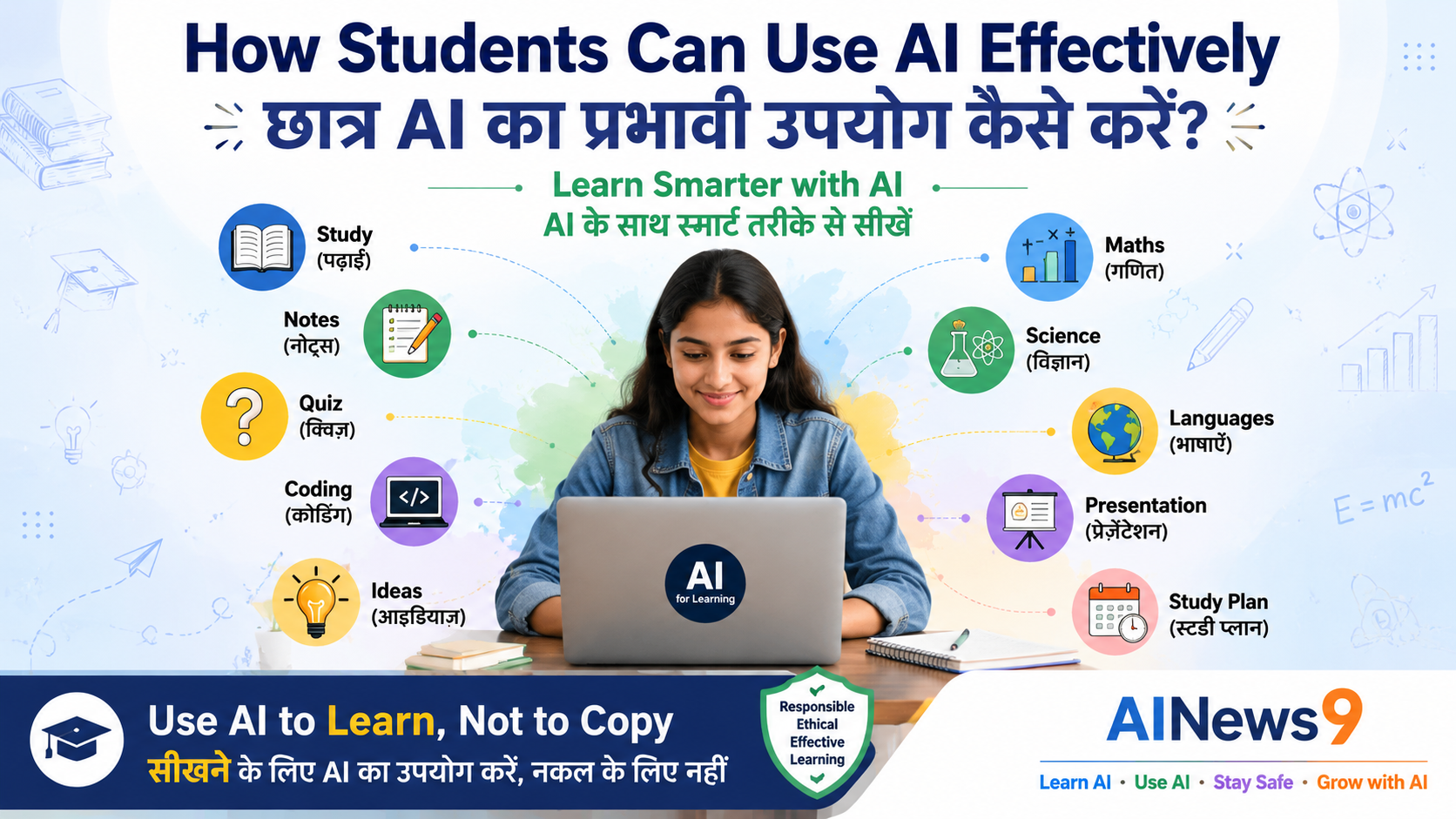
How Students Can Use AI Effectively
A Practical Beginner’s Guide to Learning Smarter with Artificial Intelligence
Artificial Intelligence (AI) is rapidly changing the way students learn, study, solve problems, and prepare for future careers. From understanding difficult subjects and creating study notes to practicing for exams and improving writing skills, AI has become a powerful learning companion for millions of students around the world.
However, the real benefit of AI does not come from completing homework faster—it comes from learning smarter.
When used responsibly, AI can help you understand concepts more clearly, improve productivity, develop critical thinking, and build skills that will remain valuable throughout your academic and professional life.
In this practical guide, you’ll discover how students can use AI effectively, ethically, and responsibly to become confident learners in the age of Artificial Intelligence.
👥 Who Should Read This
This lesson is designed for:
- School students (Classes 6–12)
- College and university students
- Competitive exam aspirants
- Online learners and self-learners
- Parents who want to guide their children in using AI responsibly
- Teachers introducing AI-assisted learning in classrooms
No prior knowledge of Artificial Intelligence is required.
📖 What You’ll Learn
By the end of this lesson, you will be able to:
- Understand how AI can improve everyday learning.
- Use AI to study smarter instead of harder.
- Create effective study plans using AI.
- Improve writing, research, presentations, and revision.
- Learn the responsible and ethical use of AI in education.
- Avoid common mistakes students make while using AI.
- Build future-ready AI skills that will remain valuable throughout your career.
📚 In This Lesson
🚀 Why Every Student Should Learn AI
Artificial Intelligence is no longer a futuristic technology—it is becoming an essential part of modern education.
Just as students learned to use computers, the internet, and smartphones over the past two decades, today’s students need to learn how to use AI effectively. Schools, universities, businesses, and governments across the world are increasingly adopting AI-powered tools to improve learning, productivity, and decision-making.
Learning how to work with AI today is similar to learning how to use the internet twenty years ago. Students who understand AI will be better prepared for higher education, future careers, and lifelong learning.
However, learning AI does not mean becoming a programmer or data scientist.
It means understanding how AI can help you:
- Learn new concepts faster.
- Think more critically.
- Solve problems creatively.
- Improve communication skills.
- Increase productivity.
- Prepare for an AI-driven workplace.
AI is becoming a life skill—not just a technology skill.
🤖 AI as Your Smart Study Partner
Many students believe AI is simply a tool that writes answers or completes homework.
That is one of the biggest misconceptions about Artificial Intelligence.
Instead, think of AI as a personal study partner that is available whenever you need help.
A good study partner does not take your exam or complete your assignments. Instead, they:
- Explain difficult concepts.
- Answer your questions patiently.
- Help you revise important topics.
- Ask practice questions.
- Encourage better thinking.
- Help you organize your study schedule.
AI can perform many of these tasks instantly, making learning more interactive and personalized.
For example, if you do not understand Newton’s Laws of Motion, instead of reading the same paragraph repeatedly, you can ask AI to explain the concept using everyday examples, simple language, or even a story.
Example Prompt
“Explain Newton’s First Law to a Class 8 student using a bicycle as an example.”
This ability to personalize explanations makes AI an excellent learning companion—but remember, AI supports learning; it should never replace your own thinking and effort.
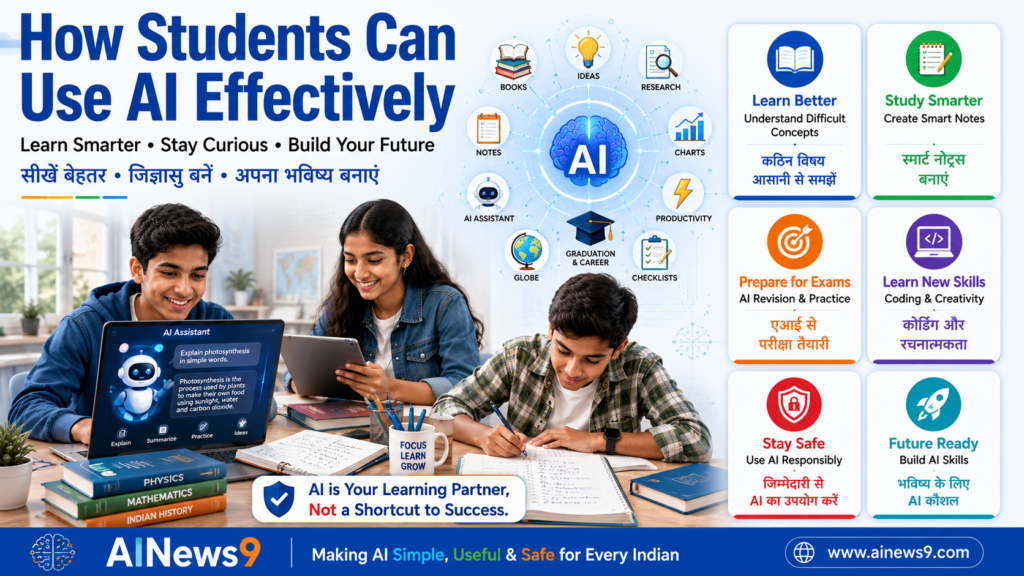
📚 Practical Ways Students Can Use AI
Artificial Intelligence can support students throughout their learning journey. The key is to use it as a tool for understanding and improving knowledge, rather than as a shortcut for completing assignments.
In the following sections, we’ll explore some of the most practical ways students can use AI in their daily academic life.
Understanding Difficult Concepts
Every student learns differently.
Some understand concepts by reading textbooks, while others learn better through examples, stories, diagrams, or visual explanations.
AI can adapt explanations to suit your learning style.
For example, instead of asking:
“Explain Photosynthesis.”
You could ask:
Example Prompt
“Explain Photosynthesis to a Class 7 student using simple language and real-life examples.”
The AI can simplify technical concepts, provide analogies, and even explain the same topic in multiple ways until you understand it.
This personalized approach makes learning more engaging and less frustrating.
Creating Better Study Notes
Preparing concise notes is one of the most effective ways to revise before examinations.
AI can help you:
- Summarize long chapters.
- Organize information into bullet points.
- Create revision checklists.
- Generate flashcards.
- Develop mind map ideas.
Rather than replacing your own notes, AI should help you organize and improve them.
Good notes are not copied—they are understood.
Preparing for Exams More Effectively
Examinations are often stressful because students have limited time to revise large amounts of information. AI can help make exam preparation more organized, focused, and productive.
AI can assist you in:
- Creating personalized revision schedules.
- Identifying weak subjects and topics.
- Generating chapter-wise quizzes.
- Creating mock tests with answers.
- Explaining incorrect answers.
- Revising important concepts quickly.
Instead of studying randomly, AI can help you build a structured revision plan based on your available time and learning goals.
Example Prompt
“Create a 14-day revision timetable for my Class 10 Science exam. I can study 3 hours every day.”
Remember, AI can help you prepare—but consistent practice and self-discipline are still the keys to success.
Improving Homework Without Cheating
One of the biggest misconceptions about AI is that it should be used to complete homework automatically.
That is not the right way to use AI.
Instead, use AI to:
- Understand the question.
- Learn the underlying concept.
- Review your own answers.
- Improve grammar and presentation.
- Check for missing points.
For example, instead of asking AI:
❌ “Write my history assignment.”
A better approach is:
✅ “Review my history assignment and suggest improvements without rewriting it completely.”
This approach helps you learn while maintaining academic honesty.
Conducting Better Research
Research is an essential skill for every student.
Whether you are preparing a school project, writing a college report, or participating in a science exhibition, AI can make research more efficient.
AI can help you:
- Understand unfamiliar topics.
- Generate research questions.
- Summarize lengthy articles.
- Compare different viewpoints.
- Organize research findings.
- Suggest reliable sources to explore further.
However, students should always verify important facts using trusted sources such as textbooks, educational websites, research papers, and official publications.
AI should guide your research—not become your only source of information.
Improving Writing Skills
Good communication is valuable in every subject and every profession.
AI can help students improve:
- Essays
- Reports
- Letters
- Emails
- Creative writing
- Project documentation
- Grammar
- Vocabulary
- Sentence structure
Rather than asking AI to write everything for you, use it as an editor or writing coach.
Example Prompt
“Review my essay and suggest improvements in grammar, clarity, vocabulary, and sentence flow without changing my writing style.”
Over time, this process helps students become better writers and communicators.
Creating Better Presentations
Many students struggle with organizing presentations.
AI can help by suggesting:
- Presentation structure.
- Slide titles.
- Key discussion points.
- Simple explanations.
- Real-life examples.
- Speaking notes.
This saves time while allowing students to focus on creativity and delivery.
Example Prompt
“Create an outline for a 10-slide presentation on Renewable Energy for Class 9 students using simple language.”
Remember that AI should help organize your ideas—it should never replace your own creativity or understanding.
Learning Programming and Coding
Students interested in computer science can use AI as a coding mentor.
AI can:
- Explain programming concepts.
- Debug code.
- Identify logical errors.
- Suggest improvements.
- Explain error messages.
- Generate practice exercises.
- Recommend learning resources.
Whether you’re learning Python, Java, C++, JavaScript, or Scratch, AI can make programming less intimidating.
The goal should never be to copy code.
Instead, ask AI to explain why a solution works so you develop genuine programming skills.
Learning New Languages
Learning a new language requires regular practice.
AI provides students with a safe environment to practice conversations without feeling embarrassed about making mistakes.
Students can use AI to:
- Improve grammar.
- Learn vocabulary.
- Practice conversations.
- Translate sentences.
- Understand pronunciation rules.
- Receive writing feedback.
Daily practice with AI can significantly improve confidence in English and other languages.
Becoming More Productive Every Day
AI is not only useful for academics—it can also help students become more organized.
Students can use AI to:
- Create daily schedules.
- Maintain study planners.
- Build habit trackers.
- Organize project deadlines.
- Prepare to-do lists.
- Balance academics with extracurricular activities.
Developing good productivity habits early in life helps students perform better both inside and outside the classroom.
Real-Life Examples of AI in Student Life
AI can support students in many practical situations.
| Situation | How AI Can Help |
|---|---|
| Preparing for an exam | Create revision plans and practice quizzes |
| Completing a science project | Brainstorm ideas and organize information |
| Writing an essay | Improve grammar and clarity |
| Learning mathematics | Explain step-by-step solutions |
| Learning programming | Explain code and debug errors |
| Preparing presentations | Create outlines and speaking notes |
| Learning English | Practice conversations and vocabulary |
| Managing study time | Build personalized schedules |
These examples show that AI is most effective when it enhances learning—not when it replaces it.
💡 AINews9 Smart Tip
The quality of AI’s response depends on the quality of your question.
Instead of asking:
“Explain AI.”
Try asking:
“Explain Artificial Intelligence to a Class 9 student using simple language, real-life examples, and a comparison with human intelligence.”
Better questions almost always produce better answers.
Learning to ask better questions is one of the most valuable AI skills you can develop.
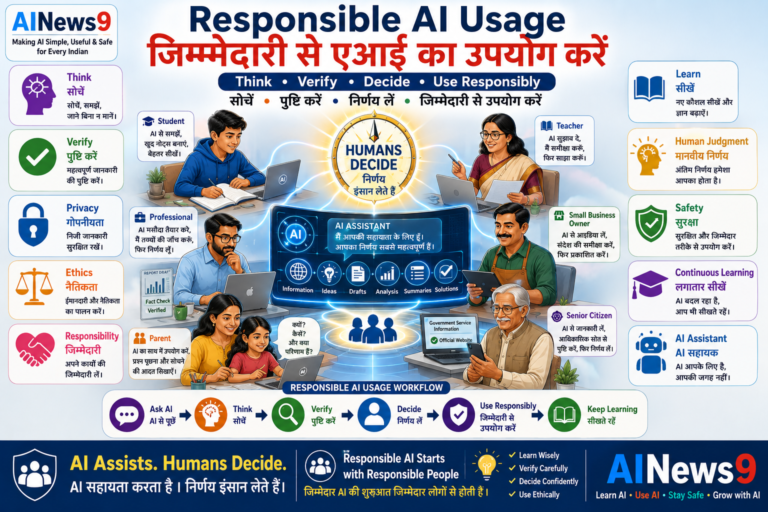
⚠️ Responsible AI Usage for Students
Artificial Intelligence is one of the most powerful learning tools ever created. However, like every powerful technology, its value depends on how responsibly it is used.
AI should help you become a better learner, better thinker, and better problem solver—not someone who simply copies answers.
The students who succeed in the AI era will not be those who use AI the most. They will be those who use AI wisely, ethically, and responsibly.
Use AI to Learn, Not to Copy
The biggest mistake students make is treating AI as a homework machine.
Imagine asking AI to write your assignment, copying the answer, and submitting it without understanding anything.
You may complete the assignment in five minutes—but you lose the opportunity to learn.
Instead, use AI to:
- Understand difficult topics.
- Review your answers.
- Improve your writing.
- Generate practice questions.
- Identify mistakes.
- Discover new ideas.
The best learning happens when you think first and AI supports you later.
Verify Every Important Answer
Although AI is incredibly powerful, it is not perfect.
Sometimes AI can:
- Provide outdated information.
- Misunderstand your question.
- Make calculation mistakes.
- Generate incorrect facts.
- Create fictional references.
Before using AI-generated information in assignments or projects, always verify it using:
- Your textbook
- Teacher’s guidance
- Trusted educational websites
- Official government or university sources
Developing the habit of verification is an essential skill in the age of AI.
Protect Your Privacy
Never share personal or confidential information with public AI tools.
Avoid entering:
- Passwords
- Aadhaar number
- PAN details
- Bank account information
- OTPs
- Examination login credentials
- Personal addresses
- Medical records
Your personal information is valuable.
Protect it just as carefully online as you would in real life.
Respect School and College Policies
Different schools and universities have different rules regarding AI usage.
Some institutions encourage AI-assisted learning, while others restrict its use during examinations or assignments.
Always:
- Follow your institution’s academic integrity policy.
- Ask your teacher if you are unsure.
- Acknowledge AI assistance when required.
- Submit work that genuinely reflects your own understanding.
Responsible AI usage builds trust between students and educators.
🚫 Common Mistakes Students Should Avoid
Many students are excited to use AI, but beginners often make similar mistakes.
Avoiding these mistakes will help you become a more confident and responsible AI user.
| ❌ Common Mistake | ✅ Better Practice |
|---|---|
| Copying AI-generated assignments | Understand first, then write in your own words |
| Believing every AI response | Verify important facts using trusted sources |
| Asking vague questions | Write clear and specific prompts |
| Depending on AI for everything | Continue developing your own thinking skills |
| Ignoring privacy | Never share confidential information |
| Using AI during restricted examinations | Follow your institution’s rules |
Remember:
AI should enhance your intelligence—not replace it.
🌟 Best AI Tools for Students
Different AI tools are designed for different purposes. Understanding their strengths helps students choose the right tool for the right task.
| AI Tool | Best For |
|---|---|
| ChatGPT | Learning, brainstorming, writing, coding, revision |
| Google Gemini | Research, Google Workspace integration |
| Microsoft Copilot | Productivity, Microsoft Office, presentations |
| NotebookLM | Studying personal notes and documents |
| Claude | Long-form explanations and writing assistance |
| Perplexity AI | Research with source references |
As you continue your AI learning journey, you’ll discover that no single tool is perfect for every task. Learning when and how to use different tools is an important digital skill.
📝 Key Takeaways for How Students Can Use AI Effectively
Congratulations! You’ve completed another important lesson in your AI learning journey.
Here are the key ideas to remember:
- ✅ AI is a learning assistant—not a replacement for your education.
- ✅ Students should use AI to understand concepts, not simply complete homework.
- ✅ AI can improve research, writing, revision, presentations, coding, and productivity.
- ✅ Asking better questions leads to better AI responses.
- ✅ Always verify important information before using it.
- ✅ Protect your personal information while using AI.
- ✅ Responsible AI usage builds lifelong learning habits.
- ✅ AI works best when combined with curiosity, creativity, and critical thinking.
❓ Frequently Asked Questions
1. Can students use AI for homework?
Yes. AI can help you understand questions, review your answers, and improve your work. However, your final submission should demonstrate your own understanding.
2. Is using AI considered cheating?
Not necessarily.
Using AI to learn, practice, or receive feedback is generally acceptable. Copying AI-generated answers without understanding them may violate your school’s academic integrity policy.
3. Which AI tool is best for students?
There is no single best AI tool.
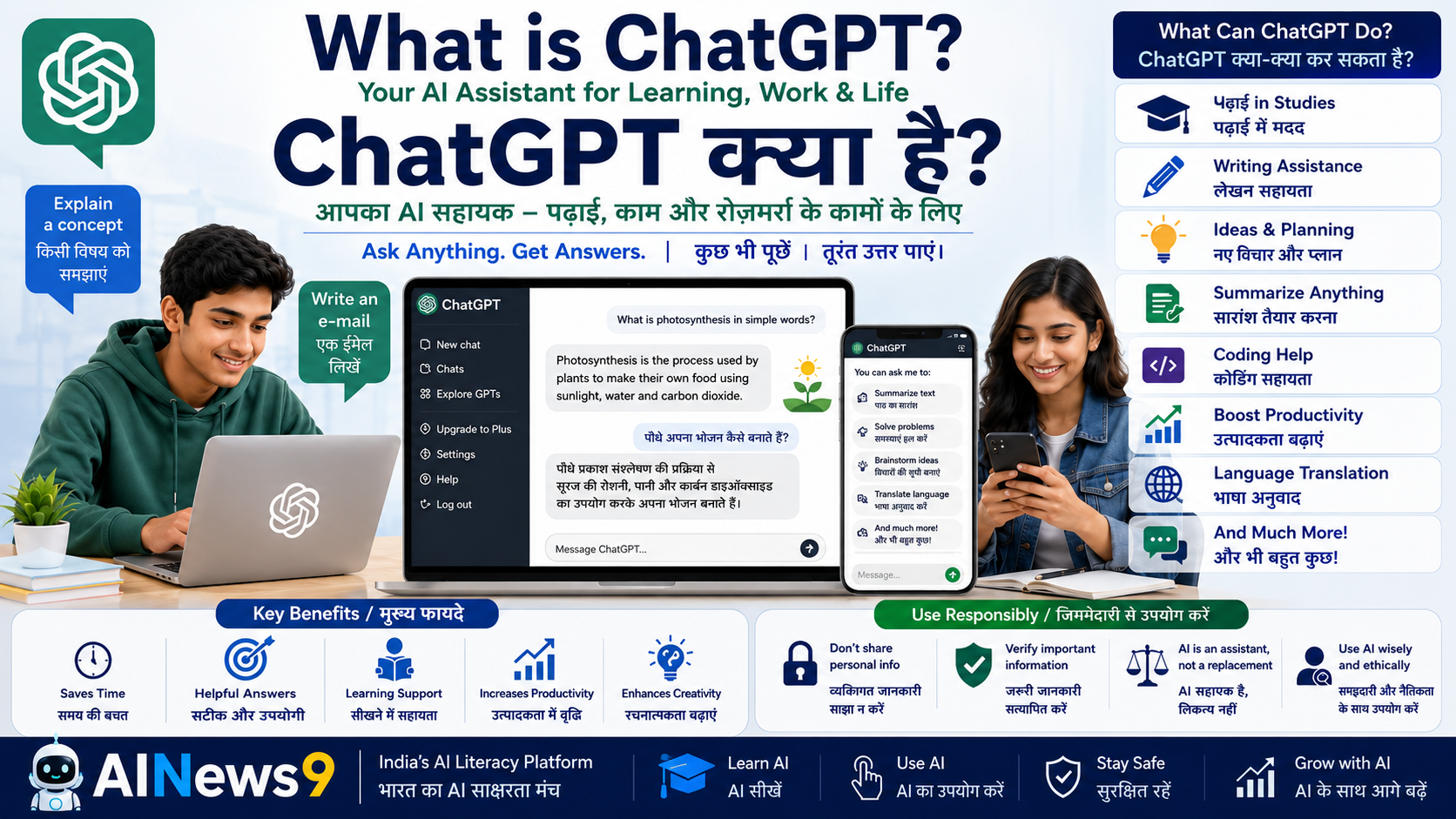
ChatGPT, Google Gemini, Microsoft Copilot, NotebookLM, Claude, and Perplexity AI each have different strengths. Choose the tool based on your learning needs.
4. Can AI help me prepare for competitive examinations?
Yes.
AI can generate practice questions, explain concepts, create revision plans, and identify weak areas. However, always rely on standard textbooks and trusted study materials for final preparation.
5. Should I trust every AI answer?
No.
Always verify important information before using it in assignments, projects, or examinations.
6. Can AI replace teachers?
Absolutely not.
Teachers provide mentorship, experience, encouragement, emotional support, and classroom interaction that AI cannot replace.
The best education combines great teachers, curious students, and responsible AI.
📚 Recommended Resources
Want to explore how Artificial Intelligence is transforming education? The following trusted resources provide reliable information, practical guidance, and additional learning opportunities.
- OpenAI – Learn how AI assistants like ChatGPT can support learning, writing, coding, and research.
- Microsoft Learn – Discover AI learning resources, productivity tips, and educational guidance for students and educators.
- Google for Education – Explore how AI-powered tools support teaching, learning, and classroom innovation.
These resources complement this lesson and will help you build a deeper understanding of AI while developing responsible digital learning habits.
💬 Final Thoughts
Artificial Intelligence is transforming education in ways that were unimaginable just a few years ago.
Students who learn how to use AI responsibly today will be better prepared for tomorrow’s classrooms, workplaces, and careers.
Remember, AI is not here to replace your intelligence—it is here to amplify it.
Stay curious.
Keep asking questions.
Continue learning.
And most importantly, use AI to become a smarter, more responsible, and lifelong learner.
The future belongs to students who combine human intelligence with Artificial Intelligence.
Every lesson builds upon the previous one, helping you become a confident and responsible AI user.
🎓 Continue Your AI Learning Journey
Now that you understand how students can use AI effectively, continue exploring the AINews9 learning journey.
Learn AI
- L005 – What is ChatGPT?
- L006 – What are AI Agents?
- L007 – What is Prompt Engineering?
- L008 – How Does AI Work?
Use AI
- U005 – Beginner’s Guide to ChatGPT
- U006 – Beginner’s Guide to Gemini
- U008 – Beginner’s Guide to NotebookLM
Stay Safe
- S001 – AI Safety for Beginners
- S003 – Common AI Scams and How to Avoid Them
- S006 – Safe Prompting Practices
Grow with AI
- G001 – AI Skills Every Student Should Learn
- G003 – AI Career Paths Explained
- G009 – AI Careers for Students
🏛️ About AINews9
AINews9 is India’s AI Literacy Platform with a mission to make Artificial Intelligence Simple, Useful & Safe for Every Indian.
Through beginner-friendly lessons, practical guides, AI safety awareness, and real-world examples, AINews9 empowers:
- 🎓 Students
- 👩🏫 Teachers
- 👨👩👧 Parents
- 💼 Professionals
- 👴 Senior Citizens
- 🏪 Small Businesses
Our four learning pillars guide every lesson we create:
- Learn AI – Build strong AI fundamentals.
- Use AI – Apply AI effectively in everyday life and work.
- Stay Safe – Learn responsible and secure AI practices.
- Grow with AI – Prepare for future careers and opportunities.
Together, let’s build an AI-literate India—one lesson at a time.