AI Ethics: Building a Fair, Safe, and Trustworthy AI Future
⚖️ A Beginner’s Guide to Fairness, Transparency, Accountability, and Human-Centered Artificial Intelligence
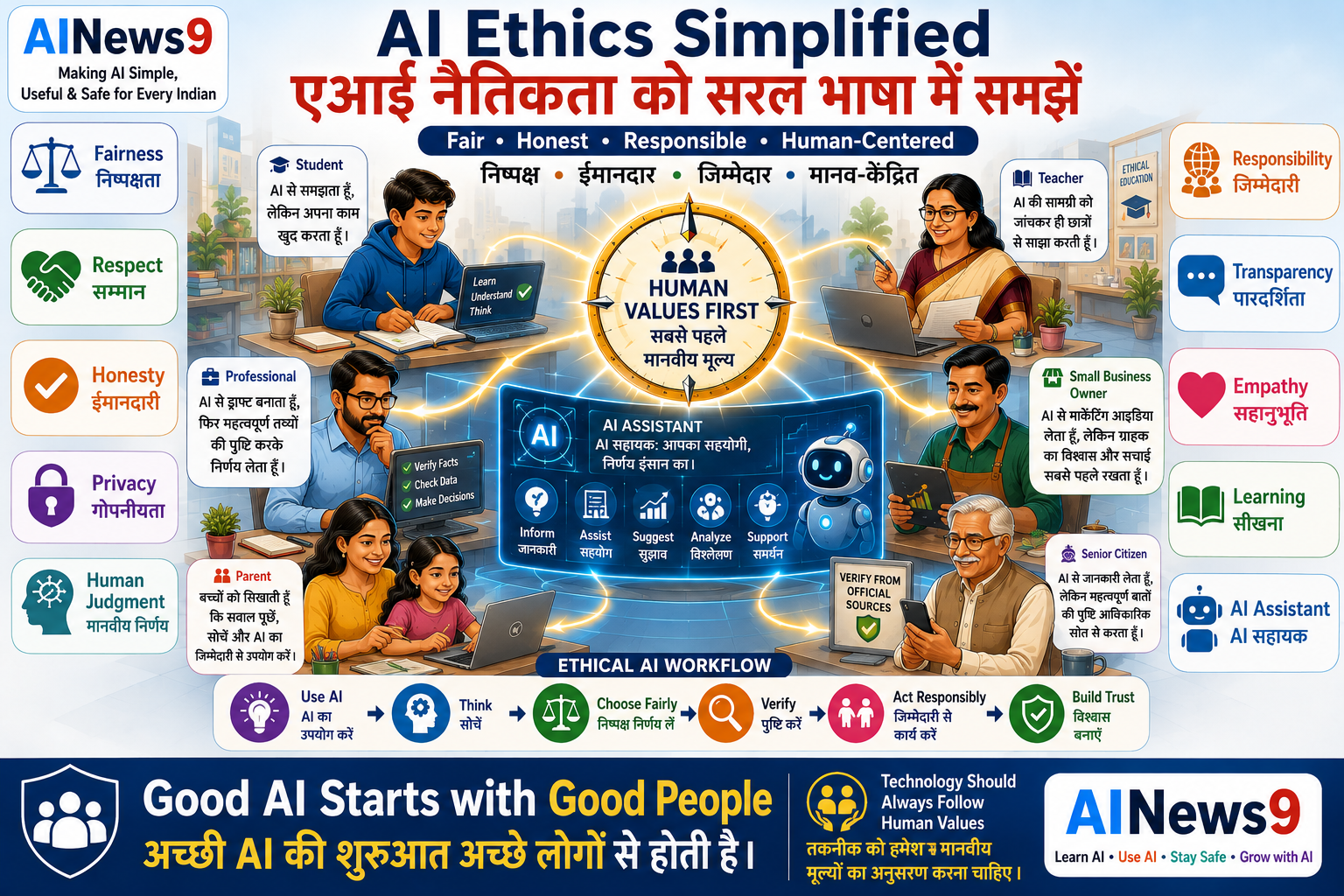
AI Ethics Simplified
Artificial Intelligence is becoming part of our everyday lives—from learning and healthcare to banking, shopping, and entertainment. As AI takes on a bigger role in important decisions, one question becomes increasingly important: How do we ensure AI is fair, safe, and trustworthy? The answer lies in AI Ethics. In this guide, you’ll discover the simple principles that help AI benefit people while protecting fairness, privacy, transparency, and human rights. No technical knowledge is required—just curiosity and a willingness to learn.
👥 Who Should Read This?
This guide is ideal for:
- 🎓 Students
- 👨👩👧 Parents
- 👩🏫 Teachers
- 💼 Professionals
- 👴 Senior Citizens
- 🏪 Small Business Owners
- 🌐 Anyone interested in understanding how AI should be used responsibly
No technical background is required.
📖 What You’ll Learn
By the end of this guide, you’ll be able to:
- Understand what AI Ethics means.
- Learn why ethical AI matters.
- Discover the six principles of trustworthy AI.
- Recognize common ethical challenges.
- Explore real-world examples of ethical AI.
- Understand your role in building a safer AI future.
- Learn the AINews9 Ethical AI Promise™.
📚 In This Guide
⚖️ What is AI Ethics?
AI Ethics is the practice of ensuring that Artificial Intelligence is designed, developed, and used in ways that are fair, transparent, accountable, safe, and beneficial for people.
Think of AI Ethics as a set of guiding values that helps answer questions such as:
- Is this AI system treating everyone fairly?
- Is people’s personal information protected?
- Can users understand how important AI decisions are made?
- Who is responsible if AI makes a mistake?
- Is AI helping people—or causing harm?
AI Ethics isn’t about slowing innovation.
It’s about making innovation more trustworthy.
Think of AI as a powerful car. A powerful engine helps it move faster, but traffic rules and responsible driving make every journey safer.
Similarly, Artificial Intelligence becomes more valuable when it follows ethical principles that protect people and society.
AI tells us what technology can do. AI Ethics helps us decide what technology should do.
🌍 Why AI Ethics Matters
Artificial Intelligence already influences millions of decisions every day.
Today, AI helps:
- 🏥 Doctors detect diseases.
- 🏦 Banks identify fraud.
- 🎓 Teachers personalize learning.
- 💼 Companies screen job applications.
- 🛒 Online stores recommend products.
- 📱 Social media platforms suggest content.
While AI creates enormous opportunities, it can also introduce bias, misinformation, privacy risks, and unfair decisions if used irresponsibly.
That is why ethical AI matters.
It helps ensure technology serves people—not the other way around.
🛡️ AINews9 Ethics Insight
The most powerful AI is not the one that makes the fastest decisions.
The most valuable AI is the one that makes decisions fairly, responsibly, and with respect for people.
🏛️ The Six Principles of Ethical AI
Ethical AI is built on a few simple principles that help technology benefit people while reducing risks. You don’t need to remember complex frameworks—understanding these six principles will help you recognize trustworthy AI wherever you see it.
🤝 1. Fairness
AI should treat everyone fairly.
It should not discriminate against people because of their gender, age, religion, caste, disability, ethnicity, or other personal characteristics.
Example:
If an AI system helps companies shortlist job applicants, it should evaluate candidates based on their skills and qualifications—not personal bias.
Why it matters:
Fair AI creates equal opportunities for everyone.
🔍 2. Transparency
People should know when AI is being used and, whenever possible, understand how important decisions are made.
Transparency builds confidence and trust.
Example:
If your bank uses AI to detect suspicious transactions, it should clearly explain why your account was temporarily blocked.
Why it matters:
People are more likely to trust AI when important decisions are explained clearly.
👤 3. Accountability
AI cannot take responsibility for its own actions.
People and organizations must remain accountable for every important AI-assisted decision.
Example:
If an AI system makes an incorrect medical recommendation, doctors and healthcare providers—not the AI—remain responsible for the final decision.
Why it matters:
Human responsibility should never disappear simply because AI was involved.
🔒 4. Privacy
AI systems often learn from large amounts of data.
Personal information should always be collected, stored, and used responsibly.
Example:
A fitness app using AI should protect your health information and never share it without your permission.
Why it matters:
Respecting privacy helps protect people’s identity, dignity, and trust.
🛡️ 5. Safety
AI should be designed to reduce mistakes, prevent misuse, and avoid causing harm.
No AI system is perfect, but responsible organizations continuously test and improve their systems.
Example:
Before an AI-powered self-driving car is allowed on public roads, it must undergo extensive safety testing.
Why it matters:
Safe AI protects people, businesses, and society from unnecessary risks.
❤️ 6. Human Oversight
AI should support human decision-making—not completely replace it.
People should remain involved whenever decisions have a significant impact on someone’s life.
Example:
AI can help teachers identify students who may need additional support, but the teacher should make the final decision after understanding each student’s situation.
Why it matters:
AI provides insights, but human experience, empathy, and judgment remain irreplaceable.
🌍 AI Ethics in Everyday Life
AI Ethics isn’t just for technology companies.
It affects many decisions we encounter every day.
Here are a few examples:
| Area | Ethical AI in Action |
|---|---|
| 🏥 Healthcare | AI assists doctors, but doctors make the final diagnosis. |
| 🎓 Education | AI personalizes learning, while teachers guide students. |
| 💼 Recruitment | AI helps shortlist candidates, but humans ensure fairness. |
| 🏦 Banking | AI detects fraud, while people review important financial decisions. |
| 🛒 Online Shopping | AI recommends products without misleading customers. |
| 📱 Social Media | AI helps reduce harmful content while respecting freedom of expression. |
When AI follows ethical principles, it improves people’s lives while respecting their rights.
⚠️ Common Ethical Challenges
Despite its benefits, AI also creates new ethical challenges.
Some of the most common include:
- ⚠️ Bias – AI may unintentionally treat some groups unfairly.
- ⚠️ Privacy Risks – Personal data can be collected or shared without proper safeguards.
- ⚠️ Deepfakes – AI-generated images, videos, and voices can be used to deceive people.
- ⚠️ Misinformation – AI can generate convincing but incorrect information.
- ⚠️ Copyright Issues – AI-generated content should respect original creators and intellectual property.
- ⚠️ Overdependence – Relying entirely on AI may reduce critical thinking and human judgment.
Recognizing these challenges is the first step toward using AI responsibly.
🤖 Ethical AI vs Unethical AI
| ✅ Ethical AI | ❌ Unethical AI |
|---|---|
| Treats people fairly | Shows unfair bias |
| Protects privacy | Misuses personal data |
| Explains important decisions | Operates like a “black box” |
| Supports human decision-making | Replaces human judgment completely |
| Helps people | Causes harm or misinformation |
The goal isn’t to create perfect AI.
The goal is to create trustworthy AI.
🛡️ AINews9 Ethics Tip #1
Before trusting an important AI-generated decision, ask yourself:
- Is it fair?
- Is it transparent?
- Is a responsible human reviewing the final decision?
If the answer is Yes, you’re much more likely to be using AI responsibly.
👨👩👧 AI Ethics for Different Users
AI Ethics isn’t only the responsibility of technology companies.
Every person who uses AI can help create a safer, fairer, and more trustworthy digital world.
Here’s how different people can contribute.
🎓 Students
Students should use AI to learn—not to cheat.
Use AI to:
- Understand difficult concepts.
- Practice solving problems.
- Improve writing and communication.
- Explore new ideas.
Always think critically and complete your own learning.
👩🏫 Teachers
Teachers can use AI to save time and create better learning experiences.
Responsible uses include:
- Creating lesson plans.
- Preparing quizzes.
- Explaining complex topics.
- Personalizing learning materials.
Teachers should also help students understand AI’s strengths, limitations, and ethical use.
👨👩👧 Parents
Parents play an important role in helping children develop healthy AI habits.
Encourage children to:
- Ask questions instead of copying answers.
- Verify information.
- Protect personal information.
- Respect others online.
- Use AI creatively and responsibly.
Learning together builds confidence and digital responsibility.
💼 Professionals
AI can improve productivity, but professional responsibility always remains with people.
Before using AI at work:
- Verify important information.
- Protect confidential data.
- Follow your organization’s AI policy.
- Review AI-generated content carefully.
Remember:
You remain responsible for the work you submit—even when AI helps create it.
🏪 Small Business Owners
AI can help businesses work smarter.
Examples include:
- Creating marketing content.
- Drafting customer emails.
- Generating product descriptions.
- Analyzing business trends.
Business owners should always protect customer privacy, verify AI-generated content, and maintain transparency with customers.
🌟 Building an Ethical AI Future
Building ethical AI isn’t only about writing better software.
It’s about making better choices every day.
Simple habits include:
- ✅ Think before trusting AI.
- ✅ Verify important information.
- ✅ Respect people’s privacy.
- ✅ Challenge unfair or biased AI decisions.
- ✅ Respect copyright and original creators.
- ✅ Use AI to help people—not harm them.
- ✅ Keep learning as AI continues to evolve.
Small responsible actions, repeated every day, create a safer AI future for everyone.
⚖️ The AINews9 Ethical AI Promise™
Ethical AI begins with ethical people.
Take a moment to read this promise.
I Promise That I Will:
✅ Use AI fairly and responsibly.
✅ Respect every person’s privacy and dignity.
✅ Verify important information before believing or sharing it.
✅ Never use AI to deceive, manipulate, or harm others.
✅ Respect copyright and acknowledge original creators.
✅ Remember that humans—not AI—are responsible for important decisions.
✅ Use Artificial Intelligence to solve problems, improve lives, and create positive impact.
This simple promise reflects the values of a responsible AI user.
🚫 Common Myths About AI Ethics
Let’s clear up a few common misconceptions.
| ❌ Myth | ✅ Reality |
|---|---|
| AI is always neutral. | AI can inherit bias from data and human decisions. |
| AI always makes the right decision. | AI can make mistakes and should be reviewed. |
| Ethics only matters for programmers. | Everyone who develops or uses AI has ethical responsibilities. |
| AI can replace human judgment. | AI supports decisions, but people remain responsible. |
| Ethical AI slows innovation. | Ethical AI builds trust and encourages responsible innovation. |
📝 Key Takeaways
Congratulations!
You now understand the basic principles of AI Ethics.
Remember these important lessons:
- ✅ AI should be fair and inclusive.
- ✅ Transparency builds trust.
- ✅ Humans remain accountable for AI-assisted decisions.
- ✅ Privacy should always be respected.
- ✅ AI should support people—not replace them.
- ✅ Ethical AI benefits individuals, businesses, and society.
- ✅ Every AI user can contribute to a more trustworthy future.
❓ Frequently Asked Questions
1. What is AI Ethics?
AI Ethics is the practice of ensuring Artificial Intelligence is designed and used fairly, safely, transparently, and responsibly.
2. Why is AI Ethics important?
AI increasingly influences decisions about healthcare, education, finance, employment, and many other areas. Ethical AI helps ensure these decisions are fair and trustworthy.
3. Is AI always unbiased?
No.
AI can inherit bias from the data it learns from or the way it is designed.
4. Who is responsible if AI makes a mistake?
People and organizations remain responsible for important AI-assisted decisions.
5. Can AI replace human judgment?
No.
AI supports decision-making, but human experience, empathy, and accountability remain essential.
6. What is the simplest rule of AI Ethics?
Use AI in ways that benefit people while respecting fairness, privacy, transparency, and human dignity.
📚 Trusted Resources
To continue learning about ethical AI, explore these trusted resources:
- UNESCO – Recommendation on the Ethics of Artificial Intelligence
- OECD AI Principles
- NIST AI Risk Management Framework
- Microsoft Responsible AI
- Google Responsible AI
- OpenAI Safety
- AINews9 Stay Safe Series
Learning from trusted sources helps you become a confident and responsible AI user.
💬 Final Thoughts
Artificial Intelligence is one of the most transformative technologies of our time.
Its future will depend not only on smarter algorithms, but also on the values of the people who create and use it.
Ethical AI isn’t about fearing technology.
It’s about ensuring technology respects people.
Every responsible choice—whether it’s verifying information, protecting privacy, reducing bias, or treating others fairly—helps build a future where AI benefits everyone.
Remember:
The future of AI will be shaped not only by technology, but by the values we choose to uphold.
🎓 Continue Your AI Journey
Continue exploring Artificial Intelligence with AINews9.
📘 Learn AI
- L001 – What is Artificial Intelligence?
- L002 – What is Generative AI?
- L003 – What is Machine Learning?
- L004 – What are Large Language Models (LLMs)?
- L005 – What is ChatGPT?
- L006 – What are AI Agents?
- L007 – What is Prompt Engineering?
- L008 – How Does AI Work?
- L009 – History of Artificial Intelligence
- L010 – AI Terminology Explained
🛠️ Use AI
- U001 – How Students Can Use AI Effectively
- U002 – How Teachers Can Use AI in Education
- U003 – How Professionals Can Use AI at Work
- U004 – How Small Businesses Can Use AI
- U005 – Beginner’s Guide to ChatGPT
- U006 – Beginner’s Guide to Gemini
- U007 – Beginner’s Guide to Claude
- U008 – Beginner’s Guide to NotebookLM
- U009 – AI for Everyday Productivity
- U010 – 10 Best AI Tools for Beginners
🛡️ Stay Safe
- S001 – AI Safety for Beginners
- S002 – What Are Deepfakes?
- S003 – AI Scams and How to Avoid Them
- S004 – AI Safety for Children & Parents
- S005 – AI and Data Privacy
- S006 – Safe Prompting Practices
- S007 – AI Misinformation: How to Identify Fake AI Content
- S008 – Avoiding AI Fraud: Practical Tips to Stay Safe Online
- S009 – Responsible AI Use: Best Practices for Everyone
- S010 – AI Ethics Simplified ✅
About AINews9
AINews9 is India’s AI Literacy Platform with a mission to make Artificial Intelligence Simple, Useful & Safe for Every Indian.
We empower:
- 🎓 Students
- 👩🏫 Teachers
- 👨👩👧 Parents
- 💼 Professionals
- 👴 Senior Citizens
- 🏪 Small Business Owners
Through our four learning pillars:
- 📘 Learn AI
- 🛠️ Use AI
- 🛡️ Stay Safe
- 🚀 Grow with AI
Together, we’re helping every Indian develop the knowledge, confidence, and values needed to use Artificial Intelligence responsibly, ethically, and productively.